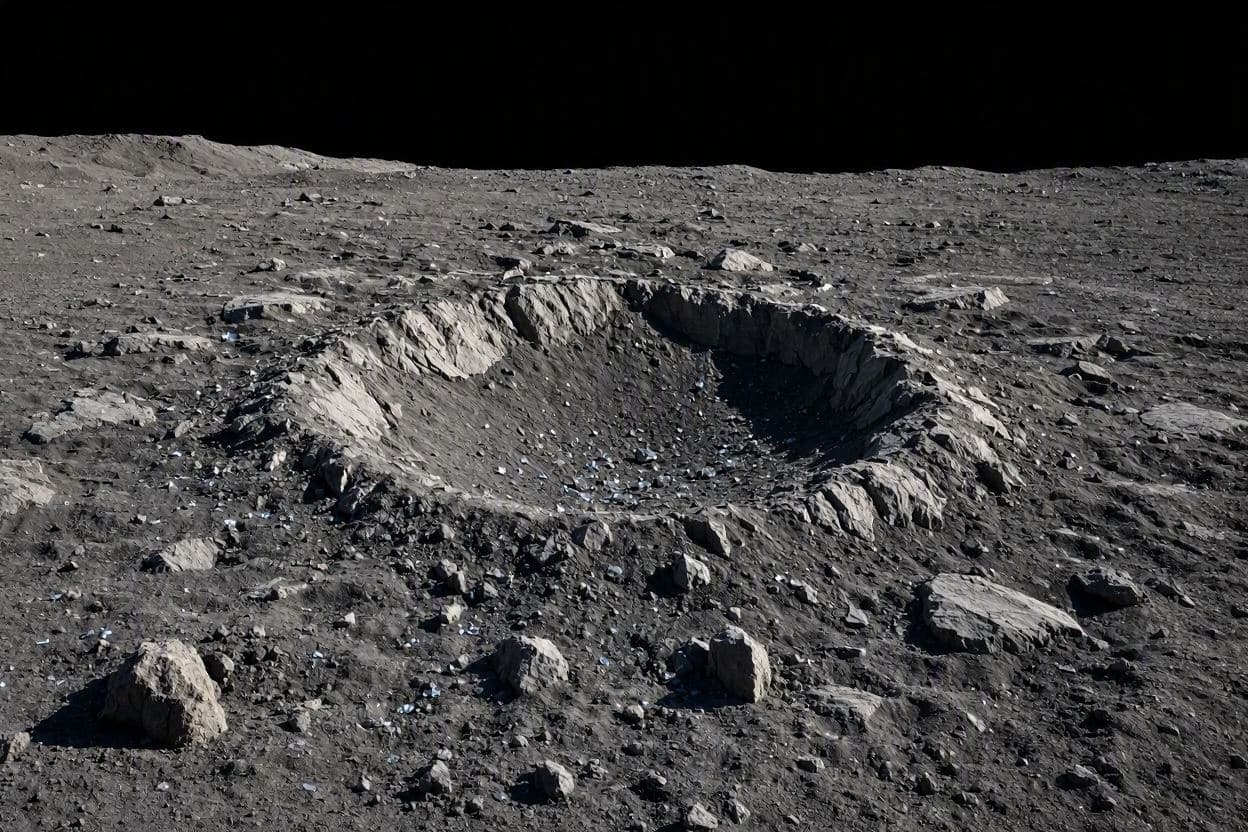
The moon has long been a silent witness to human activity, bearing the scars of Apollo landings and robotic explorers. Recently, it acquired a new mark: a crater formed by the impact of a discarded SpaceX Falcon 9 rocket stage. New images captured by lunar orbiters have revealed the site of the collision, offering scientists a rare opportunity to study the effects of such impacts on the lunar surface. The event, which occurred in early August 2026, has sparked both scientific interest and public curiosity.
The rocket stage, weighing several tons, struck the moon at high speed, creating a plume of debris and a fresh crater. Unlike controlled landings, this was an unguided impact, the result of orbital decay after a previous mission. While space agencies typically aim to deorbit such debris safely, the vast distances involved make tracking and mitigation challenging. The impact serves as a reminder of the growing issue of space junk and its potential consequences.
The Korea Pathfinder Lunar Orbiter, known as Danuri, along with NASA’s Lunar Reconnaissance Orbiter, captured before-and-after images of the site. These visuals show a distinct dark patch surrounded by ejected material, contrasting with the lighter lunar regolith. By analyzing the size and shape of the crater, researchers can estimate the energy of the impact and better understand the mechanical properties of the moon’s surface.
For planetary scientists, such events are natural experiments. They provide data on how different materials behave under hypervelocity impact conditions, information that is crucial for planning future lunar missions. Understanding crater formation helps in interpreting the geological history of the moon and other celestial bodies. Each new impact adds a data point to the ongoing study of planetary evolution.
Public reaction to the news has been mixed. Some view it as evidence of irresponsible space practices, while others see it as an inevitable part of exploration. SpaceX has acknowledged the incident, stating that it adheres to international guidelines for debris mitigation. However, the lack of active control over the upper stage highlights the limitations of current regulations. The conversation is shifting toward the need for stricter standards and active debris removal technologies.
The location of the impact, far from any planned landing sites, minimizes risk to future missions. Nevertheless, it underscores the importance of tracking objects in cislunar space. As more nations and companies launch missions to the moon, the traffic density will increase. Coordinating trajectories and managing end-of-life disposal will become critical tasks for the global space community.
Educational opportunities abound from this event. Students and enthusiasts can follow the analysis of the crater, learning about orbital mechanics and impact physics. It brings abstract concepts to life, showing the tangible results of spaceflight. The moon, once distant and untouchable, is now a dynamic environment shaped by human activity.
As the images circulate, they invite reflection on our place in the cosmos. We are leaving our mark, literally and figuratively, on other worlds. The challenge is to do so responsibly, ensuring that exploration does not come at the cost of sustainability. The crater on the moon is a small scar, but it carries a large lesson for the future of space travel.
AI Image Disclaimer: Visuals in this article are AI-generated illustrations of lunar surfaces and orbital debris, designed to visualize the concept of impact events without depicting real proprietary satellite imagery.
Sources: Space.com, USA Today, The Guardian, CNN
Published by Banx Network. This article is part of the Banx decentralized media programme, powered by the BXE token on the XRP Ledger.