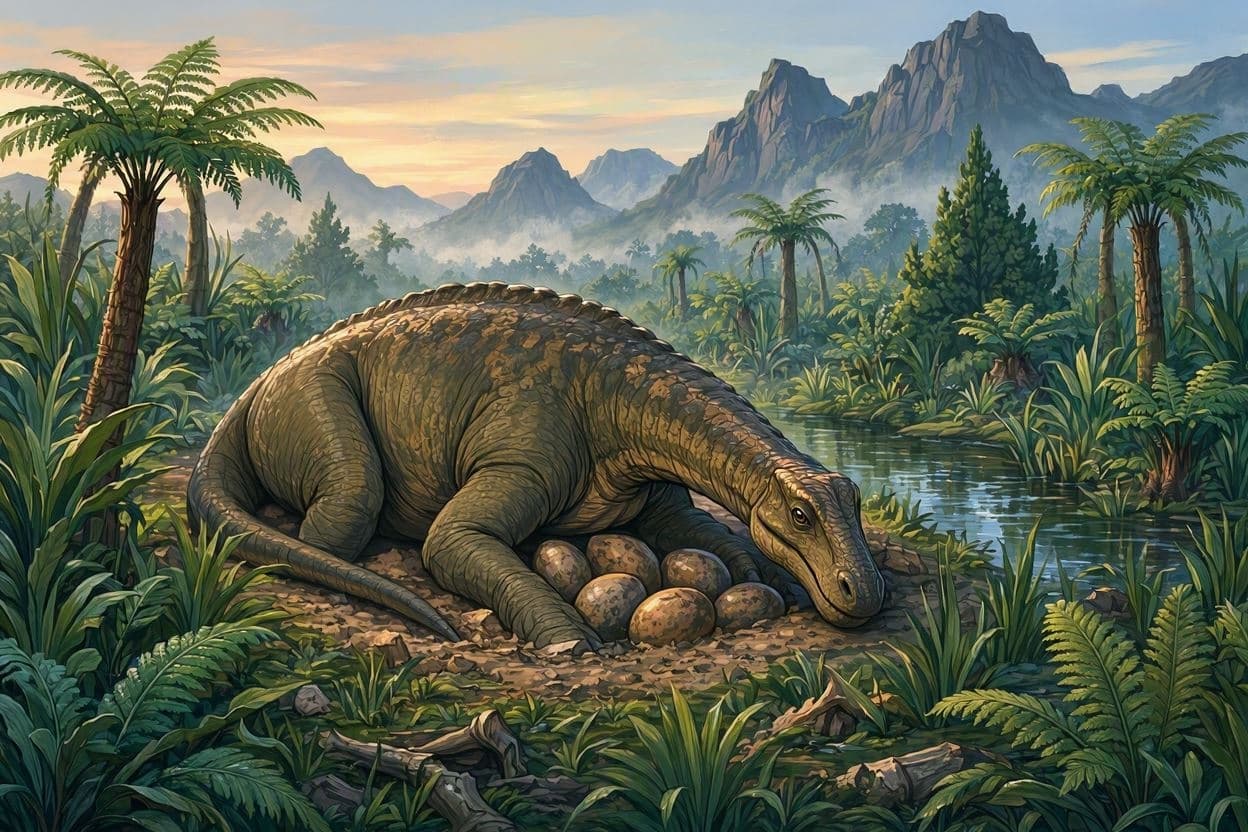
The map of prehistoric life is constantly being redrawn, each fossil discovery adding a new piece to the puzzle of our planet’s deep past. For years, scientists believed that certain dinosaur species confined their nesting grounds to specific latitudes, avoiding the cooler climates of the south. However, a recent discovery has shattered this assumption, revealing that dinosaurs nested much further south than previously thought. A Canadian researcher played a key role in this finding, highlighting the collaborative nature of paleontology. This revelation invites us to reflect on the adaptability of ancient life and the surprises still hidden in the earth’s layers.
The discovery was made in Patagonia, a region renowned for its rich fossil beds. Researchers uncovered nesting sites belonging to titanosaur sauropods, massive long-necked dinosaurs that roamed the Earth millions of years ago. These nests were located at a latitude significantly further south than any previously recorded for the species. The find suggests that these giants were more resilient to varying climatic conditions than earlier models had predicted.
The involvement of a Canadian scientist underscores the global nature of paleontological research. Institutions across borders often collaborate, sharing expertise and resources to unlock the secrets of the past. This international cooperation allows for a more comprehensive understanding of dinosaur behavior and migration patterns. It demonstrates that science knows no boundaries, uniting researchers in a common quest for knowledge.
The implications of this discovery are profound for our understanding of dinosaur ecology. If titanosaurs could nest in southern latitudes, it implies that the climate in those regions was warmer or that the dinosaurs had physiological adaptations allowing them to thrive in cooler environments. This challenges existing theories about thermoregulation and habitat preference in large sauropods.
Fossil evidence, including eggshells and embryonic remains, provides clues about the reproductive strategies of these animals. The arrangement of the nests suggests communal breeding behavior, where multiple females laid eggs in a shared area. This social aspect adds depth to our picture of dinosaur life, portraying them not just as solitary beasts but as complex social creatures.
For the local community in Patagonia, the discovery is a source of pride and economic opportunity. Paleotourism is growing, drawing visitors interested in seeing where these ancient giants once lived. Responsible excavation and preservation are essential to balance scientific inquiry with sustainable development. It is a delicate dance between protecting the past and benefiting the present.
The study also highlights the importance of continued exploration in under-sampled regions. Many areas of the world remain poorly understood in terms of their paleontological potential. Each expedition holds the promise of new discoveries that could rewrite textbooks. It reminds us that there is still much to learn about the history of life on Earth.
As researchers analyze the data, they refine models of ancient ecosystems. Understanding where dinosaurs lived and how they reproduced helps us reconstruct the environments of the Mesozoic era. This knowledge contributes to broader discussions about climate change and biodiversity, offering lessons from the deep past.
The discovery of southern nesting sites by a team including a Canadian researcher expands our understanding of dinosaur habitats. It highlights the adaptability of ancient species. Let us continue to explore the fossil record.
AI Image Disclaimer: The visuals accompanying this piece are AI-generated interpretations intended for illustrative purposes only.
Sources: CBC News Nature Ecology & Evolution Royal Ontario Museum
Published by Banx Network. This article is part of the Banx decentralized media programme, powered by the BXE token on the XRP Ledger.