Space is often imagined as a realm of permanence, where celestial bodies travel ancient paths unchanged for millions or even billions of years. Yet the cosmos is also a place of transformation. Astronomers have now identified a mysterious asteroid near the Sun that appears to be gradually disintegrating, offering scientists a rare opportunity to observe destruction unfolding in real time.
The object was detected through observations conducted by an international team of researchers studying small bodies within the inner Solar System. Unlike most asteroids, which remain relatively stable over long periods, this particular object appears to be shedding material as it travels close to the Sun.
Researchers believe the asteroid's unusual behavior is likely driven by extreme solar heating. As the object repeatedly approaches the Sun, intense temperatures may weaken its structure, causing rock and dust to break away from its surface.
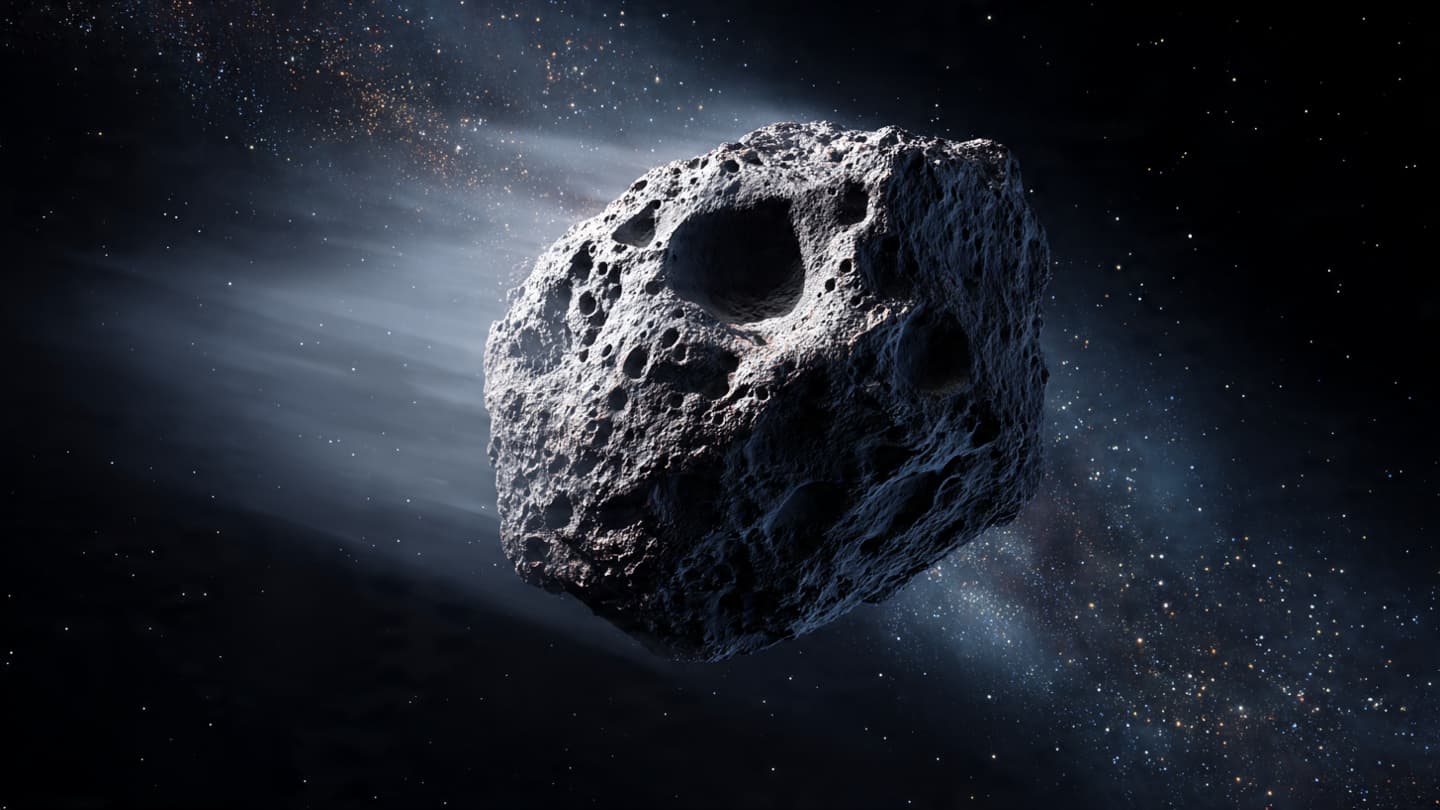
Observations indicate that the asteroid leaves behind a faint trail of debris, a characteristic more commonly associated with comets. This unusual combination of asteroid-like and comet-like properties has drawn significant scientific interest.
Astronomers note that understanding how small celestial bodies evolve under extreme conditions can improve broader models of Solar System formation. Such studies may also help explain how asteroids and comets have changed over billions of years.
The discovery highlights the increasingly sophisticated capabilities of modern astronomical instruments. Advances in telescopes and observation techniques now allow scientists to monitor subtle changes in distant objects with unprecedented precision.
Researchers caution that the asteroid poses no known threat to Earth. Instead, it serves primarily as a valuable natural laboratory for studying processes that are difficult to reproduce experimentally.
The findings may also contribute to future planetary defense research. By understanding how heat and stress affect asteroid structures, scientists can refine predictions about the behavior of near-Earth objects.
As astronomers continue their observations, the slowly disintegrating asteroid offers another reminder that the Solar System remains an active and evolving environment, filled with processes still waiting to be understood.
AI Image Disclaimer: Illustrative images accompanying this article were generated using artificial intelligence for editorial visualization.
Sources: ScienceDaily, NASA, European Space Agency, peer-reviewed astronomical research
Published by Banx Network. This article is part of the Banx decentralized media programme, powered by the BXE token on the XRP Ledger.