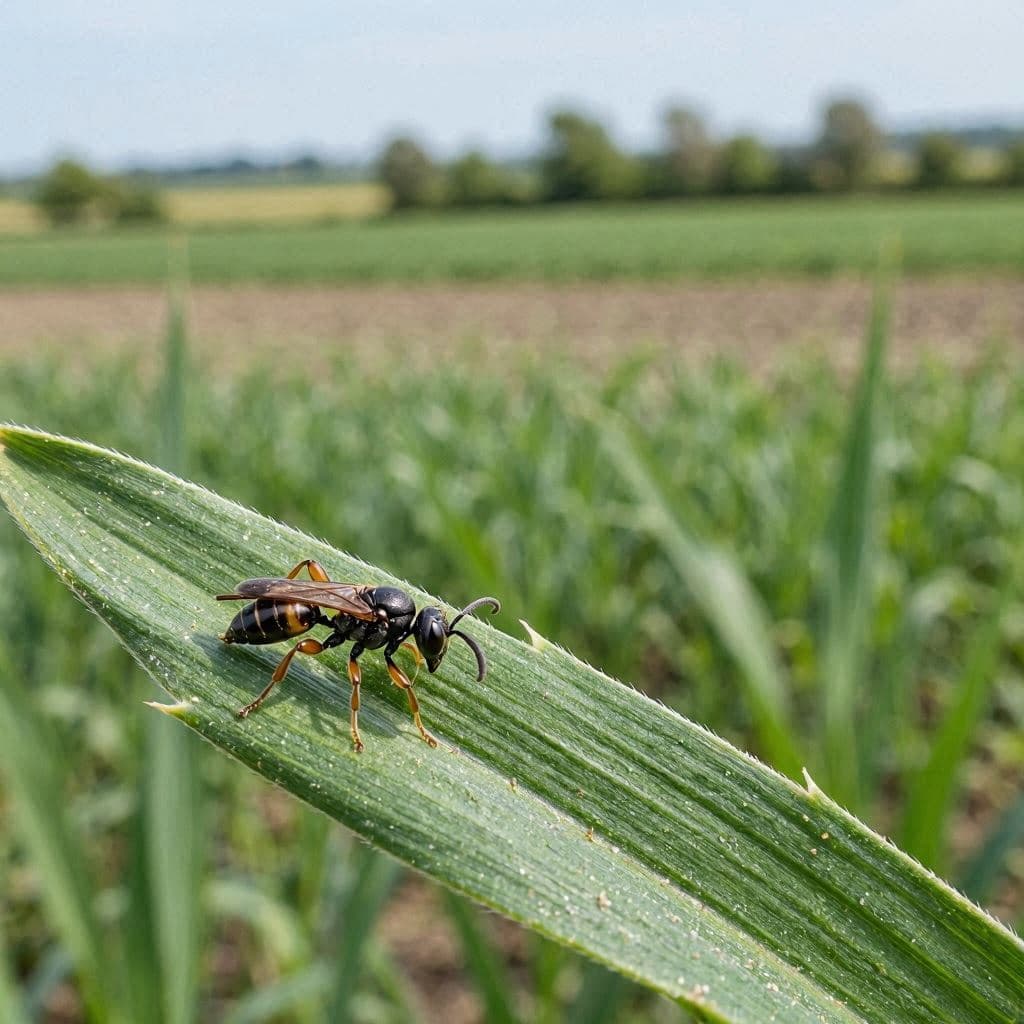
The smallest travelers often leave the deepest footprints. In fields where crops sway beneath changing skies, farmers have long faced an unrelenting challenge from insects capable of turning months of careful work into days of disappointment. Yet among the countless tiny creatures sharing those same landscapes, scientists have found an unexpected ally whose presence reminds us that nature often solves its own puzzles in remarkably quiet ways.
Researchers and agricultural experts continue to study beneficial insects that naturally suppress destructive crop pests. Rather than relying solely on chemical pesticides, farmers in many regions are introducing or protecting insects such as parasitoid wasps and other natural predators that attack species responsible for damaging staple crops. This biological control approach has gained increasing attention as agriculture seeks methods that are both productive and environmentally responsible.
Many parasitoid wasps are exceptionally small, often measuring only a few millimeters in length. Despite their size, they play a significant ecological role by laying their eggs inside or on harmful insects. As the developing larvae consume their hosts, pest populations decline naturally, reducing the need for repeated pesticide applications. Scientists describe this process as one of the most effective examples of biological pest management.
The approach offers benefits beyond protecting harvests. Reduced pesticide use can help preserve beneficial insects such as bees and butterflies, lessen chemical runoff into waterways, and slow the development of pesticide resistance among agricultural pests. Researchers emphasize that biological control works most effectively as part of integrated pest management, where monitoring, crop planning, and targeted interventions are combined.
Field trials conducted in different parts of the world have shown encouraging results against pests affecting vegetables, grains, fruits, and other commercial crops. Farmers participating in these programs often report healthier plants and more stable harvests while reducing reliance on chemical treatments. Scientists continue refining techniques to ensure beneficial insects establish themselves without disrupting local ecosystems.
Experts also caution that successful biological control depends on careful scientific assessment. Introducing a species into a new environment requires extensive research to prevent unintended ecological consequences. Modern programs therefore prioritize native or thoroughly evaluated beneficial insects and closely monitor their impact after release.
As climate change, expanding pest ranges, and growing food demand place additional pressure on agriculture, researchers believe nature-based solutions will become increasingly valuable. Tiny insects alone cannot solve every farming challenge, but they represent an important tool in creating more resilient and sustainable food systems for the future.
The renewed focus on beneficial insects reflects a broader understanding that effective farming often depends as much on ecological balance as technological innovation. While these creatures may be nearly invisible to the human eye, their contribution to protecting crops demonstrates that some of nature's most meaningful partnerships come in its smallest forms.
AI Image Disclaimer: The accompanying illustrations are AI-generated artistic representations intended to visualize the scientific topic and may not depict the exact species or research setting.
Sources (Verified):
BBC News Nature Science Reuters Food and Agriculture Organization (FAO) CGIAR CABI (Centre for Agriculture and Bioscience International
Published by Banx Network. This article is part of the Banx decentralized media programme, powered by the BXE token on the XRP Ledger.