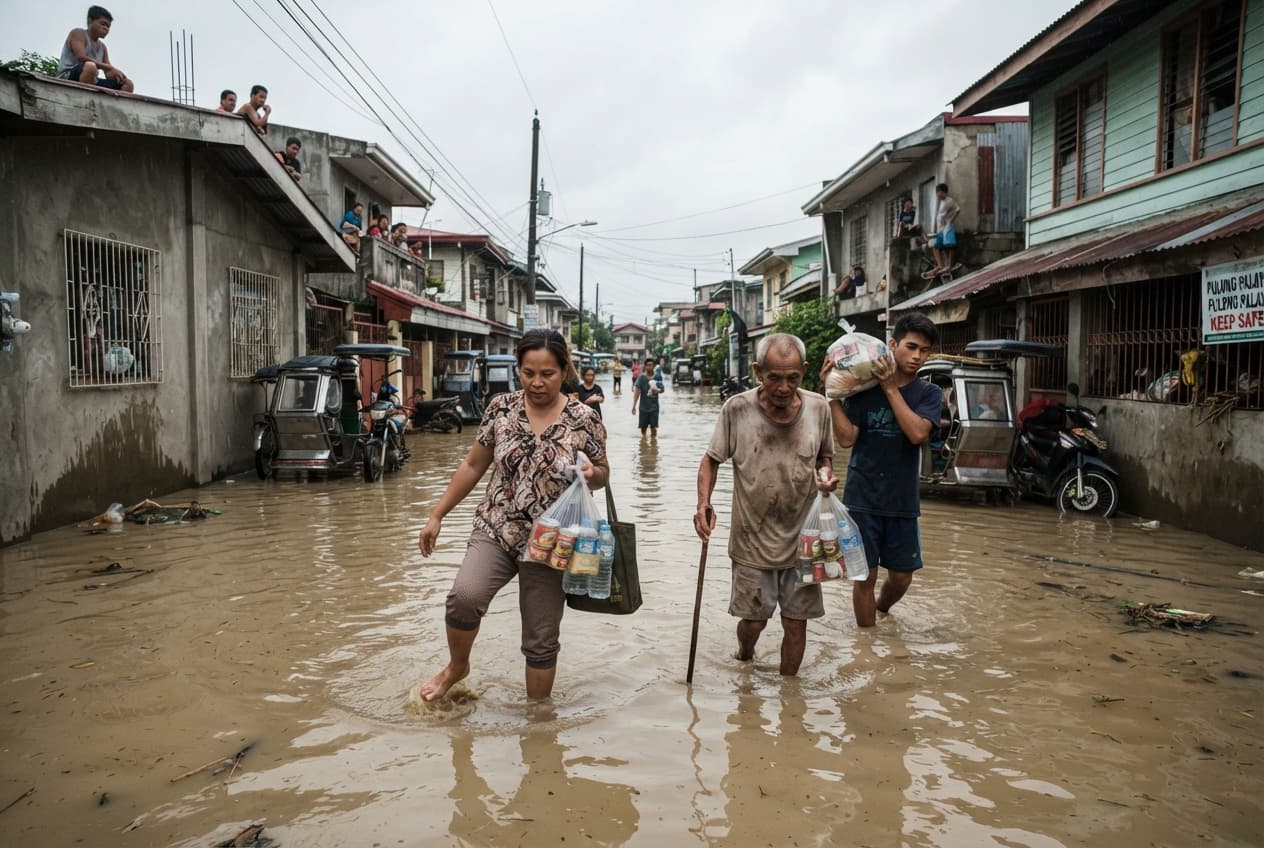
Manila, Philippines—National disaster response agencies confirmed Tuesday that the cumulative death toll from weeks of relentless southwest monsoon rains and successive tropical cyclones had climbed significantly, affecting millions of residents across multiple regional sectors. The protracted weather emergency, which intensified sharply since early August, has left vast tracts of low-lying agricultural land and dense urban barangays submerged under murky floodwaters.
Office of Civil Defense directors released updated operational figures indicating that infrastructural damage and agricultural losses have crossed historic thresholds, disrupting supply chains throughout Luzon and the central island groups. Emergency engineering battalions struggled to clear massive landslide debris blocking vital mountain passes in northern provinces where saturated hillsides collapsed under continuous precipitation.
Evacuation centers remained jammed with displaced families sheltering in school gymnasiums and municipal buildings while local social welfare teams distributed emergency food packs and potable water supplies. "We are stretched to maximum operational capacity keeping pace with continuous waves of displaced populations requiring immediate medical attention," stated civil defense spokesperson Maria Santos during a morning situation update.
Health workers deployed mobile clinics to counter rising cases of leptospirosis, acute respiratory infections, and waterborne illnesses proliferating in crowded evacuation camps lacking adequate sanitation infrastructure. Local municipal governments appealed for additional rubber boats and high-clearance rescue trucks as rising river basins threatened secondary dikes protecting densely populated residential suburbs.
Agricultural sector analysts warned of severe economic ripple effects as thousands of hectares of ripening rice and vegetable crops were completely washed out just weeks before the harvest cycle. Farmers surveyed ruined fields covered in thick river silt, facing mounting debts and little immediate clarity on government recovery subsidies promised by regional agriculture boards.
National utility providers worked around the clock to repair downed transmission towers and flooded sub-stations that left provincial towns without electrical power for days on end. Repair crews navigated hazardous waters using utility skiffs to access transformers isolated by deep inundation, facing constant risks from submerged live electrical lines.
Presidential disaster mitigation task forces convened emergency sessions in the capital to fast-track reconstruction funds for collapsed bridges and washed-out road segments that continue to isolate rural farming communities. Engineers emphasized that long-term infrastructural resilience plans must be fundamentally re-evaluated to withstand the increasing frequency of severe weather events driven by shifting regional climate patterns.
As intermittent squalls continued to sweep across the northern coastline, weary residents returned briefly to waterlogged homes to salvage what personal belongings remained above the mud line. The ongoing crisis shows few immediate signs of abating as meteorological bureaus monitor nascent tropical disturbances forming along the eastern perimeter of the Philippine Area of Responsibility.
Published by Banx Network. This article is part of the Banx decentralized media programme, powered by the BXE token on the XRP Ledger.