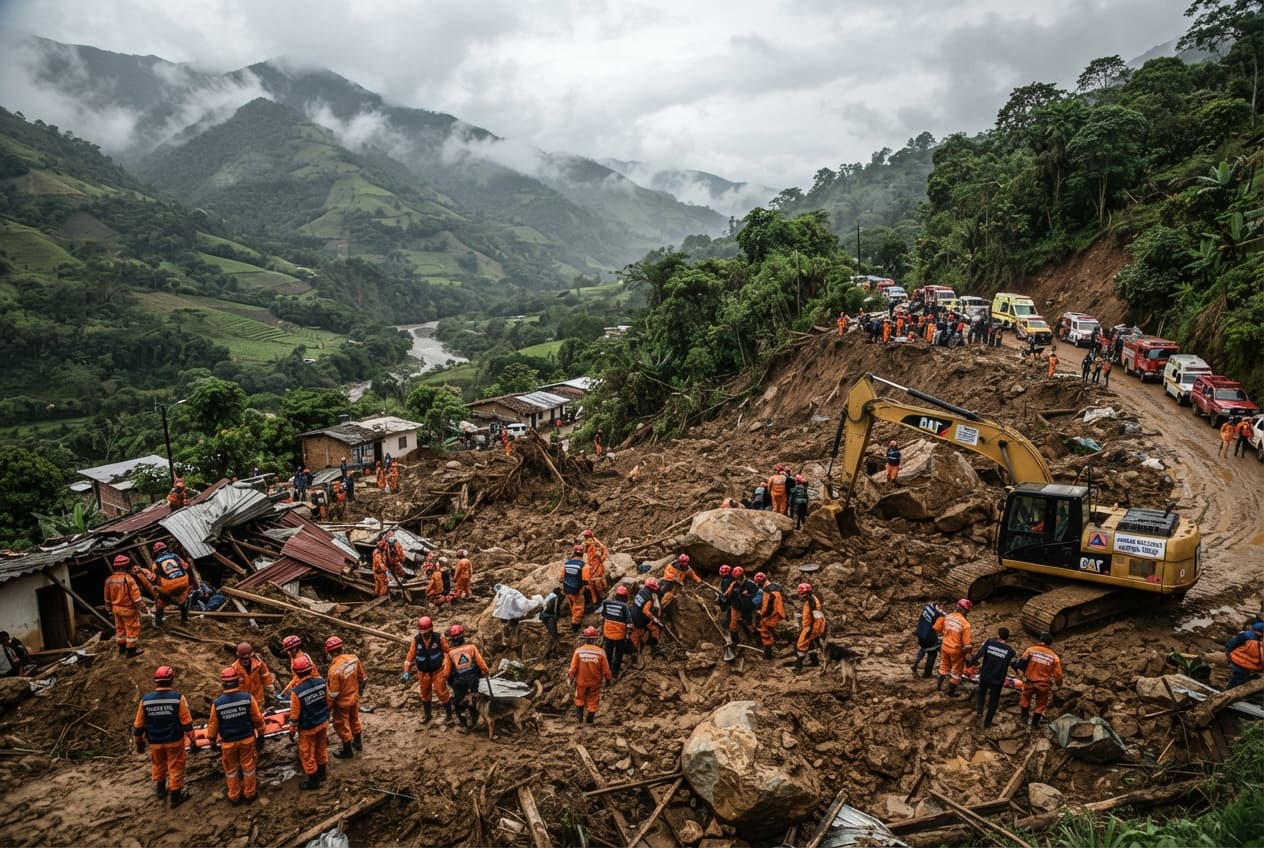
Medellín, Colombia—The side of the mountain let go without a single warning sound. Tons of saturated topsoil and rock crashed downward onto the rural hamlet just before midnight. Small adobe houses vanished beneath a thick blanket of gray mud and snapped eucalyptus trees. Villagers living further up the ridge woke to a deep, resonant rumble echoing across the canyon. Power lines snapped instantly, plunging the entire valley into total darkness. Heavy mist settled over the debris field, making initial visual assessments nearly impossible for local authorities.
Civil defense units deployed search teams equipped with manual shovels and tracking dogs into the ravine. Three bodies were recovered from the ruined structures before the first light of dawn broke. Heavy engineering machinery could not reach the remote site because access roads remained choked with debris. Rescue workers hacked through tangled masses of vegetation and timber to reach unstable pockets. Relatives of the missing gathered at the police checkpoint down the valley, demanding answers from municipal officials.
Local disaster response coordinators established a temporary command post at a nearby rural schoolhouse. Surviving residents huddled under wool blankets, recounting the terrifying speed of the nighttime slide. Municipal engineers warned that the saturated ridge remained highly unstable due to persistent seasonal precipitation. Geological monitoring teams deployed portable sensors to detect any secondary earth movements above the settlement. State authorities promised emergency housing stipends for families displaced by the unexpected catastrophe.
The agricultural terraces surrounding the hamlet were entirely obliterated by the shifting mud banks. Local crop yields and livestock were lost completely under meters of heavy rock and sterile silt. Transport infrastructure across the regional corridor suffered secondary closures as minor slips blocked adjacent paths. National government agencies faced mounting pressure to fund long-term slope stabilization projects across the department. Rural communities throughout the Andean range continue living under the constant threat of geological instability.
Search operations paused temporarily as evening fog rolled back over the steep mountain slopes. Recovery teams will resume excavation work at first light with the aid of fresh engineering units. The scar left on the green mountainside remains a stark reminder of rural vulnerability. Local authorities urge residents in adjacent high-risk zones to evacuate toward designated municipal shelters immediately. The investigation into regional zoning permits and deforestation factors will begin once recovery concludes.
Published by Banx Network. This article is part of the Banx decentralized media programme, powered by the BXE token on the XRP Ledger.