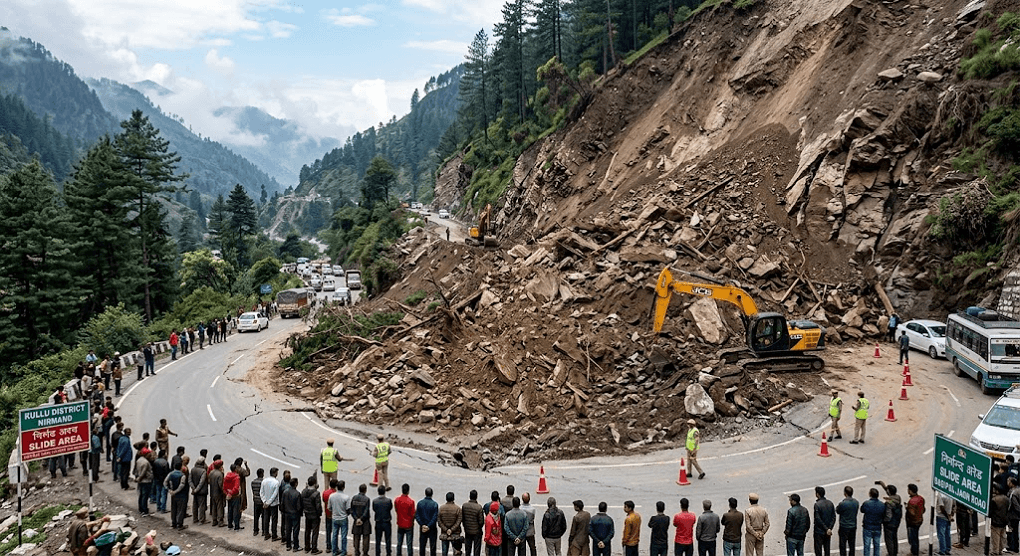
KULLU, India — A major mountain collapse triggered a massive landslide in the Nirmand subdivision of Himachal Pradesh's Kullu district early on Wednesday, September 2, 2026 completely burying and severing a nearly 200-meter stretch of a vital regional highway.
The disaster occurred along the Bagipul-Jaon road following hours of persistent downpours in the high-altitude terrain. Thousands of tons of rock, mud, and uprooted trees tore down the hillside, crushing the roadway beneath a mountain of debris. The sudden obstruction instantly severed transit links to dozens of remote villages, leaving hundreds of local residents and commuters stranded on either side of the collapse.
Emergency disaster management teams, accompanied by local police and public works personnel, rushed to the site to establish a safety perimeter and assess the stability of the remaining slope. Massive earth-moving machinery and heavy excavators have been deployed to initiate cleared debris operations, though ongoing rock falls and unstable soil conditions continue to hamper clearing efforts along the fractured mountain pass.
Local authorities have issued urgent travel advisories urging motorists to avoid the affected corridor while structural engineers evaluate the damaged mountainside. While no immediate casualties or crushed vehicles have been reported along the impacted section, district officials have set up temporary detour routes and deployed emergency relief teams to assist stranded travelers as efforts continue to clear the blocked arterial route.
The timing of the highway collapse presents a severe challenge for the region’s agrarian economy, particularly apple growers and local farmers who rely on the Bagipul-Jaon route to transport harvested produce to major market hubs. With the primary transit artery completely severed, trucks loaded with perishable goods remain immobilized along the mountain pass, raising immediate concerns over potential crop spoilage and heavy financial losses. Agricultural cooperatives have appealed to district officials for priority clearing operations or alternative high-altitude freight arrangements to ensure regional supply chains remain operational during peak harvesting season.
Geological experts inspecting the landslide site warned that monsoon-saturated soil layers and loose rock formations present an ongoing hazard along the steep slopes of the Nirmand subdivision. The collapse has reignited calls from environmental engineers and policy advocates for enhanced slope-stabilization measures, such as soil-nailing and high-tensile wire mesh, across vulnerable corridors in the Kullu valley. As weather forecasters predict continued rainfall across Himachal Pradesh over the coming days, local authorities maintain high alert status, warning that full restoration of the 200-meter damaged highway stretch may take several days of intensive clearing and structural reinforcement work.
Published by Banx Network. This article is part of the Banx decentralized media programme, powered by the BXE token on the XRP Ledger.