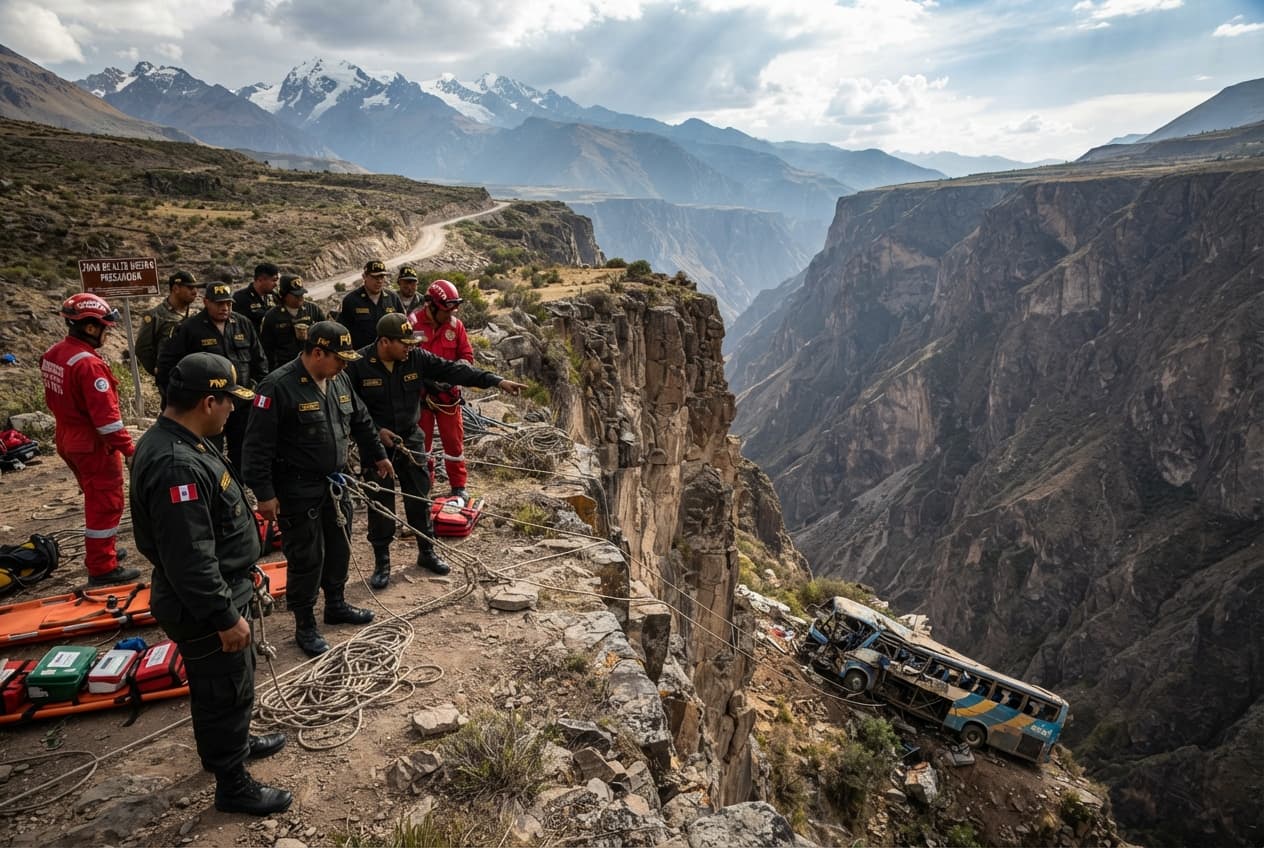
Huancayo, Peru—Six people died Friday morning when an intercity passenger bus plunged over the edge of a narrow cliff road, falling one hundred meters into a rocky canyon in the central highlands. The vehicle was navigating an unpaved mountain pass during heavy morning fog when the driver lost control on a sharp, unprotected curve. Local villagers heard the metallic crash echo through the valley and immediately notified regional emergency services via satellite radio at 6:45 a.m.
National police and volunteer firefighters arrived at the precipice after a grueling drive across treacherous switchbacks. Rescuers had to rappel down the steep, rocky slope to reach the crushed hull of the bus, which came to rest near a turbulent river bed. The impact completely obliterated the front chassis and passenger cabins, scattering seats and luggage across the boulder-strewn canyon floor.
Paramedics confirmed six fatalities at the bottom of the ravine, while twelve surviving passengers sustained critical polytrauma. Rescue workers utilized rope systems and stretchers to haul the injured survivors up the cliff face to waiting ambulances. Hospital administrators in the nearest provincial city reported that several of the hospitalized patients remain in intensive care.
Transport ministry inspectors stated that the bus operated on an authorized regional route connecting remote highland towns to the capital of the department. Investigators noted that the road lacked essential guardrails and adequate lighting, factors frequently cited in regional transit disasters. The transport company's local office has not yet issued a formal statement regarding the mechanical fitness of the fallen vehicle.
Police detained a secondary relief driver who was off-duty at the time of the crash for initial questioning at the provincial precinct. Forensic teams began recovering the remains of the deceased passengers, transferring them to the municipal morgue for formal identification. Relatives of the travelers gathered outside the coroner's office demanding immediate updates on search and recovery operations.
Heavy excavation equipment could not reach the canyon floor due to the severe terrain constraints, forcing rescue personnel to rely on manual extraction. Municipal authorities have repeatedly petitioned the central government for funds to widen and pave the dangerous mountain route. Friday's tragedy highlights the persistent infrastructure deficits plaguing rural transport corridors across the country.
Traffic along the upper mountain pass remains restricted to emergency vehicles as crews clear scattered rock debris. Investigators continue mapping tire marks at the cliff edge to determine exact speed parameters prior to the fall. Normal circulation on the route will not resume until structural engineers complete a full safety assessment of the cliffside edge.
Published by Banx Network. This article is part of the Banx decentralized media programme, powered by the BXE token on the XRP Ledger.