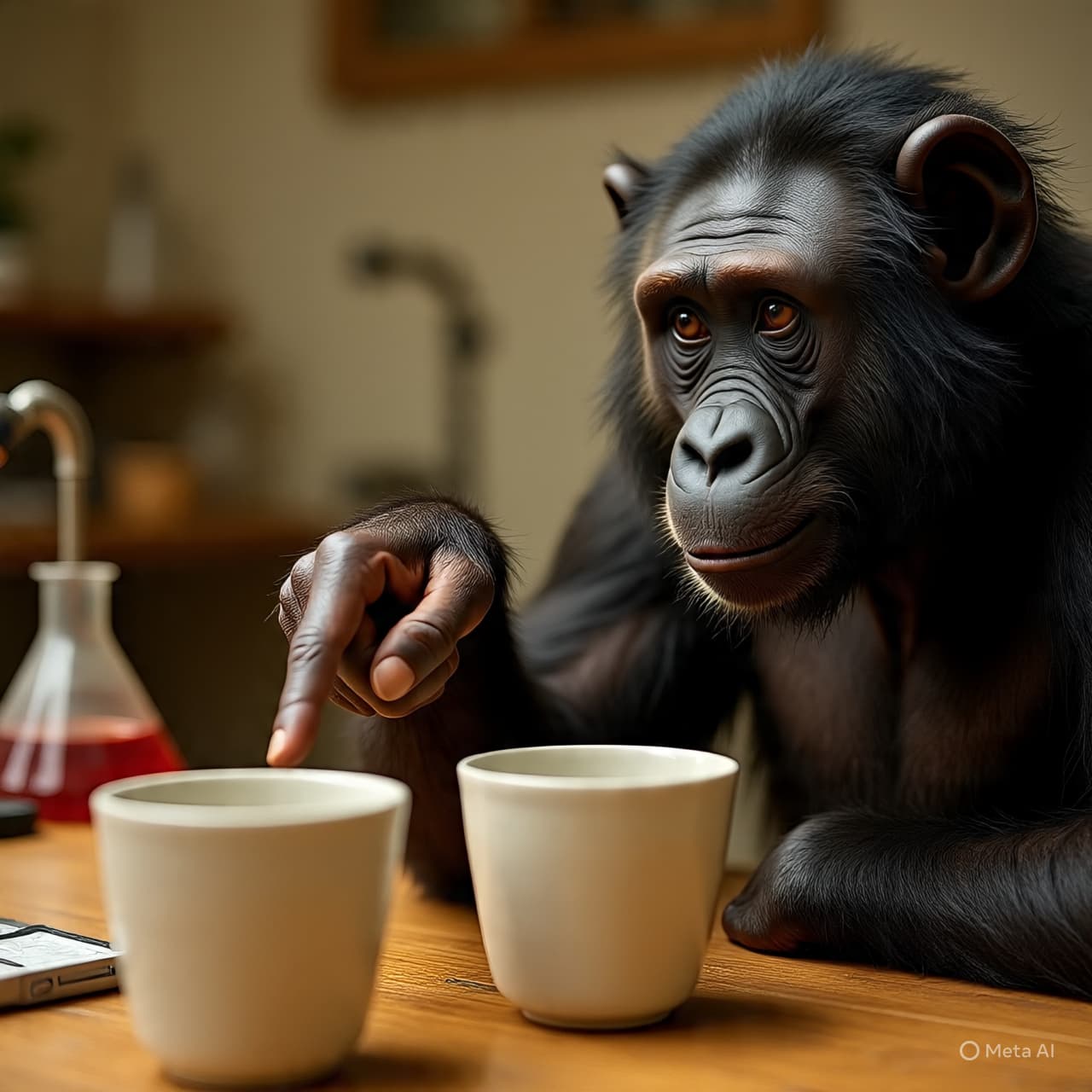
In the gentle hush of a room set with empty cups and pitchers, something remarkable took place—not just the quiet gaze of a bonobo, but a subtle invitation to wonder about what lies inside another mind. It was as if, in the absence of real juice, the very possibility of make‑believe stirred a question about the border between human thought and that of our closest living cousins.
Scientists, guided by this soft curiosity, designed a series of experiments reminiscent of a child’s tea party to explore whether apes can engage with the unreal in ways more profound than instinctive behaviour. Using a series of mimicked pours and imagined place settings, researchers with Johns Hopkins University and collaborators presented a bonobo named Kanzi with simple choices: which cup still held the pretend juice, or where an imagined grape had been placed. In these moments, visible only to the eyes of those at the table, something akin to imagination seemed to unfold.
Kanzi’s responses were more than random gestures. He pointed to the cup still “full” of invisible juice far more often than chance would allow, and when offered both real and pretend liquid, he reliably chose the actual refreshment almost every time. In a third variation, he tracked unseen grapes from bowl to jar, again indicating the correct place. These behaviours hint that some non‑human minds may be capable of working with imagined objects—something once thought to be solely human terrain.
Yet for all the wonder, scientists speak of these findings with tempered reflection. Kanzi was no ordinary ape; he had lived much of his life immersed in human‑like learning environments and understood symbolic cues better than most of his species. Whether similar capacities would emerge untrained in other apes remains an open question, one that invites careful, curious investigation rather than quick conclusion.
In tracing the unseen paths of the mind, this research does not rewrite the story of human imagination, but it does invite us to read its margins more generously. When an ape can engage with pretend situations under experimental design, we are reminded that imagination may not belong only to our species, but could be part of a shared legacy written deep into the evolutionary past.
AI Image Disclaimer (Rotated Wording) Illustrations were created with AI tools and are intended for conceptual depiction, not actual photographs.
Sources: Associated Press; The Guardian; The Wall Street Journal; Euronews; Science News
Published by Banx Network. This article is part of the Banx decentralized media programme, powered by the BXE token on the XRP Ledger.