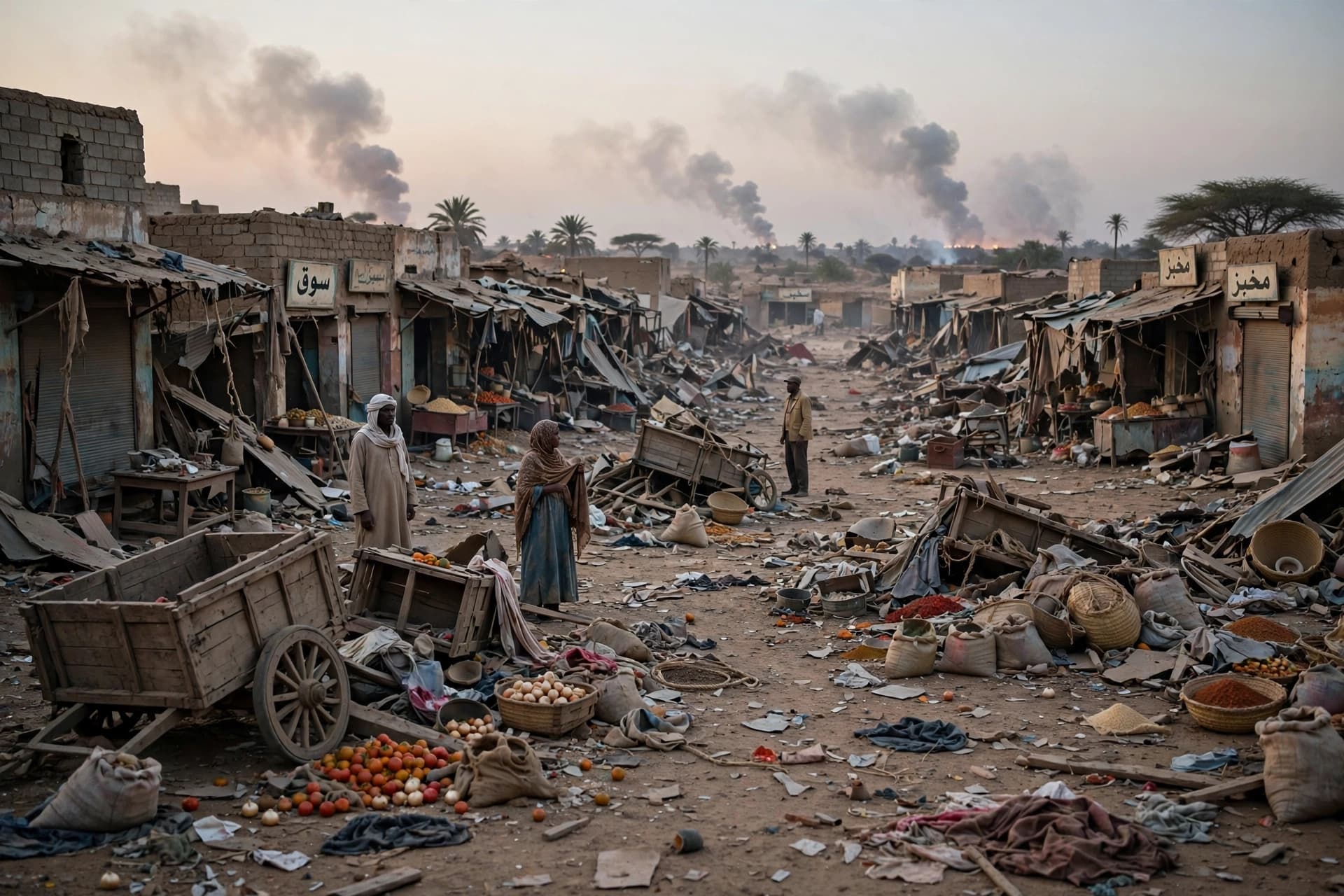
There is a particular dread that arrives from the sky now, a sound that has become as familiar in Sudan as the call to prayer or the rumble of distant artillery. Drones—small, remote, and relentless—have reshaped this war in ways that the generals who deploy them may not fully grasp and the civilians who endure them understand all too well. In recent days, a wave of drone strikes across Sudan has killed more than 160 people, according to medical personnel and human rights groups, with the deadliest single attack landing in a market town where villagers had gathered to find rides home.
The worst of the violence occurred Sunday evening in Al-Dibab, a town in West Kordofan controlled by the paramilitary Rapid Support Forces. A drone struck a transport hub where people had congregated after a day at the market, waiting for vehicles to carry them back to their villages. At least eighty people were killed, and nineteen more were wounded . Residents described a double tap—a second strike ten minutes after the first, hitting those who had come to help the wounded .
In the capital, Khartoum, a drone attack killed three children, aged two, four, and six, near the airport . The city had been relatively quiet in recent weeks, held by the government army with the front line far away, but the RSF possesses drones capable of traveling long distances . The strike was a reminder that no place in this war is truly beyond reach.
The escalation is not new but it is accelerating. The United Nations human rights chief reported in May that armed drones had become "by far and away the leading cause of civilian deaths" in Sudan, accounting for more than eighty percent of civilian casualties in the first four months of 2026—at least 880 people killed . A recent UN report estimated roughly a thousand deaths from drone strikes in the first five months of the year . The war, which began in April 2023 after the leaders of the army and the RSF fell out over power-sharing, has now entered its fourth year and shows no sign of resolution.
The sources of the drones trace the contours of a wider geopolitical contest. The Sudanese army receives drones from Iran and Turkey, and according to Sudanese media, recently from Pakistan. The RSF uses Chinese-made drones smuggled through the United Arab Emirates . The weapons arrive from abroad, but the consequences settle into the lives of people who have no say in the diplomacy that sustains the war.
For civilians, the drones have transformed daily existence into a calculation of risk. People near the front lines have dug bunkers beside their homes. They avoid markets, hesitate to tend their fields, and flee at the sound of an engine overhead. "Your whole life is disrupted," one report noted, with a plainness that captures what statistics cannot . In El Fasher, in Darfur, the situation is even more desperate; the city has been besieged, and hospitals and mosques have been struck . The war has killed an estimated 400,000 people since it began, according to partial counts, and displaced millions more .
There is a diplomatic dimension that resists easy summary. The United Nations condemns the attacks. Human rights groups document them. The warring parties deny responsibility or attribute strikes to the other side. And the drones continue to fly. On Monday, as rescue workers in Al-Dibab counted the dead and families in Khartoum buried three children, the war's logic remained unchanged: territory contested, power pursued, civilians caught in the space between.
For the people of Sudan, the question is not whether the drones will come again, but where and when. The answer, for now, is everywhere and soon.
AI Image Disclaimer: The images in this article are generated by artificial intelligence and are intended for illustrative purposes only.
Sources: NOS, RaiNews, Daily News (Sri Lanka), UN News, Panapress, Al Jazeera
Published by Banx Network. This article is part of the Banx decentralized media programme, powered by the BXE token on the XRP Ledger.