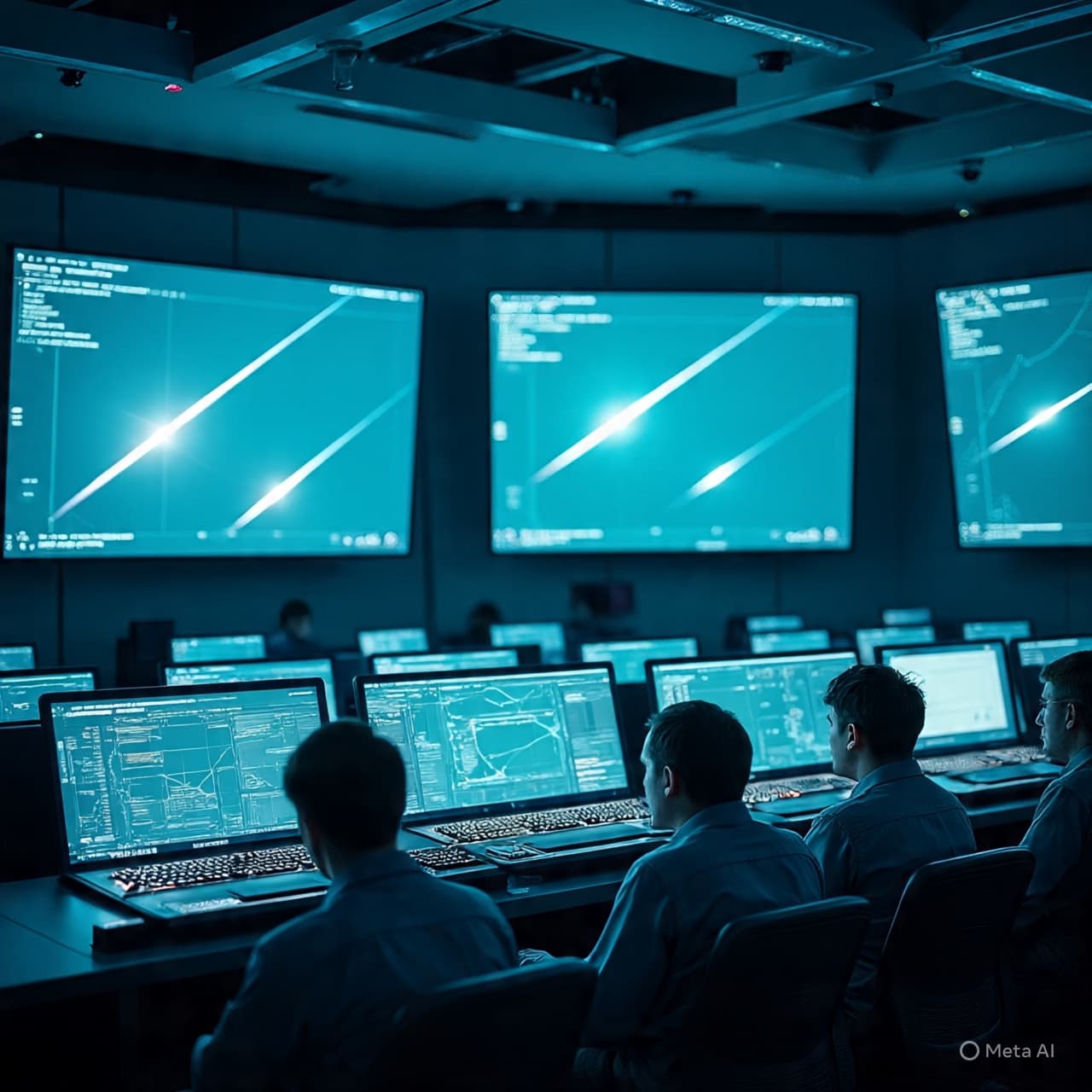
The desert sky, when seen from high altitude, appears calm—an endless wash of amber and pale blue where borders dissolve into horizon. Yet beneath that stillness lies a geometry of range rings and radar arcs, invisible lines traced in anticipation. In command rooms far from the sand, screens glow with trajectories: arcs of defense and deterrence measured not in miles alone, but in minutes.
In recent weeks, the possibility of a sustained military confrontation between the United States and Iran has drawn quiet attention to something less visible than ships or aircraft carriers—the depth of missile stockpiles and the tempo at which they might be consumed. Modern warfare, especially across the distances that define the Persian Gulf and beyond, moves on guided munitions: interceptors that rise to meet incoming threats, cruise missiles that skim coastlines, precision weapons that travel by satellite whisper.
Defense analysts have noted that in any prolonged exchange, the United States would rely heavily on systems such as Patriot interceptors, Standard Missile variants launched from naval vessels, and long-range strike munitions carried by aircraft and submarines. These are not infinite instruments. They are manufactured over months and years, assembled through intricate supply chains that stretch across states and oceans. Their use is deliberate, calibrated—but also finite.
Iran, for its part, has invested for decades in a layered arsenal of ballistic and cruise missiles, along with drones capable of saturating defenses. Its strategy, often described as asymmetric, rests on volume and persistence. In a sustained conflict, waves of projectiles could test the capacity of even advanced defensive systems. The mathematics of interception—how many interceptors are required to ensure one incoming missile is stopped—would shape daily decisions. A single target may require multiple defensive shots to guarantee success, a quiet arithmetic that can rapidly deplete inventories.
The United States maintains significant reserves, and its defense industry has accelerated production of key munitions in response to global demand in recent years. Yet Pentagon officials and independent experts have acknowledged that high-intensity conflicts can strain supply chains, particularly when multiple theaters compete for the same resources. The war in Ukraine has already illustrated how quickly precision-guided munitions can be expended. Factories have increased output, but scaling production is rarely instantaneous. Components such as rocket motors and specialized microelectronics require skilled labor and secure sourcing.
Beyond the hardware lies a subtler test: escalation control. In the choreography of deterrence, each launch carries not only explosive force but symbolic weight. Strikes on infrastructure, bases, or maritime routes could invite response and counterresponse, tightening a spiral that becomes harder to slow. Military planners speak of “ladder rungs,” the incremental steps by which conflict intensifies. The challenge is not merely to climb or descend, but to recognize when the ladder itself is swaying.
A prolonged exchange in or around the Gulf would also reverberate through global commerce. The narrow passage of the Strait of Hormuz, through which a significant share of the world’s oil supply flows, remains a geographic fulcrum. Insurance premiums for shipping could rise overnight; airlines might redraw routes; energy markets could register each flare-up in price. The movement of goods—so often taken for granted—would bend around uncertainty.
Inside the United States, lawmakers have increasingly examined the state of the defense industrial base. Hearings have explored whether production lines can expand quickly enough to replenish inventories while sustaining deterrence elsewhere. The conversation is not framed in alarm but in arithmetic: how many missiles per month, how many months to rebuild, how many contingencies to prepare for at once.
Yet numbers alone do not capture the human dimension of delay. For service members deployed aboard ships in the Gulf or stationed at regional bases, stockpiles translate into reassurance—confidence that defensive systems will hold. For civilians in cities within missile range, on either side of the divide, the calculus is reversed: fewer launches mean quieter nights.
The United States has long structured its strategy around the capacity to fight and deter in multiple regions simultaneously. A sustained war with Iran would test that assumption, not only through expenditure but through endurance. The tempo of operations, the strain on logistics, and the political will to continue would all become part of the equation.
As evening settles over the water and tankers move in slow procession through narrow straits, the horizon appears unchanged. But in warehouses and shipyards, in congressional briefings and factory floors, a quieter motion unfolds—the counting and recounting of inventory, the scheduling of production shifts, the rehearsal of contingencies.
Should confrontation deepen into prolonged war, the question would not rest solely on who can launch the farthest or intercept the fastest. It would turn on how long each side can sustain the rhythm without losing control of the beat. In modern conflict, endurance is measured not only in courage or firepower, but in the steady replenishment of what is spent—and in the discipline to know when enough has been launched.
AI Image Disclaimer Illustrations were created using AI tools and are not real photographs.
Sources U.S. Department of Defense Congressional Budget Office Center for Strategic and International Studies Reuters Defense News
Published by Banx Network. This article is part of the Banx decentralized media programme, powered by the BXE token on the XRP Ledger.