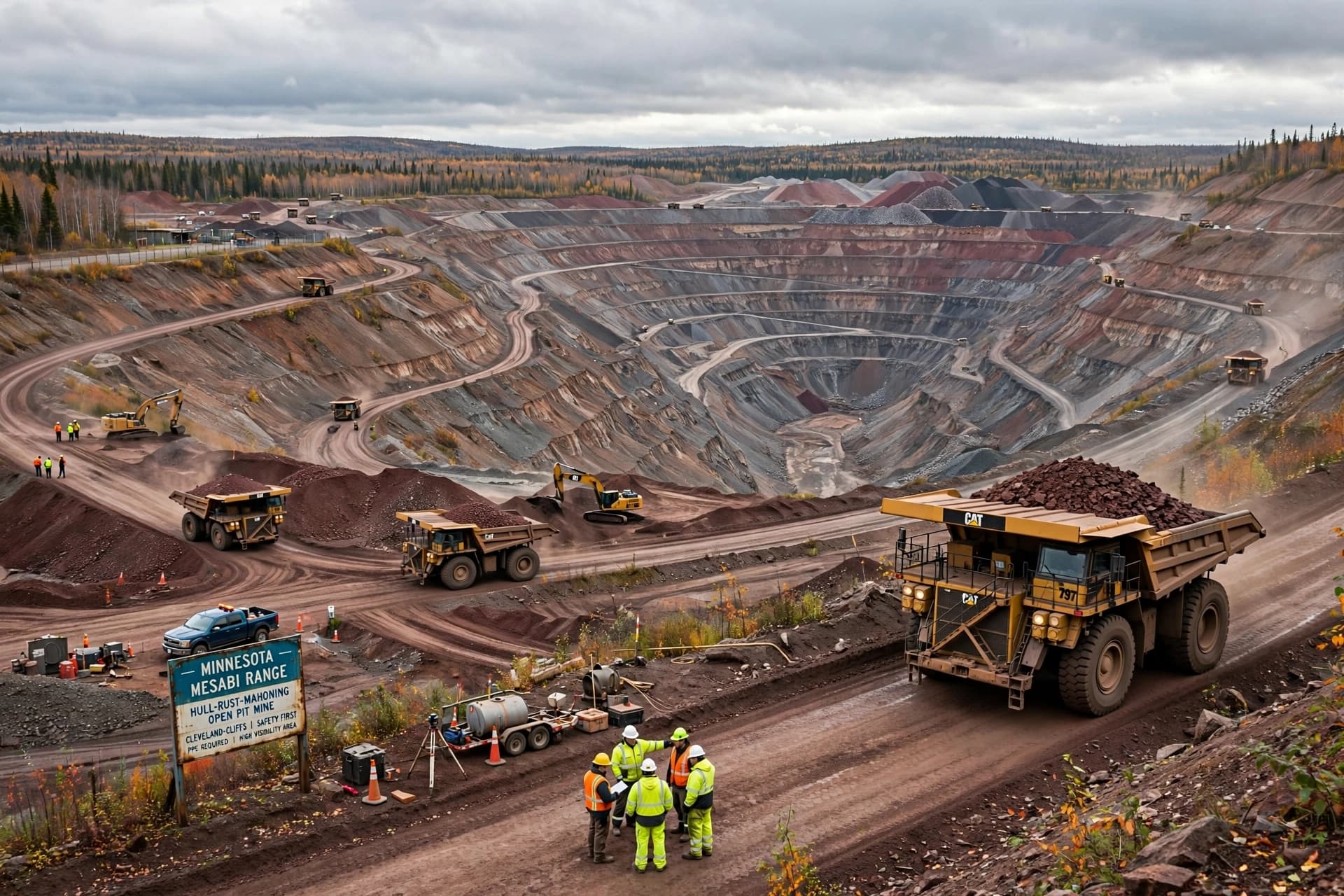
There is a particular irony in a project that mines its raw material from one state and builds its future in another—an irony that is not lost on the people who live where the ore is extracted, who watch the value-added jobs go elsewhere, and who are left to wonder what they might have done differently. In Minnesota's Iron Range, that irony has a name: Mesabi Metallics. The company is opening the nation's first new iron ore mine in more than fifty years in Nashwauk, Minnesota, a $3 billion investment that will produce direct-reduction-grade iron ore pellets. But the steel mill that will turn those pellets into finished steel—a $15 billion complex employing 1,750 workers—is being built in Iowa.
For Minnesota lawmakers, the announcement was a mixture of pride and frustration. State Representative Spencer Igo, whose district includes the Iron Range, acknowledged the significance of the mine while expressing deep disappointment that the steelmaking investment is going elsewhere. "While the ore will be mined here in Minnesota and will strengthen and bolster not just the Iron Range but the steel industry in the United States for generations, Mesabi's next $15 billion investment and as many as 1,700 jobs are going to Iowa," he said. "That should frustrate everyone who cares about the future of northern Minnesota."
The frustration is rooted in a pattern that Iron Rangers have watched for decades. The region has the resources—high-quality iron ore, a skilled workforce, and generations of mining expertise. What it has lacked, according to critics, is a regulatory and business environment that encourages companies to build processing and manufacturing facilities on site. "We have the resources, the workforce, and generations of mining expertise," said Representative Cal Warwas. "Yet the steel mill and its value-added jobs are headed to Iowa."
The project itself is remarkable in scale. Mesabi Metallics is investing $18 billion total—$3 billion in Minnesota and $15 billion in Iowa—to create what it calls a fully integrated American steel company, with a supply chain that is "mined, melted and poured" in the United States. The Iowa complex will use hot direct-reduced iron and electric arc furnace technology, significantly reducing energy use and emissions compared to traditional blast furnaces. Once operational, the plant will employ at least 1,750 full-time workers, while the Minnesota mine will create approximately 350 permanent jobs.
For the Iron Range, the benefits are real but incomplete. The mine will provide employment, tax revenue, and a market for the region's ore. But the higher-value manufacturing jobs—the ones that transform raw material into finished product—will be created in Iowa. "Today is a great day—if you live in Iowa," Warwas said. The sentiment captures a larger question about economic development in regions that supply raw materials but do not capture the value they create.
Minnesota officials have pointed to the state's regulatory environment as a factor in the decision. Mesabi Metallics' mine in Nashwauk has been in development for years, navigating permitting processes that critics say are unnecessarily slow and burdensome. "Minnesota needs leadership focused on making our state a place where major industrial projects are actually built—with predictable permitting, competitive energy costs, and policies that foster development rather than drive investment elsewhere," Warwas said. The company itself has not publicly attributed its decision to Minnesota's regulatory climate, but the timing and location of the investment have made the comparison unavoidable.
For now, the Iron Range will continue to supply the ore that feeds American steelmaking. The mine will operate, the pellets will be produced, and the trucks will carry the raw material south to Iowa. The steel mill will rise in a different state, employing workers who did not mine the ore. And the question that lingers in Nashwauk and Hibbing and Virginia—the question of what it would take to keep the next $15 billion investment at home—will remain unanswered.
AI Image Disclaimer: The images accompanying this article were generated by artificial intelligence and are for illustrative purposes only.
Sources: Minnesota House of Representatives, Mesabi Metallics, Fox21Online
Published by Banx Network. This article is part of the Banx decentralized media programme, powered by the BXE token on the XRP Ledger.