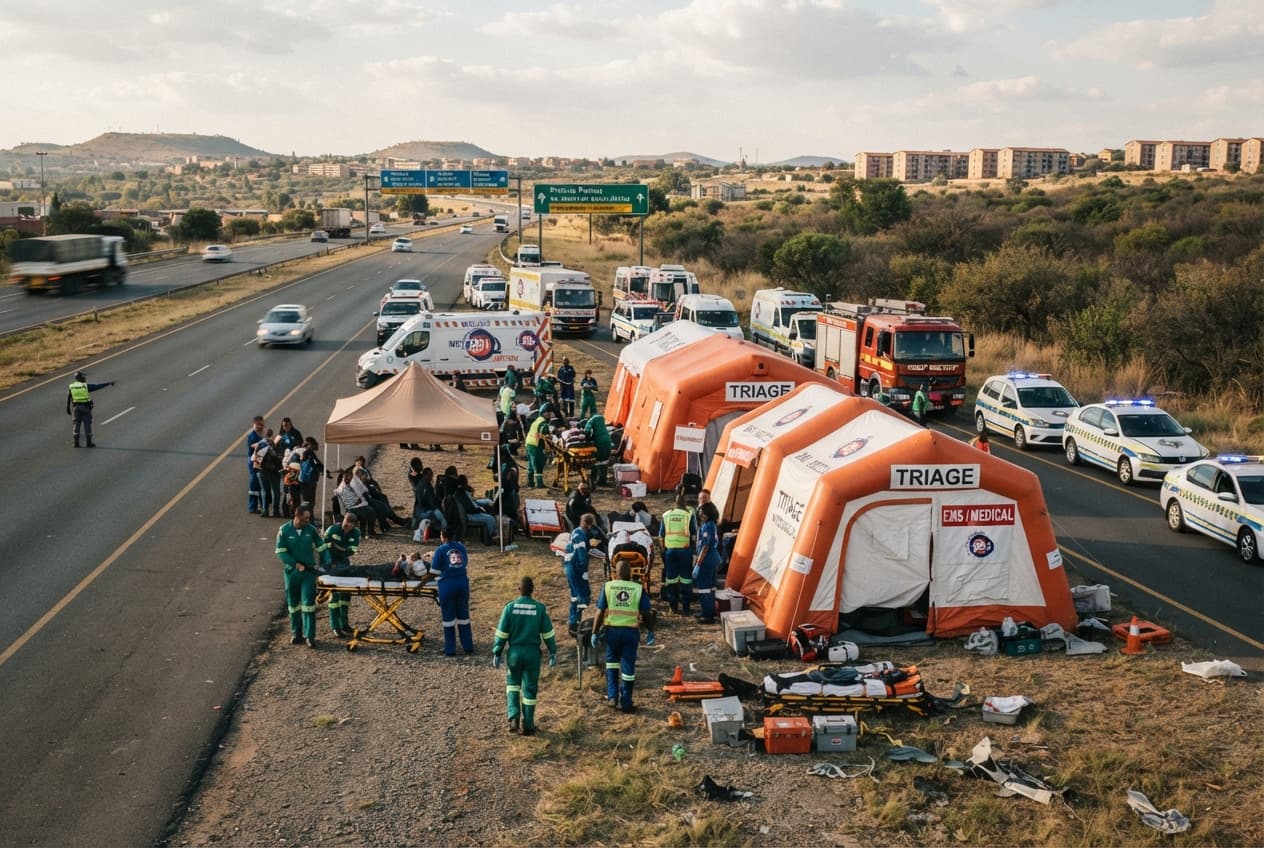
Pretoria, South Africa—The minibus rolled three times before coming to rest upside down across the asphalt lanes. Shards of safety glass showered the fast lane of the national highway just before dawn. Passengers were thrown clear of the sliding door as the chassis tore open against the concrete median. Headlights from trailing vehicles illuminated a chaotic scene of twisted metal and scattered luggage. Emergency medical services received the first distress call within seconds of the impact. State traffic police arrived to find the wreckage blocking southbound commuter traffic completely.
Paramedics established an immediate triage zone on the yellow shoulder of the highway. Five occupants sustained fatal injuries and were declared dead at the scene by attending medical personnel. Survivors crawled out from beneath seats screaming for help in the dark morning air. Rescue workers used hydraulic spreaders to free trapped passengers pinned beneath heavy row seating. Local hospitals mobilized trauma teams to receive the wave of critically injured victims arriving by ambulance. Traffic officers diverted incoming vehicles onto alternate off-ramps, causing massive gridlock across the metropolitan fringe.
Transport ministry officials faced immediate public scrutiny regarding vehicle roadworthiness and passenger capacity limits. Investigators combed the tire tracks for evidence of sudden blowouts or mechanical brake failure. Preliminary statements from surviving witnesses suggested excessive speed prior to the loss of control. The driver, who sustained moderate injuries, remained under police guard at a regional medical facility. Transport union representatives called once more for tighter regulatory enforcement across long-distance commuter routes.
Heavy-duty recovery tow trucks dragged the mangled vehicle onto a flatbed trailer under glaring halogen floodlights. Municipal cleaning crews swept debris and oil spills from the highway lanes before the morning rush hour peaked. Commuters passing the cleared site slowed down to stare at the scorched patch of asphalt. Provincial authorities announced an immediate audit of regional transport licensing protocols following the disaster. Grief counselors arrived at local community centers to assist families searching for missing relatives.
The economic cost of commuter delays compounded the collective grief felt across the urban transit network. Independent safety advocates noted that similar rollovers plague the same stretch of highway annually. Bureaucrats exchanged policy memos while victims' families planned memorial services in the townships. Normal traffic flow returned slowly as afternoon heat dried the remaining chemical foam on the shoulder. The stretch of the N1 highway remains a dangerous corridor of high-speed transit risk.
Published by Banx Network. This article is part of the Banx decentralized media programme, powered by the BXE token on the XRP Ledger.