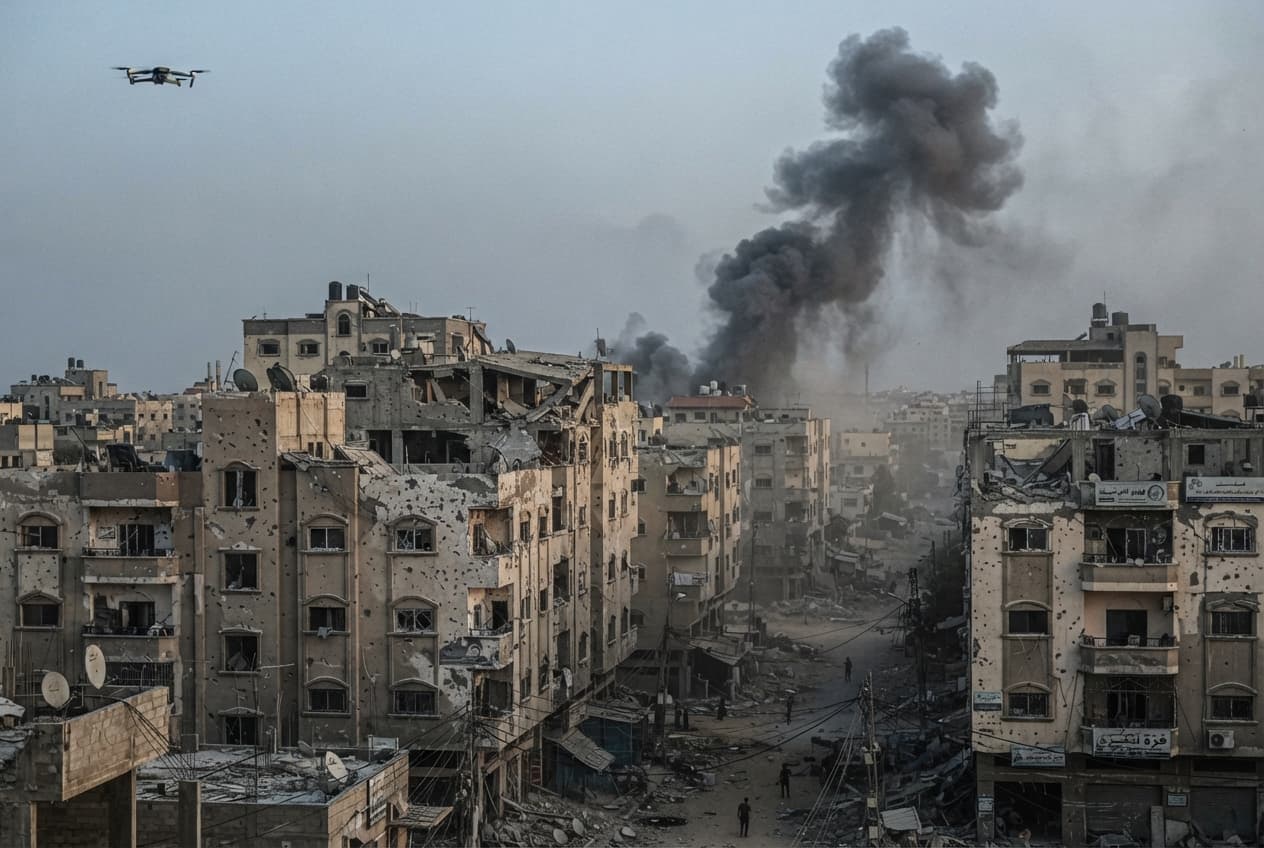
Gaza City, Palestine—Heavy military armor advanced toward critical transport arteries within the Gaza Strip on Monday, accompanied by relentless overhead drone surveillance that deepened civilian panic. Armored columns pushed closer to primary regional highways under the cover of intermittent artillery fire, restricting all civilian movement across vital north-south transit corridors. The intensified military positioning cut off essential supply lines and trapped thousands of displaced families within shrinking urban pockets.
Low-flying reconnaissance drones buzzed continuously overhead, projecting an oppressive atmosphere of constant threat across battered residential neighborhoods. Families sheltering in makeshift tent camps packed along coastal zones watched anxiously as dust plumes rose from nearby armor maneuvers. Local hospitals reported operating under critical resource shortages as incoming trauma cases overwhelmed emergency surgical departments.
Civil defense crews struggled to reach targeted zones where shelling damaged vital municipal water mains and electrical substations. Ambulance drivers navigated cratered roadways under hazardous conditions to evacuate wounded civilians from active combat perimeters. Humanitarian organizations warned that the latest territorial push threatens to halt all remaining food distribution efforts across the enclave.
A senior local emergency responder spoke to international journalists from the courtyard of a crowded municipal hospital. Every movement across these highways has become a deadly gamble under the constant hum of drones and advancing tanks, the official noted. Our medical teams cannot reach injured civilians trapped behind active military cordons without international safety guarantees.
Displaced residents interviewed near the frontline zones described harrowing conditions marked by constant explosions and severe food scarcity. Makeshift bakeries shut down operations after running out of cooking gas and flour supplies amidst the tightened military closure. Community leaders organized communal kitchens where possible, relying on dwindling stockpiles to feed malnourished children.
International aid coordinators condemned the renewed military escalation, citing catastrophic humanitarian consequences for the civilian population. Diplomatic channels remained stalled as regional mediators attempted to negotiate emergency humanitarian corridors through the advancing military zones. Local municipal committees appealed for immediate international intervention to establish safe evacuation routes for wounded non-combatants.
Engineers attempted emergency repairs on severed municipal water lines during brief lulls in artillery activity near the peripheral sectors. International observers monitored the unfolding tactical movements from border observation posts outside the besieged enclave. Local populations brace for further escalation as armored units consolidate their positions along the contested highway intersections.
Relief agencies continue updating casualty logs as communication networks flicker intermittently across the battered municipal districts. Medical personnel remain stationed inside emergency wards, preparing for an anticipated influx of wounded patients from the frontline sectors. Tactical military movements show no sign of deceleration as night falls across the embattled territory.
Published by Banx Network. This article is part of the Banx decentralized media programme, powered by the BXE token on the XRP Ledger.