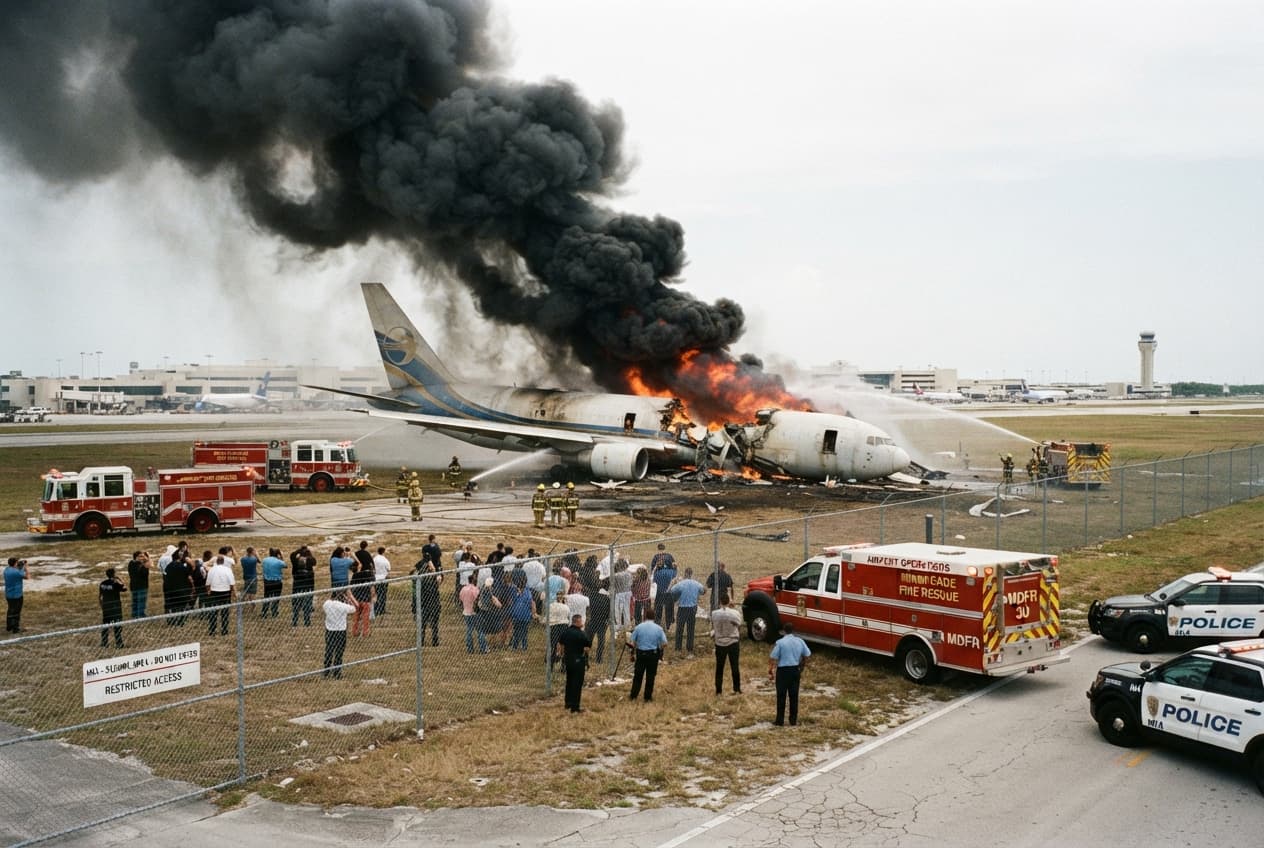
Miami, United States—Thick black smoke billowed across the perimeter of Miami International Airport just before two in the afternoon when a converted Boeing freighter failed to stop on runway thirty. Traveling at over one hundred knots, the heavy aircraft plowed through the perimeter fence, crossed a public roadway, and smashed directly into civilian traffic.
The impact crushed multiple automobiles against the asphalt before the fuselage erupted into a massive wall of fire. Flight tracking telemetry confirmed the aircraft touched down during gusting thunderstorm activity without declaring an emergency to air traffic controllers.
More than two hundred firefighters converged on the smoking wreckage within minutes, deploying foam suppression lines to beat back intense flames near the adjacent cargo warehouses. Rescue teams worked frantically to extricate victims trapped inside crushed cars beneath the aircraft nose.
Federal aviation authorities confirmed that five people died in the disaster, while five others sustained critical injuries requiring immediate hospital transport. Both flight crew members survived the impact and were questioned by investigators.
National Transportation Safety Board investigators arrived on site by late afternoon, setting up a mobile command center near the charred runway threshold. Inspectors began recovering flight data recorders and examining skid marks to determine why the heavy freighter failed to decelerate.
The catastrophic incident brought peak Labor Day travel to a grinding halt, forcing the Federal Aviation Administration to ground all arrivals and departures. Thousands of passengers faced severe delays as two primary runways remained closed throughout the evening.
Airlines and operating companies issued brief statements expressing condolences while pledging full cooperation with federal investigators reviewing braking performance and runway condition codes.
Heavy equipment and crane units stood by to lift the charred fuselage components off the public road as forensic teams continued identifying victims scattered across the restricted perimeter zone.
Published by Banx Network. This article is part of the Banx decentralized media programme, powered by the BXE token on the XRP Ledger.