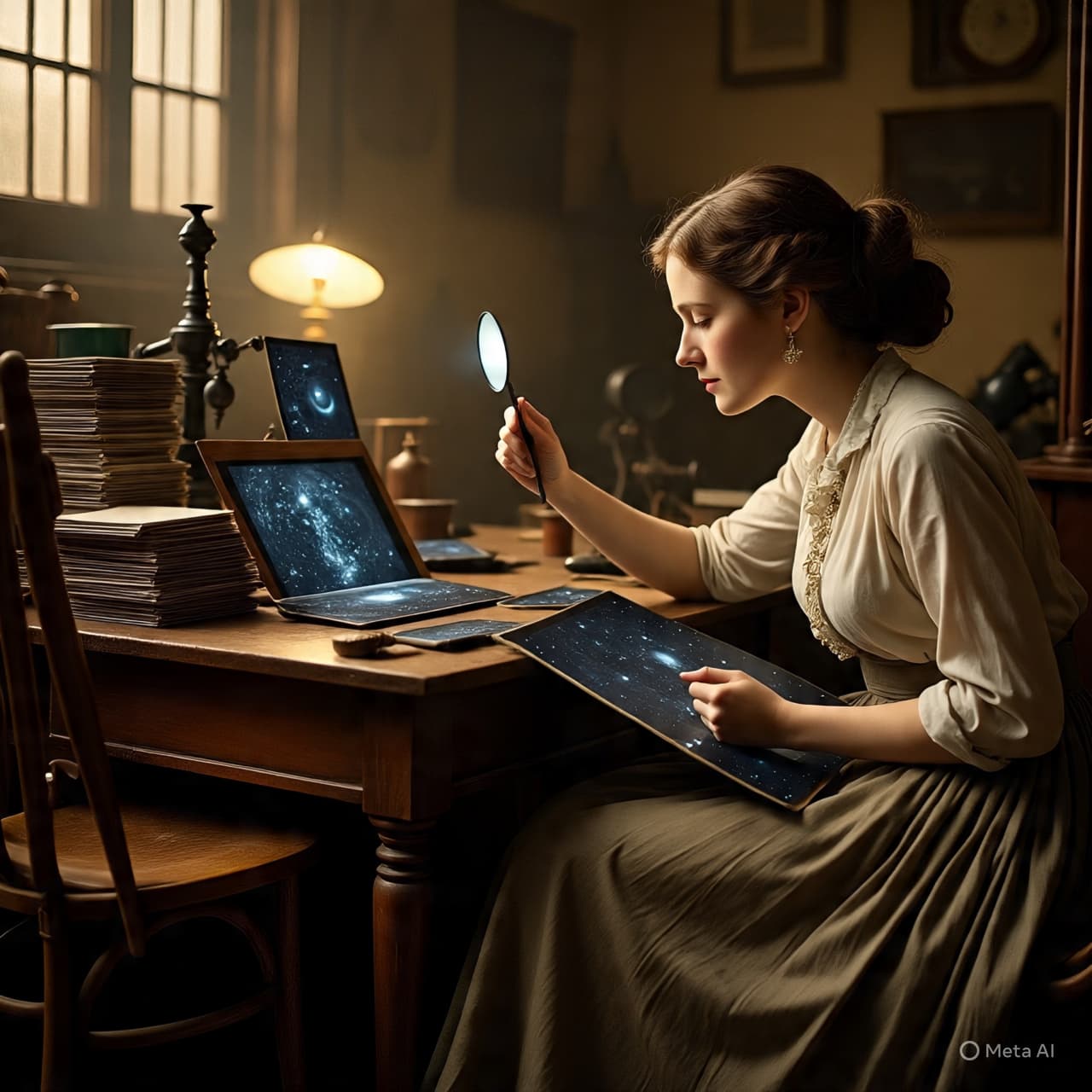
There are names that travel quietly through history, carried not by headlines but by the work they leave behind—calculations inked onto paper, observations recorded with patience, insights that shift understanding without announcing themselves. In the early days of modern astronomy, when the universe was still thought to be smaller than it is now, some of these names belonged to women whose roles were described simply as “computers,” though their contributions reached far beyond calculation.
Among them was Henrietta Swan Leavitt, whose work would gently, yet profoundly, alter how humanity measures the cosmos. Working at the Harvard College Observatory in the early 20th century, she was part of a group of women tasked with analyzing photographic plates of the night sky. Their role was methodical, often unrecognized, but essential—a careful reading of light captured on glass.
Leavitt’s attention settled on a particular class of stars known as Cepheid variables, stars whose brightness changes in a regular rhythm. Where others might have seen repetition, she noticed a pattern—a relationship between the period of a star’s brightness variation and its intrinsic luminosity. It was a subtle connection, one that required patience to uncover, but its implications extended far beyond the plates she examined.
This relationship, now known as the period-luminosity relation, offered something astronomy had long lacked: a reliable way to measure distances across space. By observing how a Cepheid star brightens and dims, astronomers could determine how luminous it truly is, and by comparing that to how bright it appears from Earth, calculate its distance. It was, in effect, a new kind of ruler—one that could extend far beyond the reach of earlier methods.
The impact of this discovery unfolded gradually. Astronomers such as Edwin Hubble would later use this method to show that the universe extends far beyond the Milky Way, identifying distant galaxies and reshaping our understanding of cosmic scale. In this way, Leavitt’s work became part of a larger narrative, one that expanded the known universe and redefined humanity’s place within it.
Yet her own recognition came quietly, if at all, during her lifetime. Like many of her contemporaries, she worked within a system that limited visibility even as it depended on her expertise. The term “computer” captured only a fraction of what she contributed—a role that combined observation, interpretation, and discovery.
There is a certain stillness in this story, a reminder that progress in science is not always accompanied by immediate acknowledgment. Sometimes, it emerges through layers of work, each building upon the last, until the full significance becomes clear.
Today, her legacy is more fully understood, not as an isolated achievement, but as part of the foundation of modern astronomy. The methods she developed continue to guide measurements of cosmic distances, informing research that reaches ever deeper into space.
As historians and scientists revisit these early contributions, the narrative continues to evolve, bringing forward voices that were once at the margins. The recognition may arrive later than the work itself, but it carries with it a clearer view of how knowledge is shaped—patiently, collectively, and often quietly.
AI Image Disclaimer Illustrations were produced with AI and serve as conceptual depictions.
Source Check (Credible Media Outlets):
NASA Smithsonian Magazine BBC Science The New York Times Nature
Published by Banx Network. This article is part of the Banx decentralized media programme, powered by the BXE token on the XRP Ledger.