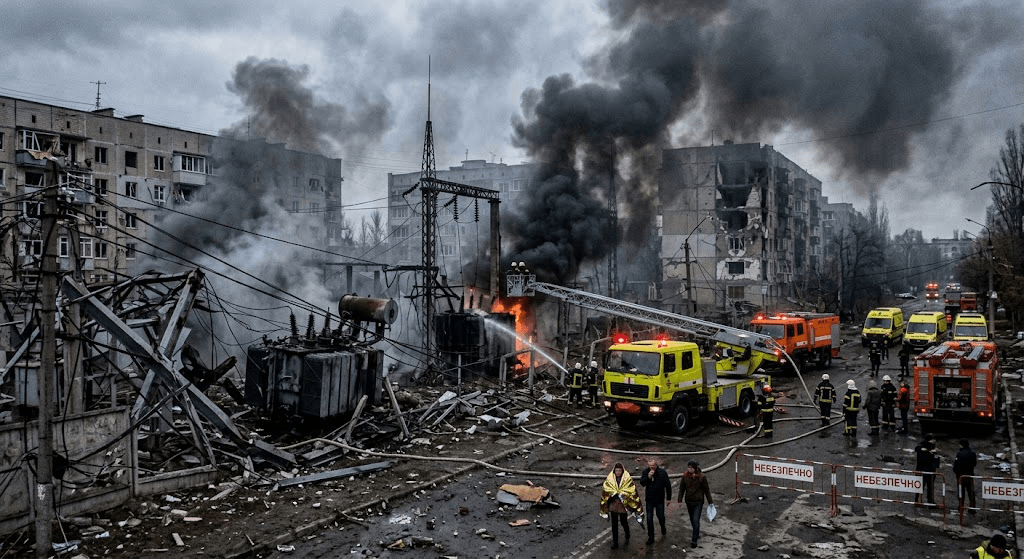
KYIV — Russian forces launched a coordinated barrage of ballistic missiles and heavy strikes across multiple Ukrainian regions overnight, killing at least six people and knocking out critical energy infrastructure. The widespread assault triggered emergency blackouts in the capital city of Kyiv and severely damaged key industrial and power generation sites nationwide.
Explosions echoed across Kyiv overnight as air defense batteries intercepted inbound missiles. Despite interception efforts, strikes directly impacted major power facilities serving the capital region, forcing emergency shutoffs to protect what remains of the electrical grid.
According to local energy provider DTEK, district-wide blackouts immediately affected multiple key areas—including Darnytskyi, Dniprovskyi, Pecherskyi, and Solomianskyi—cutting off electricity and interrupting public water supplies for hundreds of thousands of residents. Mayor Vitali Klitschko urged citizens to remain inside bomb shelters as emergency crews rushed to stabilize the grid.
Beyond Kyiv, heavy strikes pounded several other eastern, central, and southern regions—including Kharkiv, Zhytomyr, Sumy, Chernihiv, and Zaporizhzhia—where authorities confirmed at least six fatalities and numerous civilian injuries from structural collapses and secondary fires, while industrial facilities, residential blocks, and essential substation nodes sustained major structural damage.
Ukrainian officials reiterated that Russia’s sustained strategy aims directly at dismantling the country's energy network to disrupt daily civilian life and strain logistical operations.
As repair crews work around the clock to restore power and water services, Ukrainian officials have renewed urgent calls to international allies for additional advanced air defense systems and ammunition.
With critical energy hubs repeatedly targeted, authorities warn that continuous pressure on the grid risks prolonged power shortages and strains municipal services across major urban centers. Emergency response teams remain on high alert as military units prepare for potential follow-up strikes.
In the face of these escalating infrastructure attacks, humanitarian organizations and local community groups have begun mobilizing winter support hubs to distribute mobile generators, thermal gear, and emergency food supplies to the hardest-hit neighborhoods. As temperatures continue to drop, international humanitarian networks emphasize that securing steady heating and clean water access will be as vital to sustaining civilian resilience over the coming months as bolstering air defenses on the frontlines.
Published by Banx Network. This article is part of the Banx decentralized media programme, powered by the BXE token on the XRP Ledger.