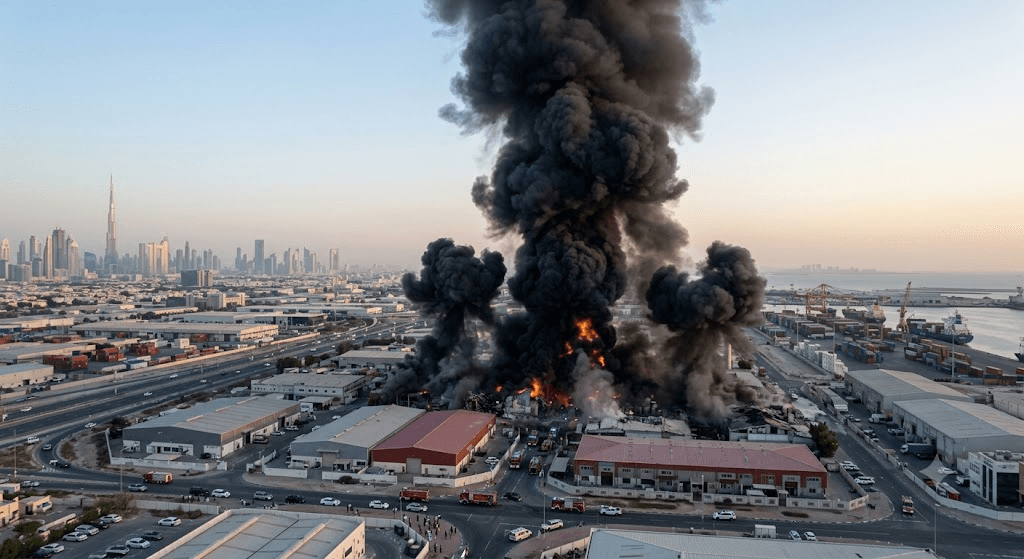
DUBAI, United Arab Emirates — Multiple loud explosions echoed across Dubai on Wednesday, August 5, 2026, sending thick columns of black smoke rising into the sky over the city’s major industrial and logistics corridor.
Residents across neighboring communities reported hearing at least three to seven heavy blasts in rapid succession, centering near the Jebel Ali region—one of the Middle East’s largest industrial hubs and deepwater ports.
The incident occurred shortly after local emergency services received reports of detonations ringing out near the Jebel Ali Free Zone and surrounding residential districts like Al Furjan. Eyewitnesses described seeing dark plumes of smoke billowing high above warehouse complexes and industrial facilities, visible from miles away across Dubai’s skyline.
Emergency response teams, including Dubai Civil Defense units and medical personnel, rushed to secure the site and contain localized fires triggered by the blasts.
Local authorities immediately established a security perimeter around the affected zone to allow firefighting crews to gain control over the fires and assess structural damage. While initial reports indicated heavy smoke originating from warehouse and storage facilities in the area, official statements regarding the exact cause, casualty numbers, or total extent of property damage remain pending evaluation by UAE officials.
The Jebel Ali district serves as a critical global shipping, logistics, and industrial hub for West and South Asia. Authorities have urged the public to rely strictly on official government channels for updates as emergency operations continue at the scene.
The financial and trade implications of the incident could ripple far beyond the immediate industrial zone, given Jebel Ali’s strategic role as a maritime and logistics gateway connecting global trade routes between Europe, Asia, and Africa. Industry analysts noted that any prolonged operational disruption at the port facilities or surrounding commercial warehouses could create temporary supply chain bottlenecks for regional freight and logistics operators.
In the hours following the explosions, local civil aviation and maritime transport authorities monitored nearby transit corridors to ensure commercial traffic remained unaffected. Meanwhile, structural engineers and hazardous material assessment teams joined emergency personnel on the ground to inspect adjacent storage units and secure potentially volatile compounds, ensuring the surrounding residential neighborhoods remained safe from secondary environmental hazards.
Published by Banx Network. This article is part of the Banx decentralized media programme, powered by the BXE token on the XRP Ledger.