Key Highlights
- Incident:A massive dry landslide struck Yarubagar in Gorkha, Nepal.
- Impact:Dust clouds engulfed a cliffside staircase, raising safety concerns.
- Response:Local authorities are monitoring the area for further risks.
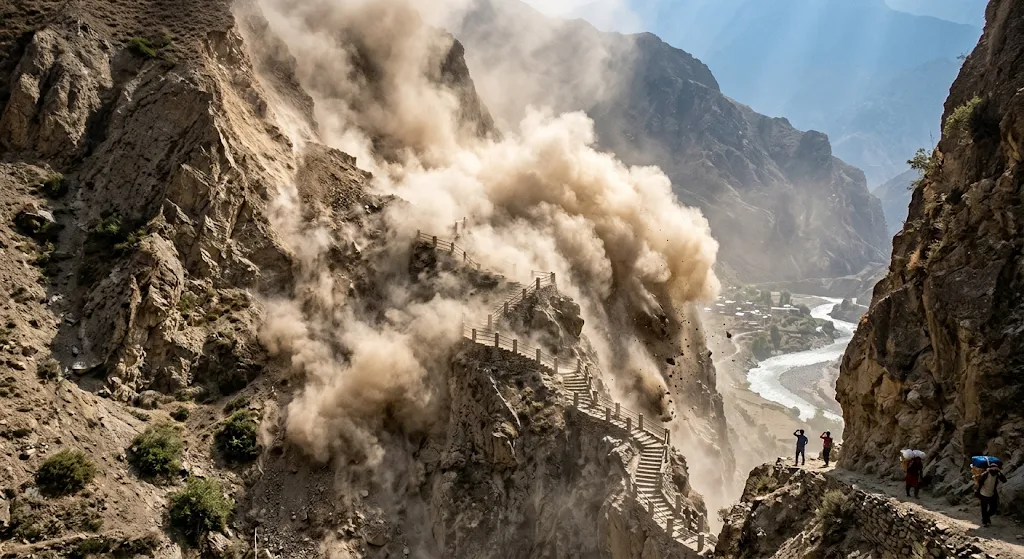
A massive dry landslide struck Yarubagar in Dharche Rural Municipality-1 of Nepal’s Gorkha district on Saturday morning, sending a towering plume of dust billowing across the valley and engulfing a steep cliffside staircase along the local trail. The incident occurred in the forest area near Thado Bharyang—a steep, stair-stepped trail section in Yarubagar—where a huge mass of dry earth and rock suddenly gave way and tumbled down the slope. Dramatic visuals from the area showed thick clouds of dust completely blanketing the cliffside staircase and surrounding terrain as debris cascaded down the mountainside.
According to local administration officials, no human casualties or major property damage have been reported so far. However, the sudden collapse has significantly heightened safety risks for residents, porters, and trekkers who regularly rely on the steep corridor to navigate the rugged Himalayan foothills. Local authorities have urged pedestrians and nearby villagers to exercise extreme caution and avoid unnecessary movement near the unstable slope, warning that loose soil and rocks could trigger secondary slides in the area.
The latest incident adds to ongoing geological instability across the Gorkha region, which has experienced repeated landslides and river corridor disruptions in recent months. Authorities are continuing to monitor the Yarubagar slope to assess whether emergency trail diversions or stabilization work will be required. Dharche Rural Municipality Chairman Laxman Gurung confirmed that a team has been dispatched to assess the site but emphasized the ongoing danger. "The dust itself poses a major visibility and health hazard, and we are fearful that the movement of pedestrians below the fractured cliff could precipitate a secondary, potentially more lethal, slide. We are urgently looking for alternative routes for the safety of locals and the movement of goods," Gurung said.
Geological experts warn that this incident is a stark symptom of a widespread, post-monsoon instability that plagues Nepal's alpine environment. Continued slope saturation from the recent rains, coupled with the region's inherent tectonic activity, means many previously stable cliffs are now "on a knife-edge," according to Dr. Rabin Shrestha of the Tribhuvan University Geology Department. He stressed that without significant engineering interventions or permanent trail realignments, vital access points throughout the foothills will remain incredibly vulnerable to similar sudden failures.
The situation remains fluid as local authorities work to ensure the safety of residents and travelers in the area. The community is urged to stay informed and heed warnings as the risk of further geological activity persists in the region.
Published by Banx Network. This article is part of the Banx decentralized media programme, powered by the BXE token on the XRP Ledger.