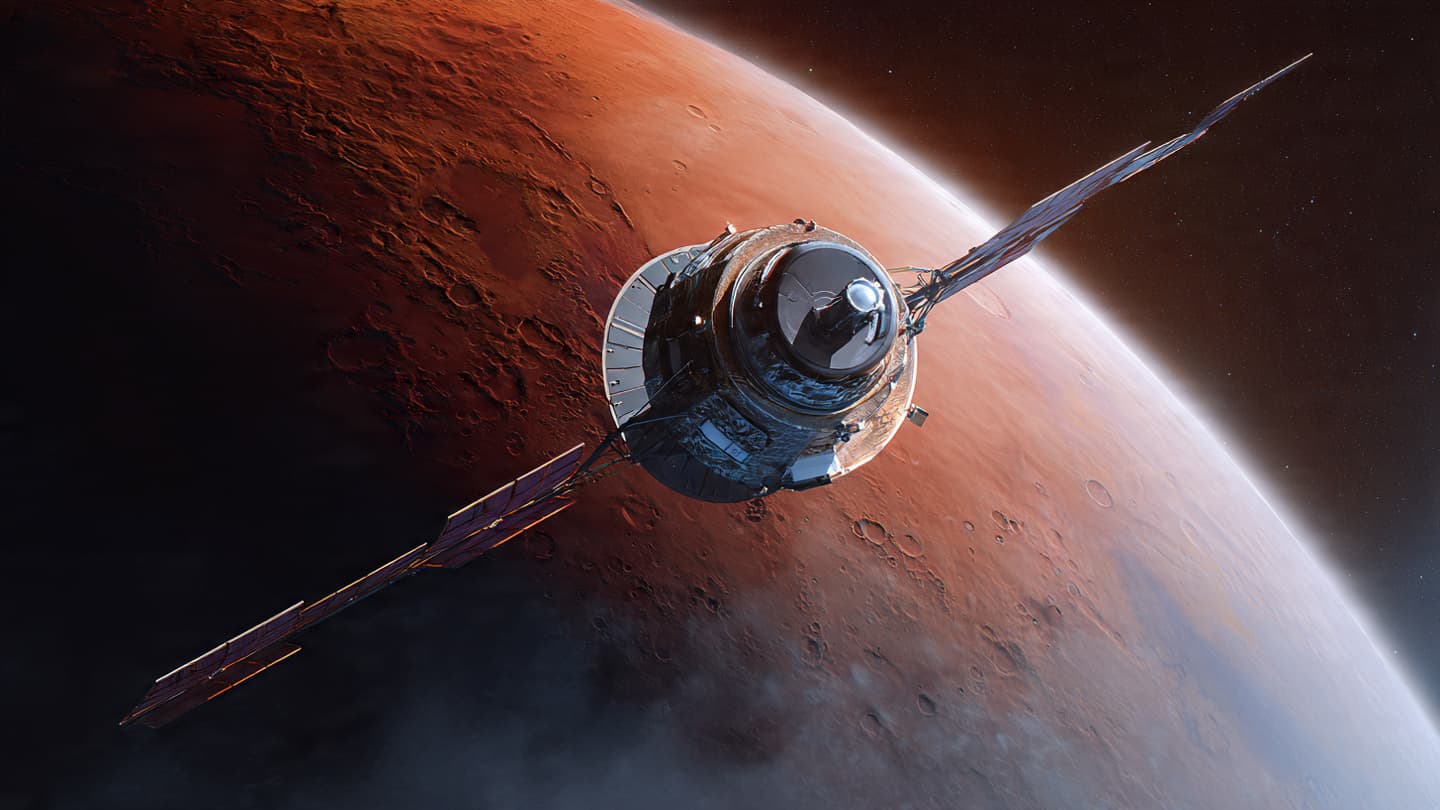
Space missions often resemble long voyages across an ocean without shores, where even brief encounters along the route can shape the success of an entire journey. While ’s spacecraft continues its ambitious path toward a rare metal-rich asteroid, recent attention turned toward an unexpected waypoint: Mars. To many observers, the question emerged naturally — why would a mission destined for a distant asteroid make a visit near the Red Planet at all?
Scientists explain that the encounter was part of a carefully planned gravitational assist maneuver. Rather than stopping at Mars in the traditional sense, the spacecraft used the planet’s gravity to alter its speed and trajectory, conserving fuel while gaining momentum for the much longer voyage ahead.
Gravity assists have become a fundamental strategy in deep-space exploration. By passing near a planet at precise angles and velocities, spacecraft can effectively borrow orbital energy, allowing missions to travel farther without carrying prohibitively large amounts of fuel from Earth.
The Psyche mission’s ultimate destination is the asteroid , located in the asteroid belt between Mars and Jupiter. Scientists believe the object may contain large amounts of metal, leading some researchers to theorize that it could represent the exposed core of an ancient protoplanet formed during the early solar system.
Studying Psyche may provide insights into how rocky planets, including Earth, formed billions of years ago. Since Earth’s metallic core remains inaccessible beneath thousands of kilometers of rock, a naturally exposed metal-rich asteroid offers researchers a rare opportunity to study planetary interiors indirectly.
The Mars flyby also allowed engineers to test navigation systems, communications, and spacecraft operations during a critical stage of the mission. Complex interplanetary travel requires constant adjustments and precise calculations across distances measured in hundreds of millions of miles.
Public fascination with the mission reflects broader curiosity surrounding asteroid exploration. Once viewed mainly as distant rocky debris, asteroids are increasingly recognized as scientific archives preserving material from the solar system’s earliest history.
NASA officials say the Psyche spacecraft remains on course toward its destination, with arrival expected later in the decade. For now, the brief encounter with Mars serves as another example of how planetary gravity itself becomes part of humanity’s expanding toolkit for exploring deep space.
AI Image Disclaimer: Some spacecraft and planetary visuals connected to this article may be AI-generated renderings inspired by NASA mission concepts.
Sources: NASA, Jet Propulsion Laboratory, Space.com, Scientific American, Ars Technica
Published by Banx Network. This article is part of the Banx decentralized media programme, powered by the BXE token on the XRP Ledger.