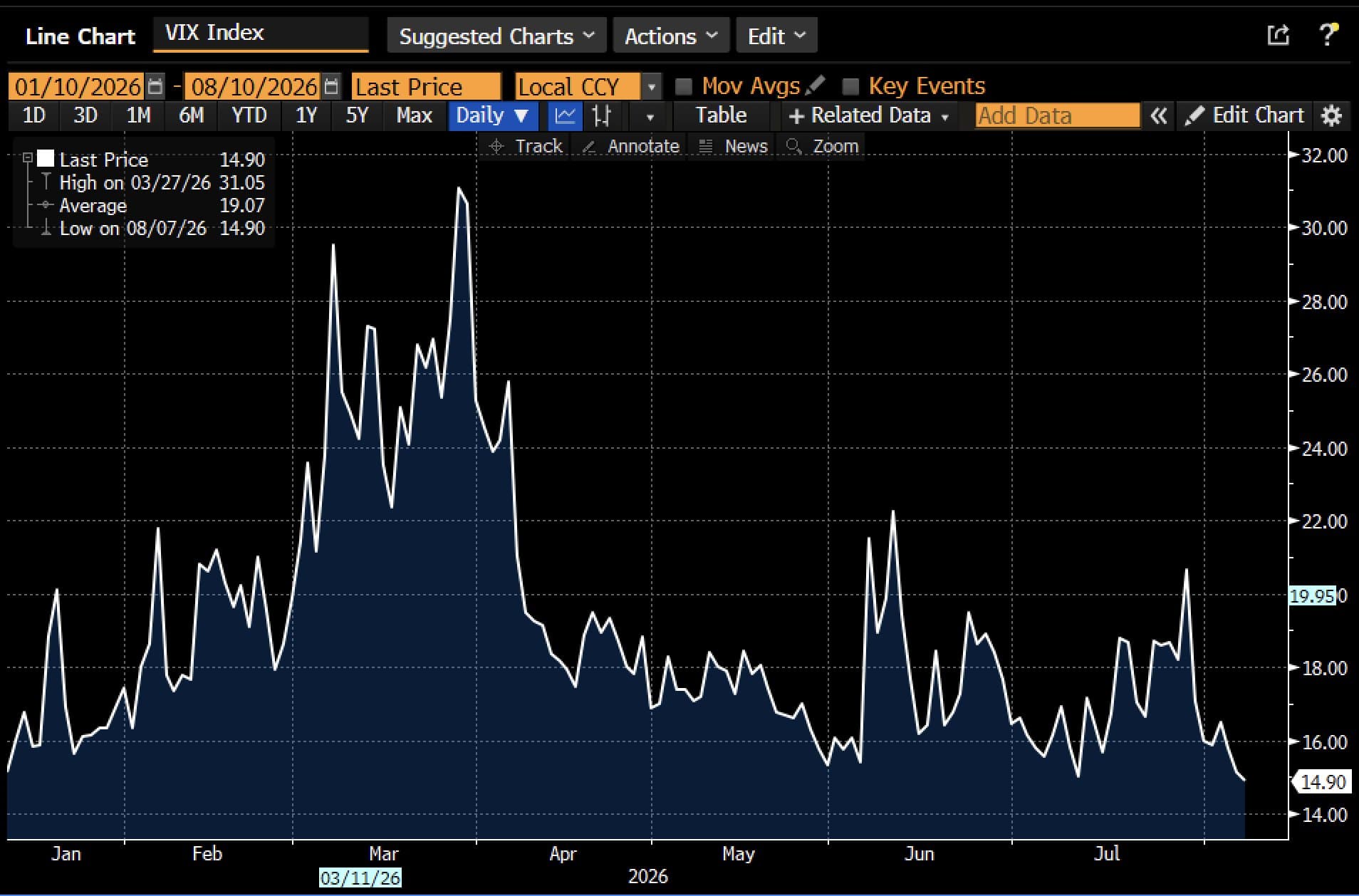
Investment advisers are increasingly warning investors to prepare for a more volatile period in financial markets, yet one of the most closely watched measures of market fear is sending a surprisingly different message. The VIX, which measures the implied volatility of the S&P 500, has fallen to its lowest level since January, according to the market commentary shown in the post by Bloomberg journalist Lisa Abramowicz. The move creates an unusual contrast between investor caution and the relatively calm expectations being priced into U.S. equities. The VIX is often described as the market's “fear gauge” because it reflects expectations for volatility in the S&P 500 over the coming weeks. When investors aggressively purchase options to protect portfolios or speculate on larger market swings, implied volatility generally rises. When demand for that protection falls, the VIX can decline. A lower VIX therefore does not necessarily mean that markets are free from risk. Instead, it can indicate that investors are currently assigning a lower probability to extreme short-term moves. The chart accompanying the post shows that volatility surged sharply during the first quarter before declining considerably. The VIX reached levels around 30 during its major spike and subsequently moved lower as markets stabilized. By August, the index shown on the chart was around 14.9, close to the lowest levels displayed for the year. That decline suggests that expectations for immediate equity-market turbulence have cooled considerably compared with the conditions seen earlier in 2026. The bond market is providing an equally interesting signal. According to the post, implied bond-market volatility is nearly 30% below its five-year average. That matters because government bonds remain central to global financial markets, influencing borrowing costs, mortgage rates, corporate financing and the valuation of stocks and other assets. A relatively subdued level of expected bond volatility suggests that options markets are not currently pricing an exceptionally large disruption in interest-rate markets. However, the apparent calm should not be confused with the disappearance of risk. Financial markets can remain quiet immediately before major changes in economic expectations. Inflation data, central-bank decisions, employment figures, geopolitical developments and unexpected changes in government policy can all rapidly alter volatility expectations. When positioning becomes concentrated around a stable market environment, a surprise can sometimes produce a disproportionately large reaction. The current situation is therefore less about whether volatility is “low” or “high” and more about the difference between realized concerns and market pricing. Advisers may be warning clients because they see risks that are not yet fully reflected in options markets. At the same time, investors trading volatility are effectively saying that the probability of a major near-term shock remains relatively contained. This divergence is important for investors because markets frequently move before the underlying economic story becomes obvious. A low VIX can support higher equity valuations because investors demand less compensation for uncertainty. It can also encourage investors to increase exposure to riskier assets. But if volatility suddenly rises, those positions can become vulnerable as investors simultaneously attempt to reduce risk. The message from the current data is therefore mixed. Market pricing remains relatively calm, while professional warnings emphasize the possibility of renewed turbulence. Rather than proving that either side is correct, the difference highlights how quickly expectations can change. For global investors, the VIX and bond-volatility measures remain important indicators of market sentiment. Their current weakness suggests that financial markets are not pricing an immediate crisis. But historically, periods of unusually calm volatility have not eliminated the possibility of future shocks. The important question is not simply how low volatility can go, but what event could cause expectations to change.
Published by Banx Network. This article is part of the Banx decentralized media programme, powered by the BXE token on the XRP Ledger.