Key Highlights
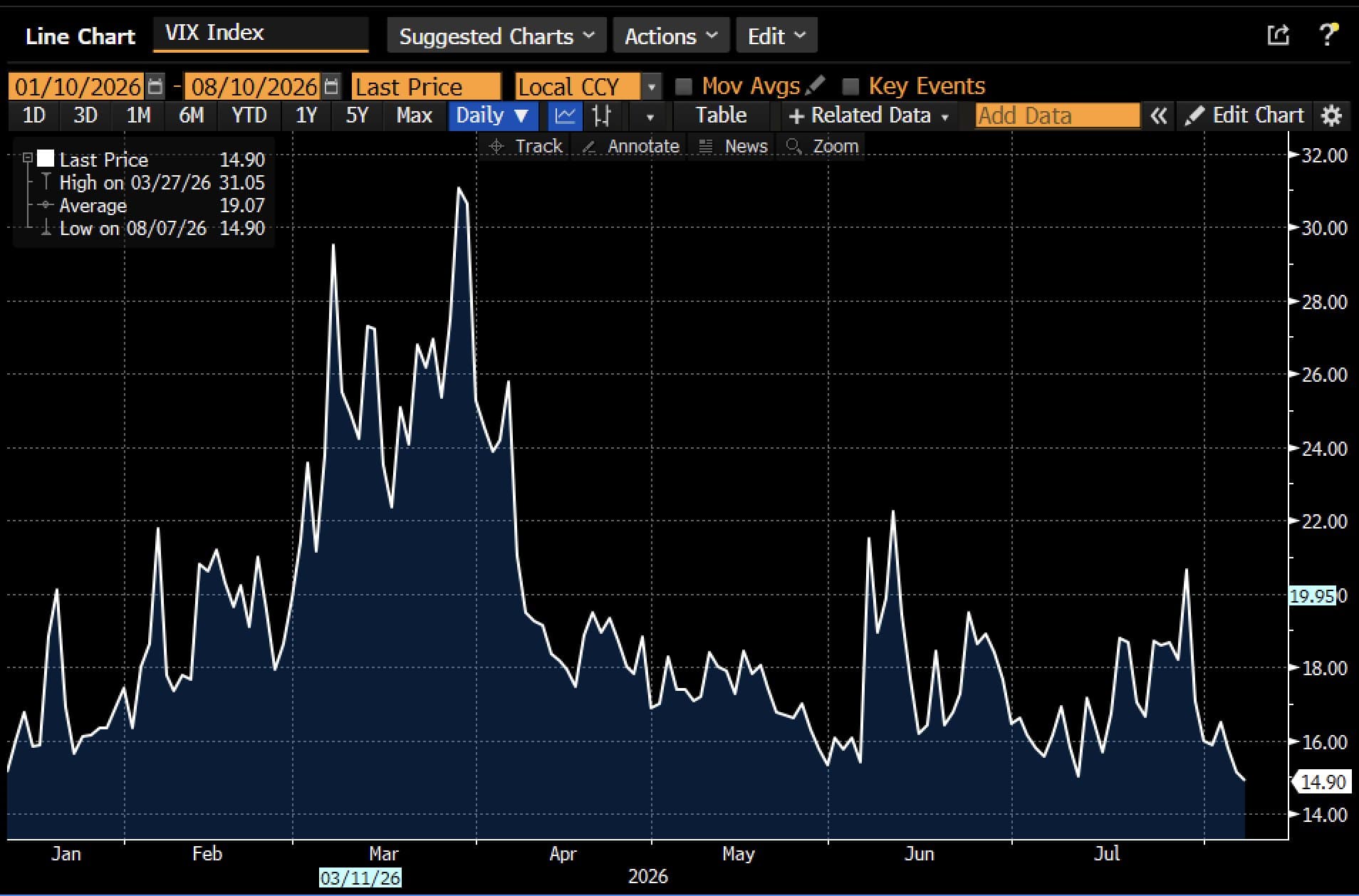
- VIX falls to its lowest level since January, signaling calm.
- Investment advisers warn of potential volatility despite low VIX.
- Bond market volatility is also below average, indicating stability.
Investment advisers are increasingly cautioning investors to brace for a more volatile period in financial markets. This warning comes even as one of the most closely monitored indicators of market fear, the VIX, has fallen to its lowest level since January. According to Bloomberg journalist Lisa Abramowicz, this creates a striking contrast between the cautious outlook from advisers and the relatively calm expectations reflected in U.S. equities.
The VIX, often referred to as the market's “fear gauge,” measures the implied volatility of the S&P 500 over the coming weeks. Typically, when investors buy options to hedge against potential market swings, implied volatility rises, leading to an increase in the VIX. Conversely, a decline in demand for such protective options can result in a lower VIX. Thus, a lower VIX does not necessarily indicate a risk-free market; rather, it suggests that investors currently perceive a lower likelihood of extreme short-term market movements.
Recent data shows that the VIX experienced a significant surge during the first quarter of 2026, reaching levels around 30 before declining sharply as market conditions stabilized. By August, the index had dropped to approximately 14.9, close to its lowest levels for the year. This decline indicates that expectations for immediate turbulence in the equity markets have cooled significantly compared to earlier in the year.
In addition to the VIX, the bond market is sending intriguing signals. Implied bond-market volatility is currently nearly 30% below its five-year average. This is noteworthy because government bonds play a crucial role in global financial markets, affecting borrowing costs, mortgage rates, corporate financing, and the valuation of various assets. A subdued level of expected bond volatility suggests that options markets are not anticipating significant disruptions in interest-rate markets.
However, the apparent calm in the markets should not be mistaken for the absence of risk. Financial markets can often remain quiet just before major shifts in economic expectations. Factors such as inflation data, central bank decisions, employment figures, geopolitical events, and unexpected changes in government policy can all rapidly alter volatility expectations. When market positioning becomes concentrated around a stable environment, any surprises can lead to disproportionately large reactions.
The current landscape is less about whether volatility is “low” or “high” and more about the disparity between realized concerns and market pricing. Advisers may be warning clients because they perceive risks that are not yet fully reflected in options markets. Meanwhile, investors trading volatility seem to indicate that the probability of a major near-term shock remains relatively contained.
This divergence is crucial for investors, as markets often react before the underlying economic narrative becomes clear. A low VIX can support higher equity valuations, as investors demand less compensation for uncertainty, potentially encouraging greater exposure to riskier assets. However, if volatility suddenly increases, those positions may become vulnerable as investors rush to mitigate risk.
The mixed signals from current data highlight the complexity of the financial landscape. While market pricing appears calm, professional warnings underscore the potential for renewed turbulence. This situation does not definitively validate either perspective but emphasizes how swiftly expectations can shift.
For global investors, the VIX and bond-volatility measures remain vital indicators of market sentiment. Their current weakness suggests that financial markets are not anticipating an immediate crisis. However, historically, periods of unusually low volatility have not ruled out the possibility of future shocks. The pressing question is not merely how low volatility can go, but what events could trigger a change in expectations.
Published by Banx Network. This article is part of the Banx decentralized media programme, powered by the BXE token on the XRP Ledger.