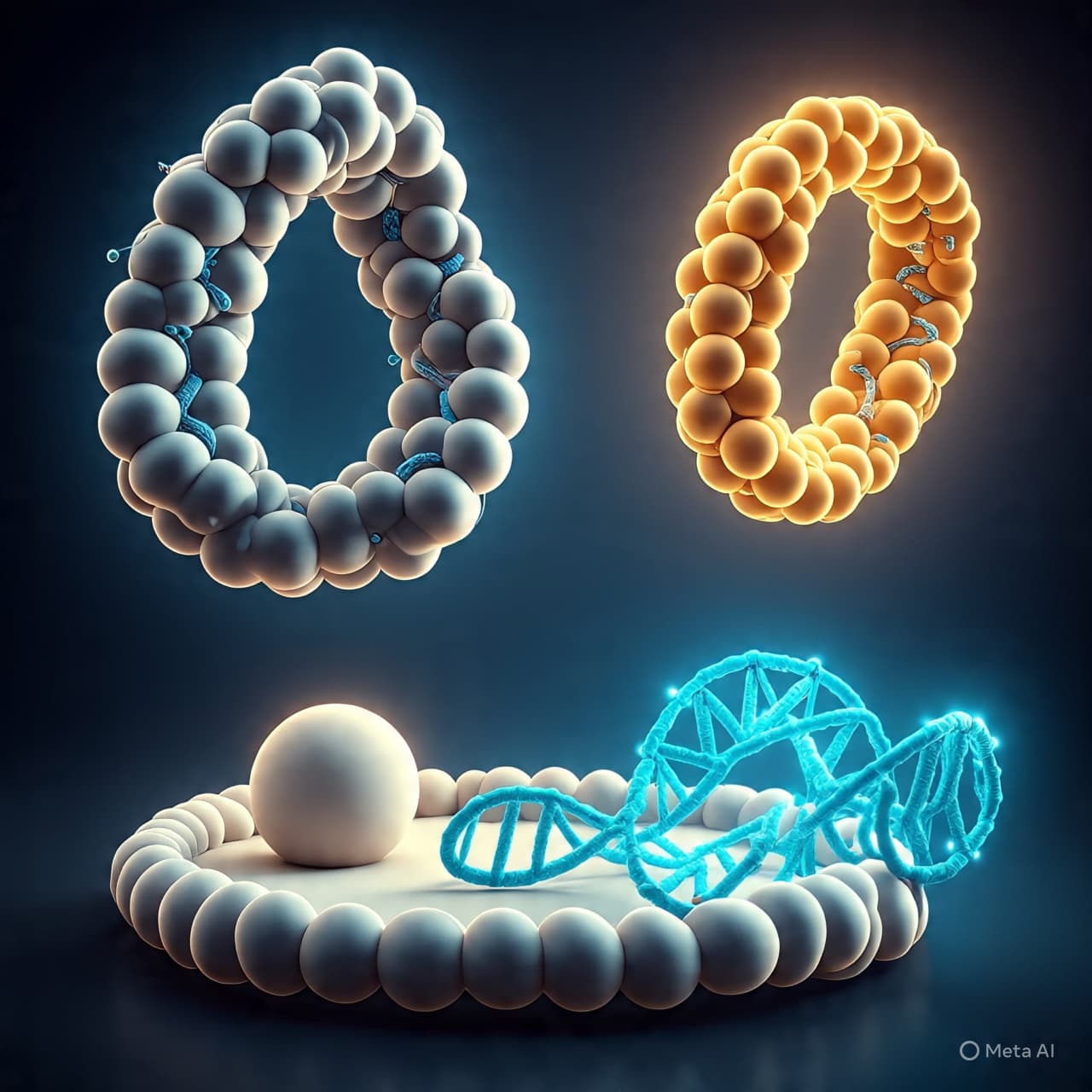
There are moments in science when the invisible becomes almost tangible like watching constellations slowly assemble in a night sky. In the vast microscopic cosmos of the human cell, DNA does not float aimlessly; it folds, twines, and loops in a choreography both ancient and essential. Recently, a global consortium of researchers unveiled something akin to a star map for our own genetic universe: a detailed atlas of more than 140,000 DNA loops that link distant stretches of our genome into a three-dimensional whole.
If a chromosome were a mountain range on a terrestrial map, these loops would be the ridges and valleys that chart not just terrain but hidden waterways and pathways. For decades, scientists have known that our genomic material the 23 pairs of long DNA molecules in every human cell must fold to fit inside a nucleus smaller than a millionth of a meter across. But to truly understand how that topography shapes life, health, and disease, researchers needed a way to see not just the sequence of base pairs, but their spatial dance.
This ambitious effort, part of the 4D Nucleome Project, brought together genomic assays, computational modelling, and deep learning to catalog the physical interactions that bring distant segments of DNA into contact. The result: a comprehensive catalogue of over 140,000 regulatory loops in human embryonic stem cells and connective fibroblast cells, stitched together into high-resolution three-dimensional maps of entire genomes at the single-cell level.
What makes these looping structures so captivating is not their number alone, but what they represent. DNA loops act like bridges bringing enhancers, the long-distance switches that regulate gene activity, into physical proximity with genes that may lie far away on the linear sequence. In doing so, they help turn genes on or off at just the right moment, a process that underlies development, cellular identity, and even disease.
Imagine reading a book where key chapters suddenly reach across pages to whisper to one another that is, in essence, how these loops influence biology. Genes essential to many cell types, sometimes called “housekeeping” genes, were found to connect with entirely different regulatory sequences in stem cells than in fibroblasts, suggesting that each cell type uses the same genomic letters in multiple, dynamic dialogues.
Beyond cataloguing interactions, the team demonstrated computational methods that can predict how the genome will fold based solely on DNA sequence. This predictive power is not merely academic; it could help scientists understand how variations in our genetic code even single letter changes might ripple through the genomic architecture to shape gene function and disease susceptibility.
Yet, as with any grand map, this one raises as many questions as it answers. The intricate choreography of chromosome folding still holds mysteries how loops form in different cell states, how they change over time, and how they influence complex traits remains open to exploration. What is clear is that the genome is less like a simple script and more like a dynamic theater, where distance and form matter as much as the individual genetic letters.
Through this lens, we see not just sequences, but landscapes a rich, four-dimensional genomic atlas that invites scientists to trace the winding paths of life’s most fundamental code.
In gentle, steady progress, researchers continue to build the bridge between genetic information and its physical manifestation, offering new ways to understand health, disease, and the hidden architecture of life itself.
AI Image Disclaimer (Rotated Wording) “Visuals are created with AI tools and are not real photographs.”
Sources Based on Sources Role Phys.org / Science X Network; Nature; Northwestern University news; NIH Common Fund / 4D Nucleome; Chemical & Engineering News.
Published by Banx Network. This article is part of the Banx decentralized media programme, powered by the BXE token on the XRP Ledger.