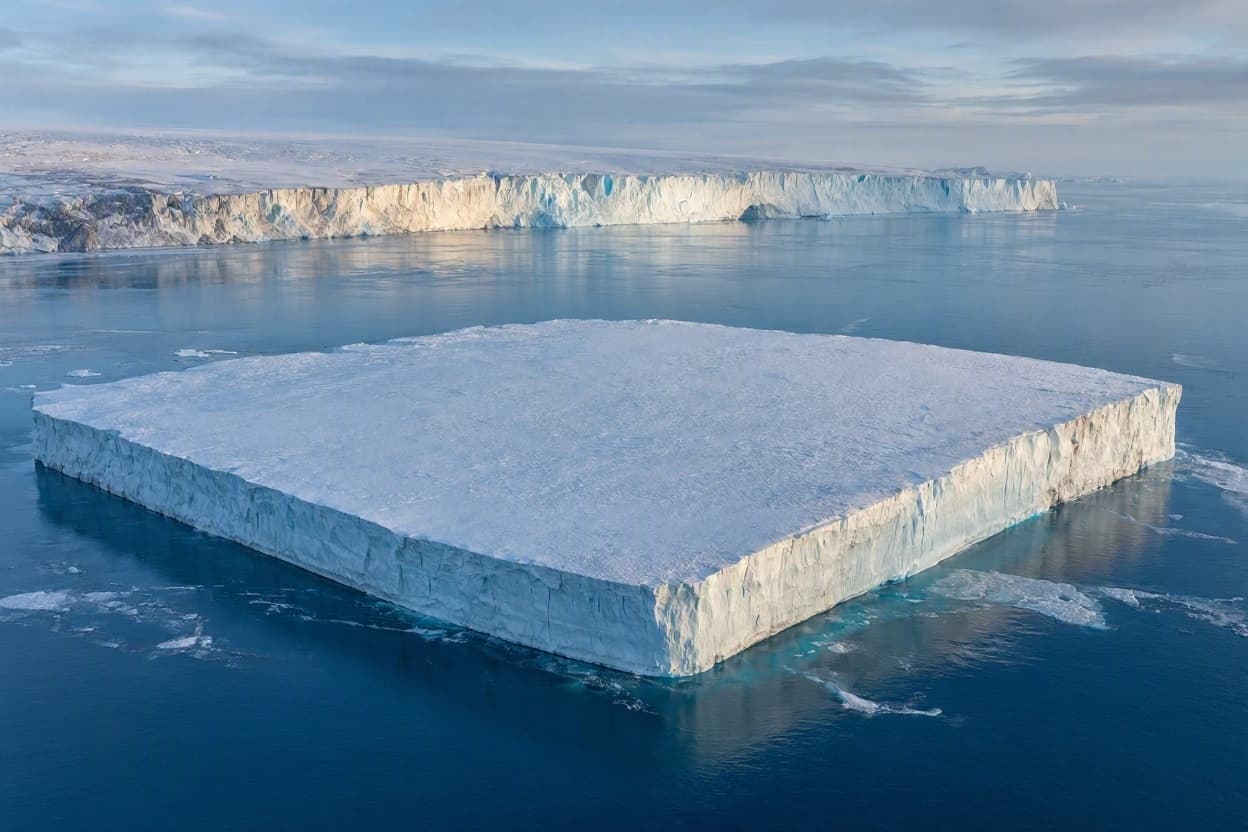
In the remote and icy reaches of northwest Greenland, the Petermann Glacier stands as a sentinel of the Arctic climate. For years, it has held back a vast reservoir of ice, flowing slowly toward the sea. Recently, however, this giant shed a piece of itself, calving an ice island roughly the size of Manhattan into the ocean. This event, while part of the natural lifecycle of glaciers, serves as a poignant indicator of the changing dynamics in the polar regions and the ongoing retreat of the Earth’s frozen frontiers.
The calving of such a massive iceberg is a dramatic spectacle, captured by satellites and observed by researchers monitoring the region. The ice island, covering hundreds of square kilometers, drifted away from the glacier’s terminus, joining the flotilla of ice that navigates the Arctic waters. While large calving events are not uncommon for Petermann, which has experienced significant breaks in recent decades, each occurrence adds to the growing body of evidence regarding glacial instability.
Scientists study these events to understand the mechanisms driving ice loss. Warmer ocean waters undercut the glacier’s floating tongue, weakening its structure and making it prone to breaking. Atmospheric warming also plays a role, melting the surface and creating cracks that propagate through the ice. The combination of these factors accelerates the flow of ice from the interior of Greenland into the ocean, contributing to global sea-level rise.
The Petermann Glacier is one of the largest in Greenland, holding enough ice to raise sea levels significantly if it were to melt completely. While the current calving event does not represent an immediate catastrophe, it is a piece of a larger puzzle. Each iceberg that breaks off reduces the buffer that holds back the inland ice sheet, potentially leading to faster discharge in the future. Monitoring these changes is crucial for predicting long-term climate impacts.
Local communities and marine ecosystems are also affected by such events. Icebergs can alter shipping routes and pose hazards to navigation. They also influence local ocean currents and salinity levels as they melt, impacting marine life. For the indigenous peoples of the Arctic, these changes are not abstract data points but tangible shifts in their environment, affecting hunting, fishing, and travel.
The visual magnitude of the ice island captures the public imagination, serving as a powerful symbol of climate change. Images of the massive block of ice drifting in the open water remind us of the scale of the Earth’s cryosphere and its vulnerability. It is a reminder that the poles are not distant, isolated regions but integral components of the global climate system.
Research continues to track the movement and melting of the ice island. Satellites provide real-time data on its trajectory, helping scientists model its lifespan and impact. Understanding how these large ice masses behave helps refine climate models, improving our ability to forecast future sea-level rise and prepare coastal communities for the changes ahead.
The breakaway of the Manhattan-sized ice island from the Petermann Glacier is a significant event in the ongoing narrative of Arctic change. It underscores the urgency of addressing climate change and the importance of continued scientific monitoring. As the ice retreats, it leaves behind a story of transformation, urging humanity to listen to the warnings written in the melting snow.
AI Image Disclaimer: Please note that any accompanying visuals for this article are AI-generated representations intended for illustrative purposes only.
Sources: NASA Earth Observatory, National Snow and Ice Data Center (NSIDC), BBC News, The Guardian
Published by Banx Network. This article is part of the Banx decentralized media programme, powered by the BXE token on the XRP Ledger.