Banda Aceh, Indonesia—A magnitude 5.8 earthquake struck off the coast of Northern Sumatra on Friday, shaking coastal settlements and sending residents fleeing onto streets across several western districts.
Data registered by the Indonesian Agency for Meteorology, Climatology, and Geophysics placed the epicenter at an offshore depth along the active Sunda megathrust fault line. Seismic sensors recorded moderate-to-strong ground shaking along coastal towns, where residents reported swaying buildings and rattling fixtures shortly after the initial tremor hit.
BMKG duty seismologists immediately analyzed real-time ocean gauge data to evaluate sea-level disturbances, confirming within minutes that the earthquake did not possess the structural fault displacement required to generate a destructive tsunami along the Sumatran coastline.
"Seismic parameters confirm an offshore epicenter along the subduction zone, but sea-level monitoring indicates no tsunami threat to coastal regions," stated a BMKG senior officer during an emergency press briefing. "Field teams are coordinating with regional disaster management agencies to check for localized structural damage."
Local disaster mitigation agencies dispatched assessment teams to inspect critical public infrastructure, including bridges, hospital facilities, and coastal port terminals. First responders surveyed residential neighborhoods for cracked masonry or collapsed brick walls, particularly in older non-reinforced structures.
Port authorities temporarily paused maritime loading operations along regional docks while structural engineers conducted rapid visual inspections of crane towers and concrete piers. Ferry operators reported no disruptions to offshore transit lines, though vessel captains noted brief vibrations in shallow harbour waters during the quake.
Disaster management officials in regional command centers established communication links with district heads to compile preliminary damage reports from isolated coastal villages. Initial updates indicated no immediate reports of severe casualties or large-scale structural failures across primary population centers.
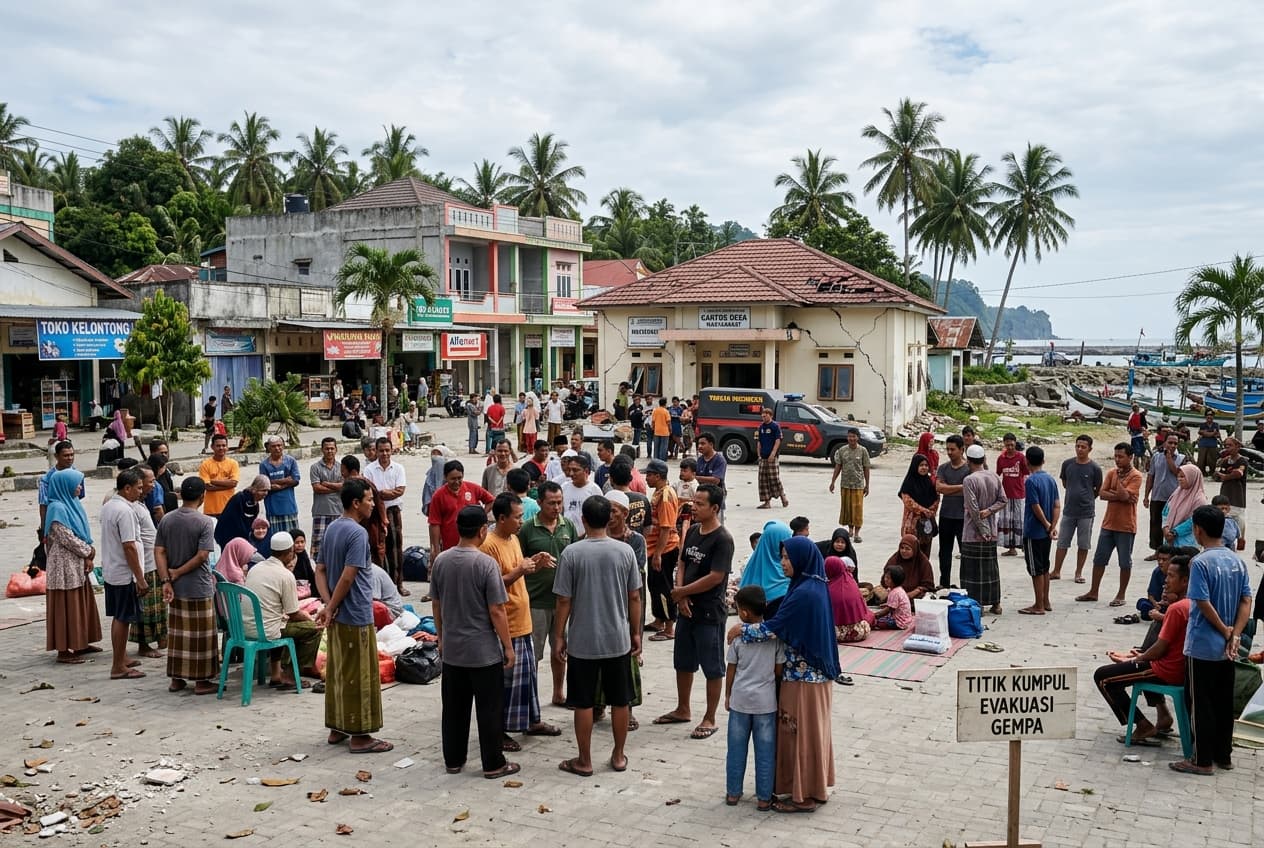
Coastal residents who evacuated multi-story buildings gathered in open fields and sports grounds for safety as minor aftershocks registered on regional seismometers. Emergency services reminded the public to remain vigilant and avoid re-entering visibly damaged buildings until safety inspections concluded.
Seismologists continue monitoring automated sensor arrays across Northern Sumatra for secondary aftershocks. Disaster response teams remain on standby at regional headquarters while structural engineers conclude field evaluations across vulnerable coastal districts.
Published by Banx Network. This article is part of the Banx decentralized media programme, powered by the BXE token on the XRP Ledger.