There is something quietly poetic about the idea that history does not hurry. It waits. It rests in drawers, in boxes, in forgotten corners of archives, patient as stone. And sometimes, after decades of silence, it returns to speak again. In Western Australia, a crocodile-like “sea-salamander” fossil has done precisely that — resurfacing half a century after being misplaced in a museum oversight, and in doing so, reshaping scientific understanding of an ancient lineage.
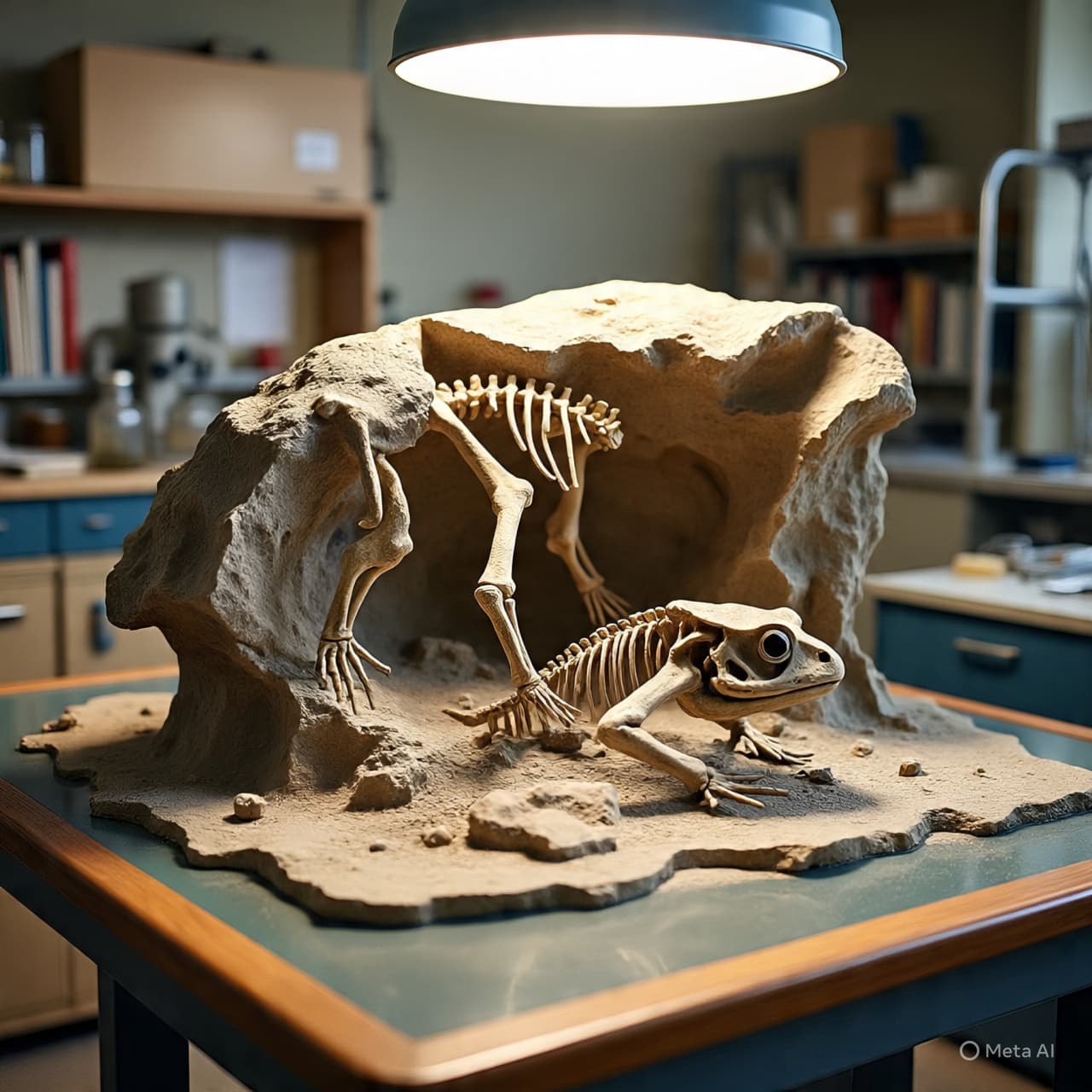
The fossil, first uncovered roughly 50 years ago, belonged to a long-extinct amphibian from the Triassic period, a time when life on Earth was rebuilding after the greatest mass extinction in planetary history. With an elongated body, strong jaws, and aquatic adaptations, this creature resembled a hybrid between a salamander and a crocodile. Its form suggested an animal well suited to rivers, lagoons, and shallow coastal waters that once stretched across the supercontinent Pangaea.
Yet for decades, this particular specimen was effectively lost — not to erosion or decay, but to human error. Misfiled or mishandled within museum collections, it slipped from active scientific scrutiny. Like many artifacts stored in institutional archives, it remained preserved but unexamined, its significance dormant.
Its rediscovery has proven more than administrative correction. Upon reanalysis, researchers determined that the fossil represents either a new species or a significantly more complete example of a rare amphibian group previously known from limited remains. Detailed study of its skull structure, jaw alignment, and vertebral features revealed anatomical distinctions that had not been fully appreciated in earlier examinations.
In paleontology, completeness matters. A single bone can hint at existence; a well-preserved skeleton can redefine relationships. The Western Australian fossil provided clearer insight into how these crocodile-like amphibians evolved and how widely they spread across ancient ecosystems. Its features suggest a creature adapted for powerful swimming, possibly ambushing prey in freshwater channels that once carved through prehistoric landscapes.
The broader implication is geographic as well as biological. Fossils of similar amphibians have been found in other parts of the world, indicating that these animals were not isolated inhabitants of a single region. The rediscovered specimen strengthens evidence that early Triassic amphibians occupied a far-reaching ecological network during a time when Earth’s continents were joined together.
There is also a humbling note within this story. Museums are often imagined as static vaults of finished knowledge, yet in reality they are dynamic spaces where interpretation evolves. Collections contain countless specimens awaiting fresh eyes, new tools, and revised questions. Advances in imaging technology, comparative anatomy, and evolutionary modeling allow today’s scientists to extract insights that may not have been possible decades ago.
The fossil’s return to relevance underscores the importance of preservation and documentation. Even when temporarily misplaced, the specimen endured. Stone is patient. Science, too, can be patient — willing to revisit old findings with renewed curiosity.
Importantly, researchers stress that further study is ongoing. Peer review and comparative analysis with related fossils will refine its classification and evolutionary placement. But even at this stage, the rediscovered amphibian offers a meaningful addition to the understanding of post-extinction recovery and early reptile-amphibian ecosystems.
In straightforward terms, the fossil — once lost in a museum administrative error — has now been formally examined and identified as a significant Triassic amphibian specimen. Its rediscovery highlights both the scientific value of museum collections and the evolving nature of paleontological research.
AI Image Disclaimer Images in this article are AI-generated illustrations, meant for concept only.
Sources
ABC News The Guardian Reuters BBC News Science Magazine
Published by Banx Network. This article is part of the Banx decentralized media programme, powered by the BXE token on the XRP Ledger.