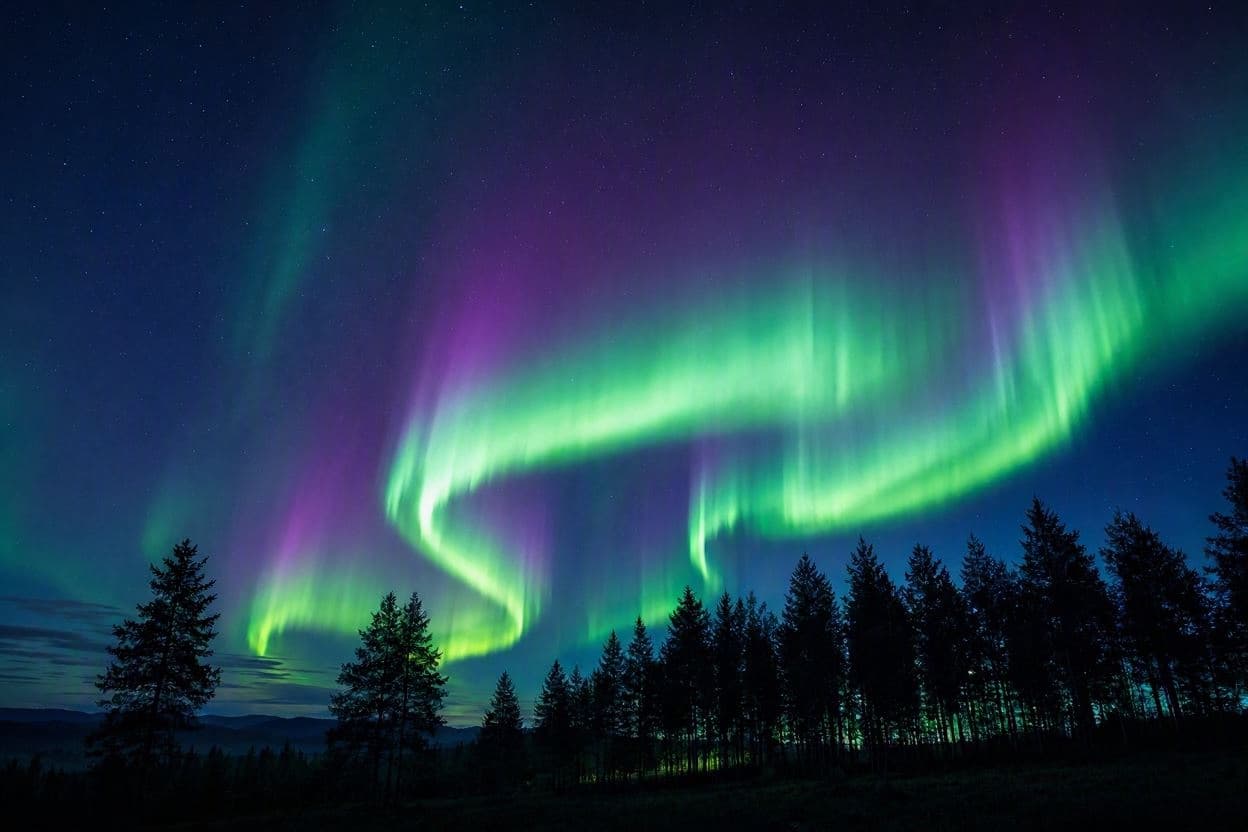
The night sky is usually a canvas of steady stars, but occasionally, it transforms into a dancing theater of light. The aurora borealis, or Northern Lights, is one of nature’s most spectacular displays, painting the heavens in hues of green, pink, and purple. Typically reserved for high latitudes, these lights have been known to travel south during periods of intense solar activity. Recent alerts suggest that the aurora may be visible in up to 20 U.S. states this Tuesday night. This rare event invites us to step outside, look up, and marvel at the dynamic connection between our planet and the Sun.
The aurora is caused by charged particles from the Sun interacting with Earth’s magnetic field. When solar storms are particularly strong, these particles penetrate deeper into the atmosphere, exciting oxygen and nitrogen atoms and causing them to emit light. The current forecast indicates a significant geomagnetic storm, which could push the auroral oval far south of its usual range. This phenomenon is a reminder of the powerful forces at play in our solar system.
For residents in states that rarely see the Northern Lights, this is a unique opportunity. Places as far south as Alabama and California may have a chance to witness the display, weather permitting. Clear skies and minimal light pollution are essential for the best viewing experience. Experts recommend finding a dark location away from city lights and looking north. Patience is key, as the lights can appear suddenly and fade quickly.
The visibility of the aurora depends on the strength of the solar wind and the orientation of the magnetic field. Scientists monitor these factors closely, issuing alerts to help people prepare. While predictions are not always exact, the current models suggest a high probability of visibility. This uncertainty adds to the excitement, making the potential sighting feel like a special gift from nature.
Photographers and stargazers are already preparing their equipment. Capturing the aurora requires long exposures and careful settings, but the results can be breathtaking. Social media often fills with images of these events, creating a shared sense of wonder across the country. Even those who do not see the lights directly can enjoy the experience through the eyes of others.
Beyond its beauty, the aurora serves as a visible indicator of space weather. Strong geomagnetic storms can affect satellite operations, power grids, and communication systems. By observing the lights, we are reminded of the vulnerability of our technological infrastructure to solar activity. It underscores the importance of monitoring and understanding space weather.
For many, watching the aurora is a spiritual or meditative experience. The silent dance of light evokes a sense of awe and humility. It connects us to the larger cosmos, reminding us that we live on a planet protected by a magnetic shield. This perspective can be grounding in a fast-paced world.
As Tuesday night approaches, communities are sharing tips and locations for optimal viewing. Local astronomy clubs may organize gatherings, fostering a sense of community. Whether seen from a backyard or a remote park, the aurora brings people together under the same sky. It is a moment of collective appreciation for natural beauty.
The Northern Lights may be visible in 20 states this Tuesday night due to strong solar activity. It offers a rare chance to witness a stunning natural phenomenon. Let us look up and enjoy the show.
AI Image Disclaimer: Please be aware that images used in this context are AI-generated visualizations for illustrative purposes.
Sources: NOAA Space Weather Prediction Center NASA Live Science
Published by Banx Network. This article is part of the Banx decentralized media programme, powered by the BXE token on the XRP Ledger.