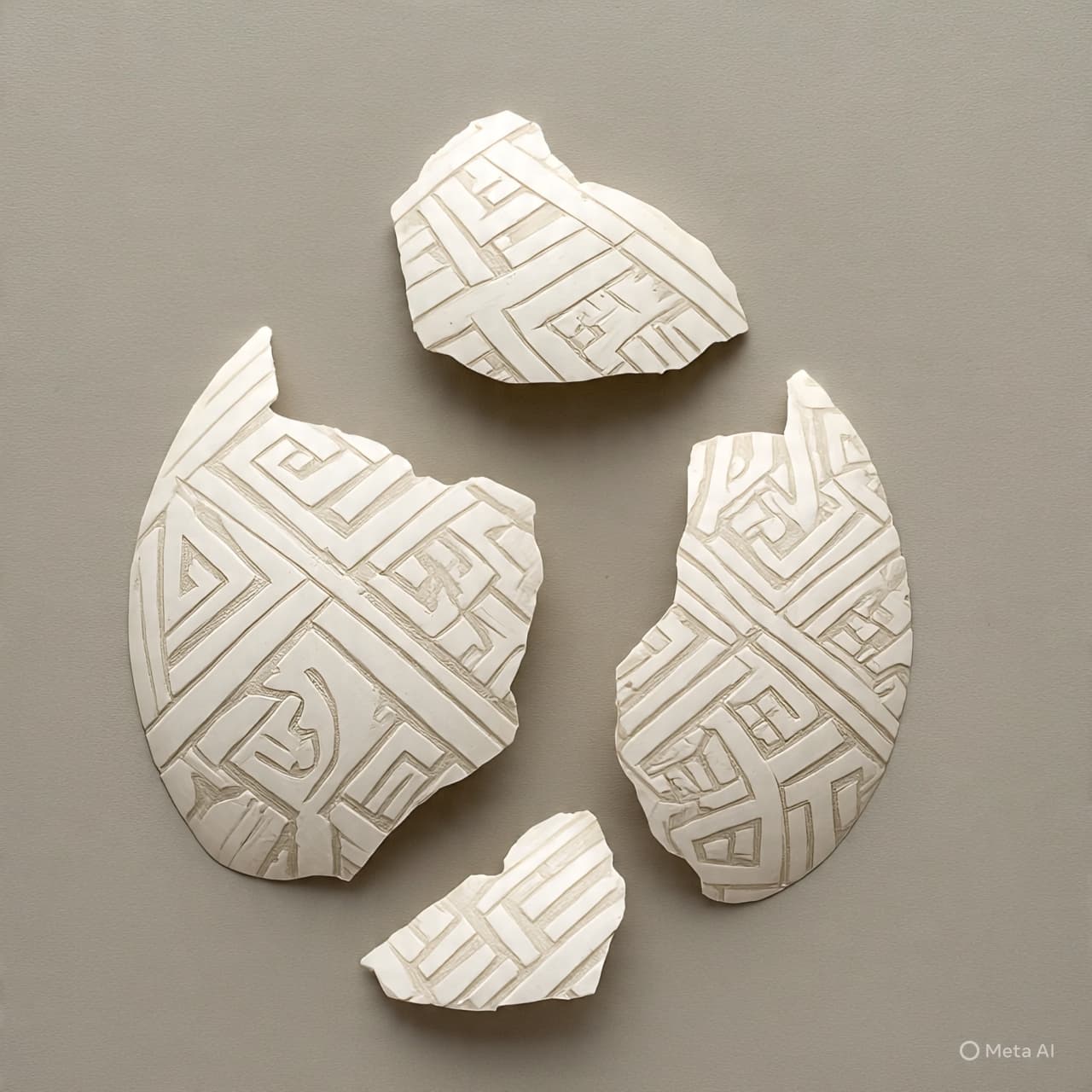
In the dry light of southern Africa, where wind moves softly across open scrubland and horizons stretch without interruption, fragments of the distant past rest quietly in museum drawers and excavation trays. They are small, curved pieces of ostrich eggshell — pale, brittle, easily overlooked. Yet etched upon them are lines that may represent some of humanity’s oldest known geometries.
Tens of thousands of years ago, long before cities, before written language, before metal, people engraved deliberate patterns into ostrich eggs. The fragments, discovered at sites such as Diepkloof Rock Shelter, date back roughly 60,000 years to the Middle Stone Age. On their surfaces, archaeologists have identified repeated motifs: cross-hatched bands, parallel lines, carefully spaced markings that form rhythmic designs.
These were not random scratches. Microscopic analysis shows the engravings were made intentionally, often before the eggs were broken, suggesting they decorated intact shells. At the time, ostrich eggs served a practical purpose. Their thick shells were used as durable water containers, essential for survival in arid environments. Small perforations allowed them to be filled and sealed. The geometric patterns may have marked ownership, signaled group identity, or carried symbolic meaning now lost to time.
What is striking is the consistency. Across multiple layers of sediment and generations of habitation, similar motifs reappear. The repetition hints at shared conventions — visual languages passed down within communities. Geometry, in this context, becomes not abstraction but communication.
The findings from Diepkloof and comparable sites such as Blombos Cave have reshaped discussions about early human cognition. Once, symbolic behavior was thought to emerge much later in prehistory, tied to the rise of cave paintings in Europe. But these engraved eggshells, along with ochre pieces bearing etched patterns, suggest that abstract thinking and symbolic expression were already well established among Homo sapiens in Africa tens of thousands of years earlier.
The designs themselves are simple — intersecting lines, repeating bands, structured spacing — yet simplicity does not imply simplicity of mind. To conceive of a pattern, to repeat it with intention, and to maintain stylistic continuity across time requires memory, teaching, and shared meaning. In those etched lines, scholars see evidence of social networks and cultural transmission.
There is also an intimacy to the medium. An ostrich egg fits within two hands. Its surface curves gently, inviting touch. The act of engraving would have required patience and care, perhaps performed around a hearth or during communal preparation of supplies. The resulting container would travel with its owner across landscapes of sand and grass, a small vessel carrying both water and identity.
Archaeological science continues to refine the dating of these artifacts through techniques such as optically stimulated luminescence and radiocarbon analysis of associated materials. Each layer of sediment adds precision to the timeline, anchoring the engravings firmly within the Middle Stone Age.
Today, the fragments sit far from the hands that once held them. Under laboratory lights, their faint lines remain visible — human marks on a natural curve. They remind us that geometry did not begin in textbooks or temples, but in lived experience. It arose from the instinct to order, to signify, to leave a trace.
In the long arc of human creativity, these ostrich eggshell engravings are quiet yet profound. They suggest that even in deep prehistory, people saw more than utility in the objects around them. They saw pattern. They saw meaning.
And in scratching lines onto fragile shells, they inscribed one of the earliest chapters in the story of abstract thought — a geometry born not of stone monuments, but of everyday survival beneath open skies.
Published by Banx Network. This article is part of the Banx decentralized media programme, powered by the BXE token on the XRP Ledger.