FULL ARTICLE There is a certain poetry in darkness softened by a quiet glow — that moment when night shelters its secrets and a gentle light dares to dance upon them. On Mars, where the sun’s fire is distant and the wind whispers through ancient valleys, a mechanical wanderer reached into the twilight and, with a small yet purposeful beam, invited us to behold what had long been hidden in shadow.
In an unusual maneuver for one of humanity’s most seasoned explorers, NASA’s Curiosity rover activated its built‑in LED lights at night to illuminate a recently drilled patch of Martian rock called Nevado Sajama. These tiny but steadfast lights, part of the rover’s Mars Hand Lens Imager, served as an artificial dawn against the deepening Martian dark. Used more commonly in daylight to peer into pits and shadows, the LEDs here became a kind of lantern — a human‑devised glow that brought into focus textures, grains, and contrasts on the fractured rock face that the fading sun could not reveal.
For much of Curiosity’s long mission across Gale Crater, scientists and engineers have relied on the steady arc of the sun to paint the landscape in natural light, lending context to soil and mineral studies. But night, long a quiet companion on Mars, held parts of the rover’s world in a visual hush. By artificially lighting the drill site with precision, researchers gained a rare opportunity to study how light and dark interplay on surfaces otherwise lost to the night. The result is not dramatic fireworks but subtle revelations: smoother walls inside the drilled circle, new contrast in mineral surfaces, and a refined glimpse at the geology that Mars has patiently shaped over eons.
This quiet experiment reconnects us with a simple truth about exploration — that sometimes, it is not the brightest sunlight but careful observation in shadow that teaches us most. The rover’s gentle beacon has offered scientists a chance to see familiar terrain in a fresh way, and to consider how even the smallest innovations can lift the veil on distant worlds. As Curiosity continues its long vigil beneath the phantom glow of Martian skies, it reminds us that discovery is not always about monumental leaps but often about patient light falling where we least expect.
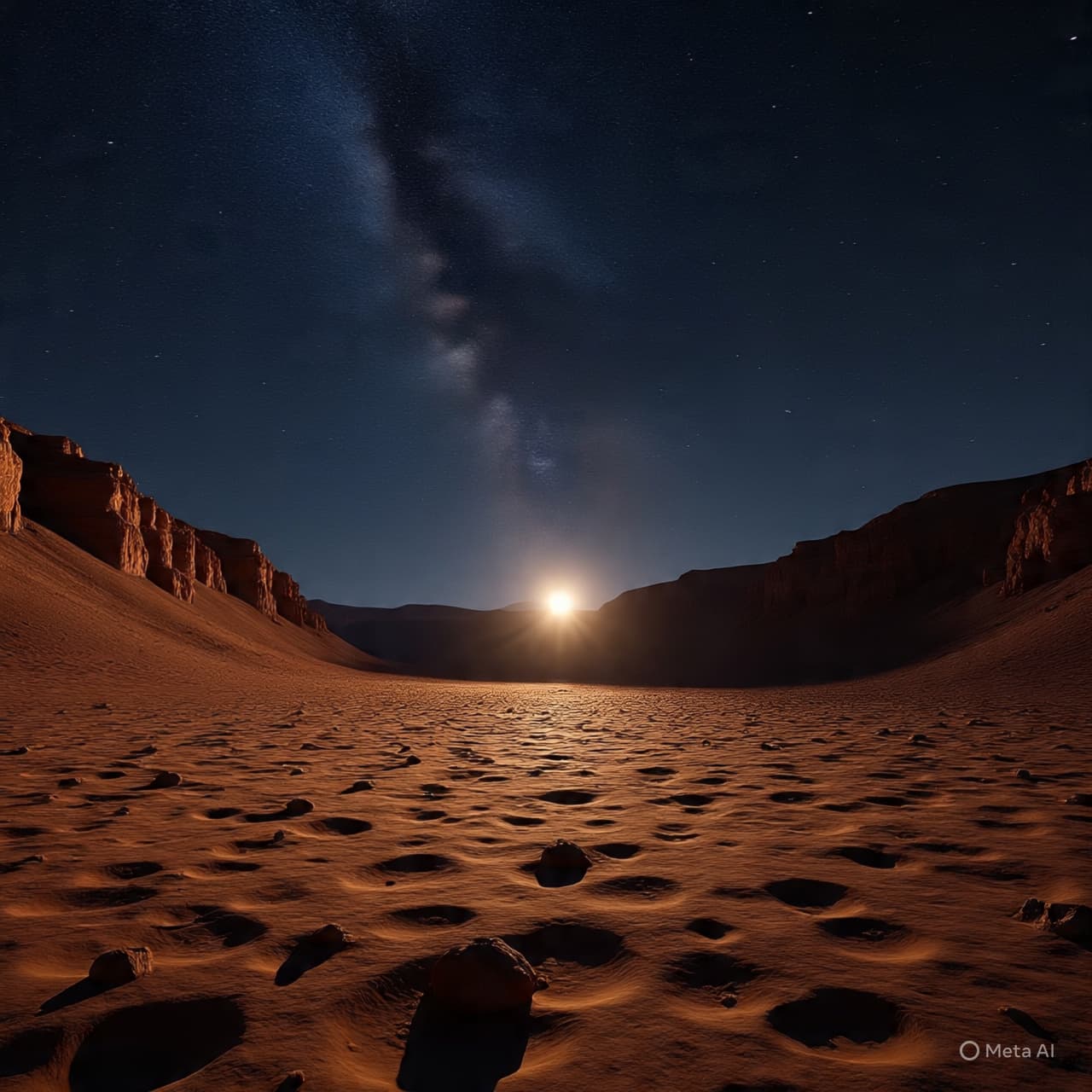
AI Image Disclaimer Visuals are created with AI tools and are not real photographs.
Sources (Credible Mainstream/Niche) Daily Galaxy – coverage of Curiosity rover lighting up Mars at night (based on NASA release)
Published by Banx Network. This article is part of the Banx decentralized media programme, powered by the BXE token on the XRP Ledger.