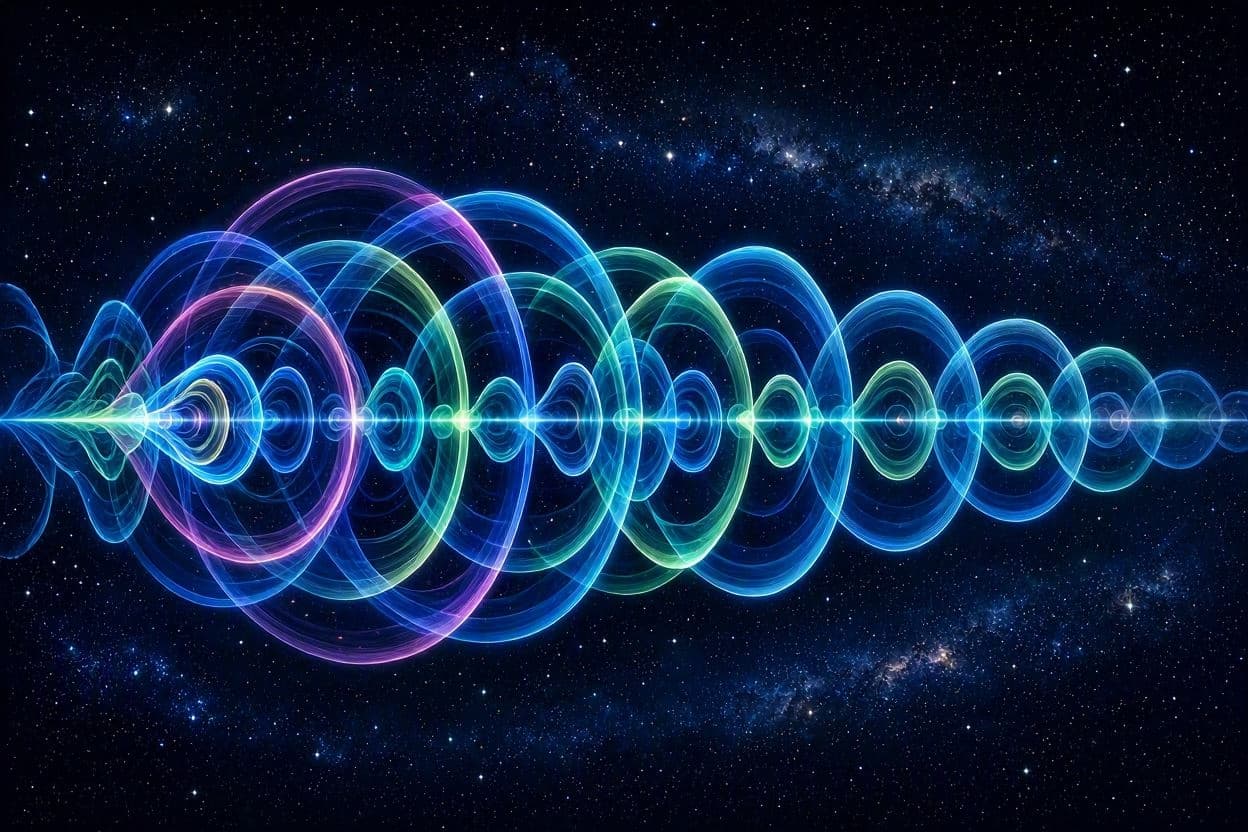
In the vast silence of the cosmos, there are sudden, fleeting whispers that travel across billions of light-years. These are fast radio bursts (FRBs), intense flashes of radio waves that last only a millisecond yet release as much energy as the Sun does in days. For years, they were enigmatic signals with no clear source, but recent discoveries suggest they may hold the key to unlocking some of the universe’s deepest secrets, from the distribution of matter to the nature of gravity itself.
Astronomers have recently detected the brightest FRB ever recorded, originating from a nearby galaxy. This powerful signal, along with others traced to distant epochs of cosmic history, provides a new tool for mapping the invisible structure of the universe. As these waves travel through space, they interact with the sparse gas and plasma that fill the void between galaxies. By analyzing how the signals are distorted or delayed, scientists can measure the amount of matter they encountered, effectively weighing the unseen components of the cosmos.
One of the most significant applications of FRBs is their potential to resolve the "missing baryon problem." While we know how much ordinary matter should exist in the universe based on early cosmic measurements, only about half of it has been accounted for in stars and gas clouds. FRBs act as cosmic flashlights, illuminating the diffuse web of hot gas that connects galaxies. Each burst adds a data point to this grand map, helping researchers locate the missing mass that has eluded detection for decades.
Furthermore, the study of FRBs offers insights into the extreme environments where they originate. Many bursts are linked to magnetars, neutron stars with incredibly strong magnetic fields. Observing these events allows physicists to test the limits of matter and magnetism under conditions that cannot be replicated on Earth. The variability in burst patterns—some repeating, others singular—suggests a diversity of mechanisms at play, inviting a deeper exploration of stellar evolution and death.
The technological advancements enabling these discoveries are equally remarkable. New radio telescopes and arrays, such as CHIME and MeerKAT, are scanning the sky with unprecedented sensitivity and speed. These instruments capture thousands of bursts, creating a rich dataset that was unimaginable just a few years ago. The sheer volume of data allows for statistical analyses that reveal trends and correlations, turning isolated anomalies into a coherent scientific narrative.
Experts describe this era as merely the beginning. As more sensitive instruments come online, the number of detected FRBs is expected to grow exponentially. This influx of information will refine our models of cosmic expansion and dark energy. It may even help test fundamental theories of physics, such as general relativity, by observing how gravity affects the propagation of these signals over vast distances.
For the public, the mystery of FRBs captures the imagination, reminding us that the universe is still full of surprises. These brief flashes connect us to the most energetic events in existence, bridging the gap between human curiosity and cosmic reality. They serve as a testament to the power of observation and the enduring quest to understand our place in the cosmos.
As research continues, the story of fast radio bursts evolves from one of confusion to clarity. Each detection brings us closer to a comprehensive understanding of the universe’s structure and history. It is a journey of discovery that promises to reshape our knowledge of the cosmos, one millisecond at a time.
AI Image Disclaimer: The visual elements accompanying this article are AI-generated interpretations designed to illustrate the concepts of radio waves and cosmic phenomena, without depicting specific real-world telescope data or actual burst locations.
Sources: CNN, Caltech, Nature Astronomy, SciTech Daily
Published by Banx Network. This article is part of the Banx decentralized media programme, powered by the BXE token on the XRP Ledger.