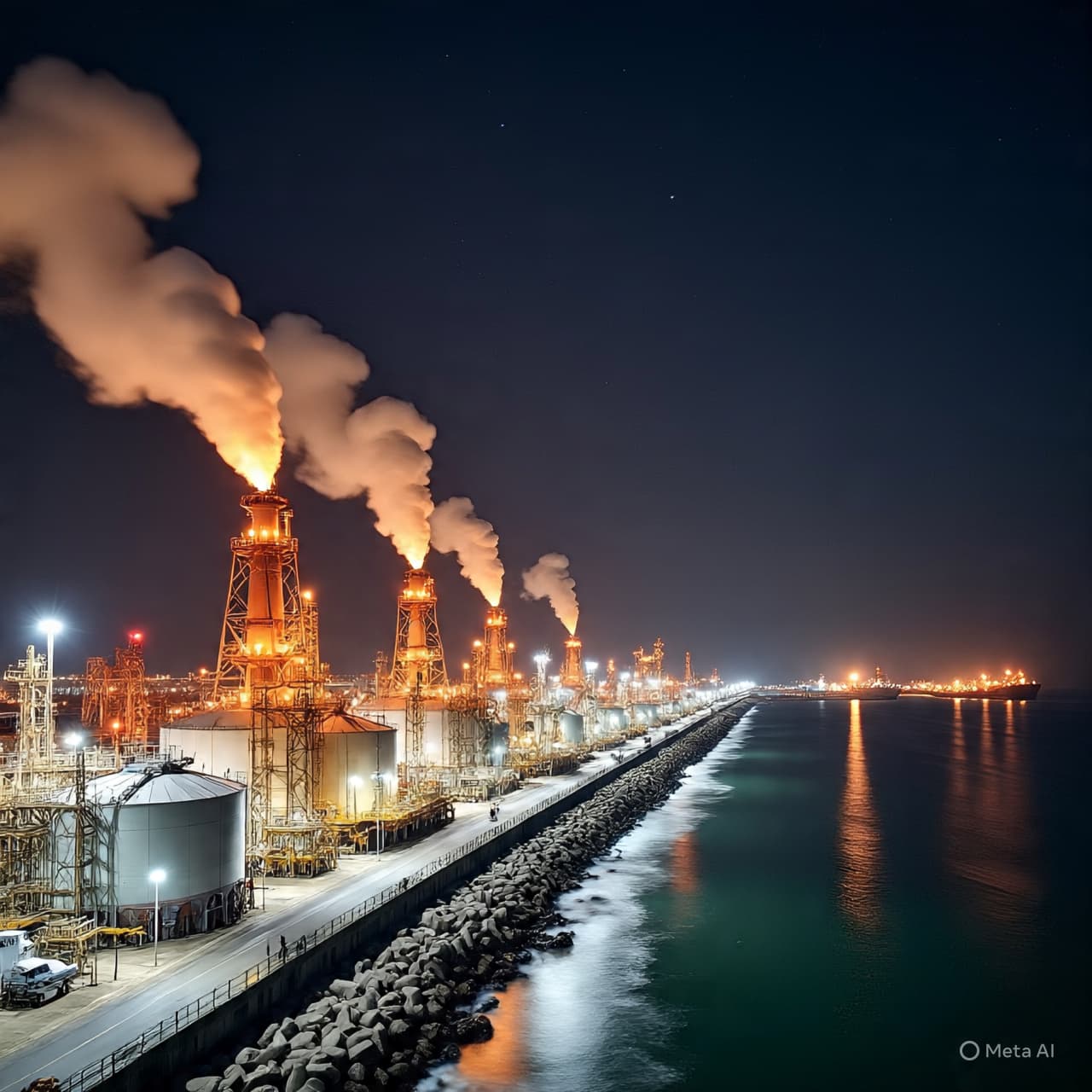
There are nights when the horizon does not simply fade into darkness, but flickers—briefly, unevenly—as if something distant has chosen to speak in light instead of silence. Along the Baltic coast, where industry meets the restless edge of the sea, such flickers have begun to draw attention again, appearing not as passing anomalies but as signals that something beneath the surface may be shifting.
Recent satellite images and circulating footage suggest that fires have once again broken out at key Russian oil port facilities along the Baltic Sea. These ports, vital corridors for energy exports, have long operated as steady gateways between inland production and global markets. Now, they appear marked by intermittent blazes—episodes that, while not entirely unprecedented, have begun to form a pattern difficult to overlook.
Though details remain measured and, at times, incomplete, reports indicate that at least two significant sites have been affected. Among them are facilities near Ust-Luga and Primorsk, both central to Russia’s oil export infrastructure. Flames and smoke captured from above suggest localized fires, with emergency responses initiated shortly after detection.
The causes, however, remain less clearly defined. Russian officials have, in past incidents, attributed similar events to technical malfunctions or operational hazards—risks not uncommon in large-scale energy facilities. Yet, in the current geopolitical climate, such explanations are often received alongside quieter speculation. Some observers have raised the possibility of external interference, including drone-related activity, though no definitive confirmation has been offered in these latest cases.
In a landscape already shaped by the ongoing tensions of the Russia-Ukraine War, even isolated disruptions can carry broader implications. Oil ports along the Baltic are not merely industrial sites; they are nodes within a larger network that connects supply chains, economies, and strategic considerations. When interruptions occur—whether brief or prolonged—they echo outward, touching markets and drawing the attention of those watching from afar.
For nearby communities and workers, the experience is more immediate. Emergency crews move with practiced coordination, addressing flames, securing perimeters, and working to ensure that damage remains contained. Operations, where possible, continue in adjusted form, reflecting an effort to balance continuity with caution.
At the same time, the recurrence of such incidents introduces a quiet question about resilience. How often can disruptions be absorbed before they begin to alter expectations? And how do institutions respond when patterns, once considered irregular, start to feel more familiar?
International observers continue to monitor developments, relying on satellite imagery, official statements, and fragmented reports to piece together a clearer understanding. Markets, too, respond with subtle shifts, attentive to any sign that supply routes might be affected, even temporarily.
For now, the fires appear to be under control, with no widespread damage reported beyond the immediate sites. Investigations are expected to follow, as authorities seek to determine the causes and assess any broader risks.
The Baltic coast returns, gradually, to its usual rhythm—ships moving, waters steady, lights dimming back into the night. Yet the memory of those brief, bright interruptions lingers, not as alarm, but as a reminder that even in the most established systems, moments of uncertainty can still find their way to the surface.
AI Image Disclaimer Graphics are AI-generated and intended for representation, not reality.
Source Check (Credible Media Identified):
Reuters BBC News The Guardian Al Jazeera Bloomberg
Published by Banx Network. This article is part of the Banx decentralized media programme, powered by the BXE token on the XRP Ledger.