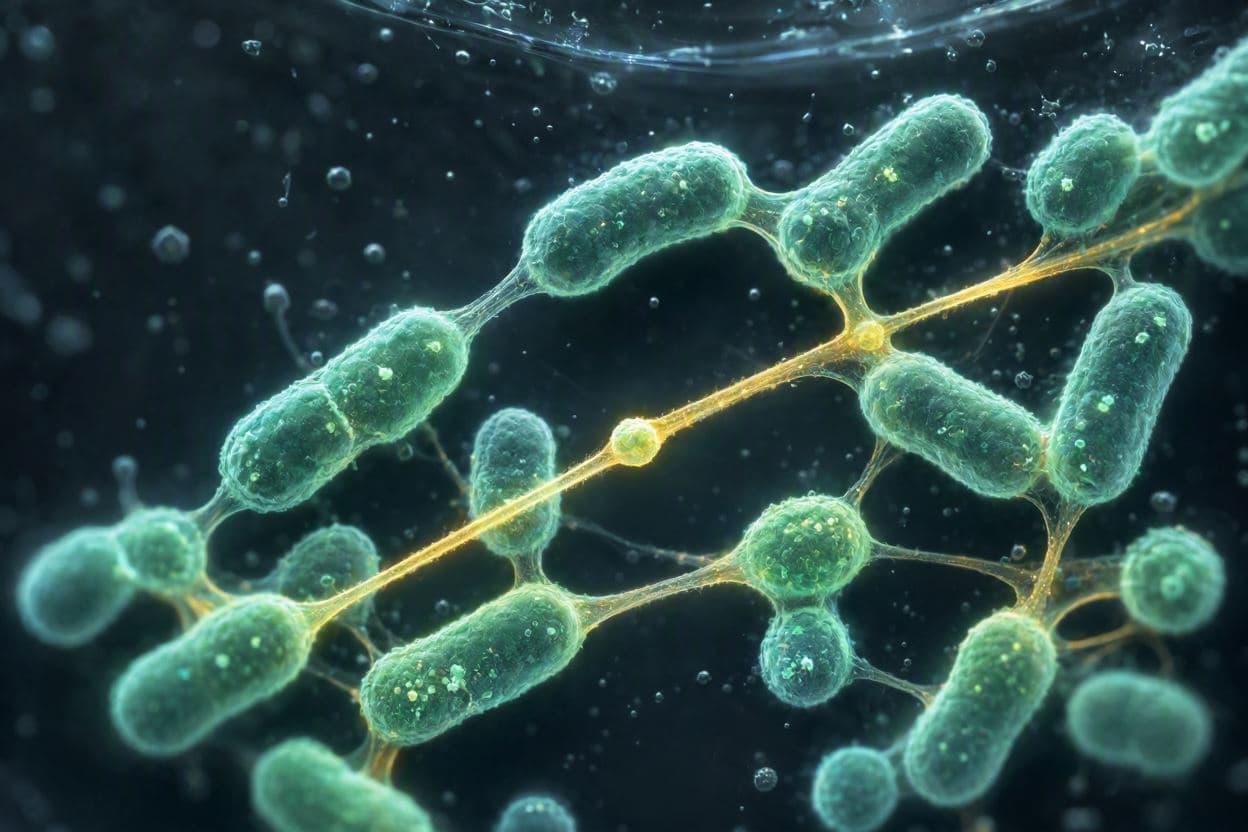
In the microscopic realm, where life first stirred in the primordial soup, there existed a sophistication that rivals our own social complexities. We often think of communication as a uniquely human trait, defined by language and gesture, but recent studies suggest that the roots of connection run much deeper. Ancient bacteria, the earliest architects of life on Earth, possessed structures for intercellular communication that mirror the intricate networks found in human tissues today, revealing a shared heritage of connectivity.
The discovery focuses on nanotubes, tiny bridges that allow cells to exchange materials and signals. While these structures have been well-documented in modern human cells, finding similar mechanisms in ancient bacterial lineages suggests that this form of communication is an evolutionary ancient trait. It implies that the ability to share resources and information was crucial for survival from the very beginning of life.
These bacterial nanotubes function similarly to gap junctions in human cells, allowing for the direct transfer of ions, molecules, and even electrical signals. This finding blurs the line between simple single-celled organisms and complex multicellular life, suggesting that the blueprint for cooperation was established billions of years ago. It challenges the view of bacteria as solitary entities, portraying them instead as social beings capable of collective behavior.
The evolutionary implications are profound. If ancient bacteria could communicate in this way, it suggests that the transition to multicellularity was not a sudden leap but a gradual enhancement of existing communicative abilities. The structures used by our cells today may be refined versions of those first developed by our microbial ancestors, highlighting a continuous thread of biological innovation.
This research also sheds light on the resilience of early life. In harsh primordial environments, the ability to share nutrients and warning signals would have provided a significant survival advantage. Communities of bacteria could act as a unified front, resisting stressors that would have overwhelmed individual cells, paving the way for more complex life forms to emerge.
Furthermore, understanding these ancient communication pathways offers new insights into human health. Many diseases, including cancer and neurodegenerative disorders, involve disruptions in cell-to-cell communication. By studying the primitive versions of these structures in bacteria, scientists may uncover fundamental principles that apply to human physiology, potentially leading to new therapeutic approaches.
The study also invites a philosophical reflection on the nature of individuality. If even the simplest life forms are interconnected through physical bridges, then the concept of the isolated individual is an illusion. Life, from its earliest moments, has been a collaborative endeavor, dependent on the flow of information and resources between entities.
As we continue to explore the microscopic world, we find that the boundaries between species and eras are more porous than we imagined. The legacy of ancient bacteria lives on in our own cells, reminding us that we are part of a vast, interconnected web of life that spans billions of years.
The revelation that ancient bacteria possessed human-like communication structures underscores the deep evolutionary roots of connectivity. It highlights the importance of cooperation in the history of life and offers new avenues for medical research. By looking back to the origins of life, we gain a clearer understanding of the mechanisms that sustain us today.
AI Image Disclaimer: Visuals for this article are AI-generated representations designed to illustrate the concept of bacterial nanotubes and cellular communication.
Sources: Cell Nature Microbiology Science Daily
Published by Banx Network. This article is part of the Banx decentralized media programme, powered by the BXE token on the XRP Ledger.