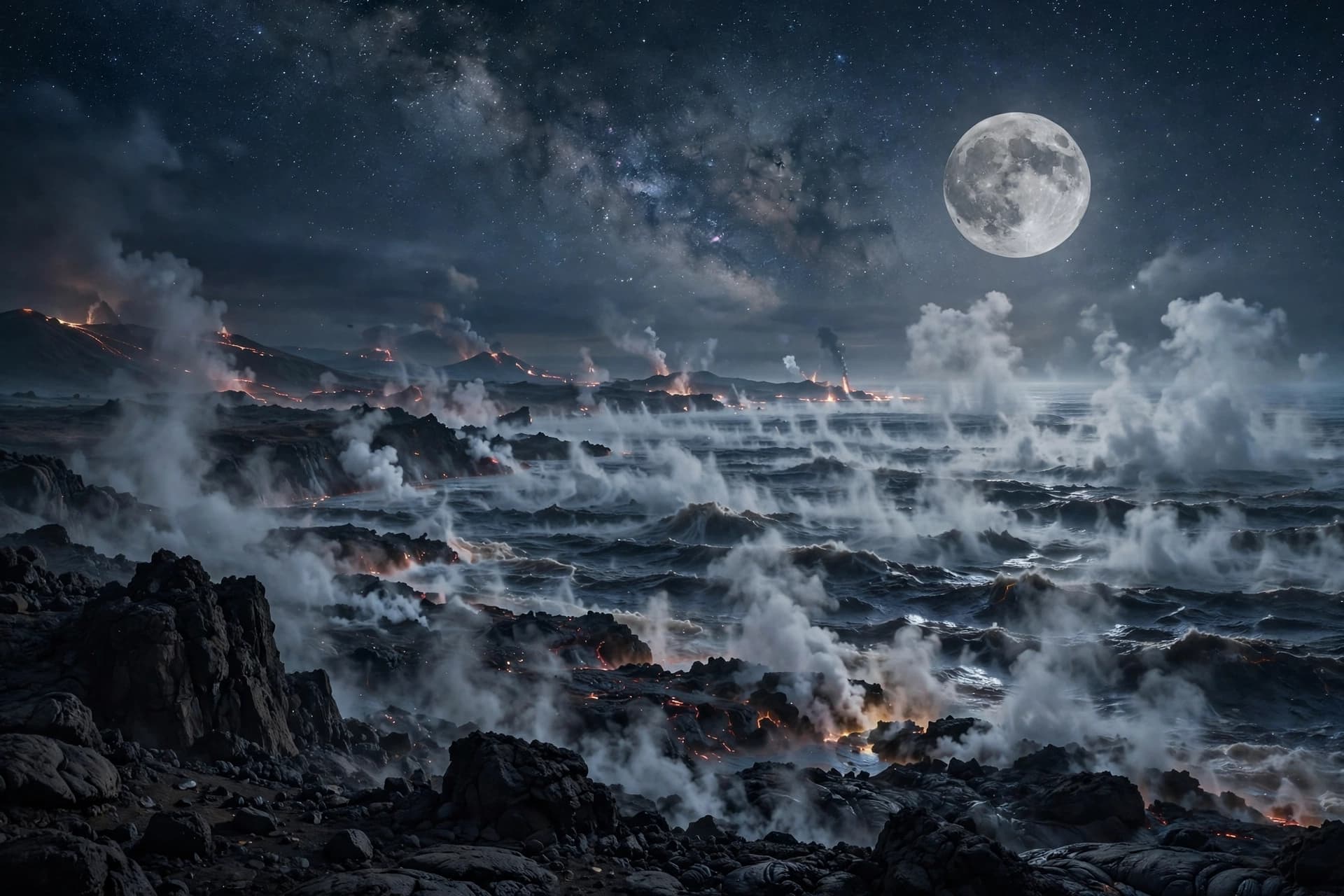
In the deep recesses of geological time, long before the first single-celled organisms emerged, the Earth was undergoing a transformation that would set the stage for life. Recent research suggests that the planet may have reached optimal conditions for the chemistry of life—specifically the "RNA world"—as early as 4.33 billion years ago. This finding pushes back the timeline for when Earth became habitable, offering a new perspective on the origins of life and the resilience of our planet in its earliest, most turbulent eons.
The study, published in Nature Communications, uses sophisticated modeling to reconstruct the environmental conditions of the Hadean eon. By analyzing the stability of RNA molecules under various temperatures, pH levels, and chemical concentrations, researchers identified a "sweet spot" where prebiotic chemistry could thrive. This window of opportunity appears to have opened shortly after the Moon-forming impact, a cataclysmic event that once thought to have sterilized the planet. Instead, the cooling crust and forming oceans may have created niches where organic molecules could assemble and persist.
The RNA world hypothesis posits that before DNA and proteins, self-replicating RNA molecules served as both genetic material and catalysts for chemical reactions. For this system to emerge, the environment needed to be stable enough to prevent the rapid degradation of these fragile molecules. The new model suggests that by 4.33 billion years ago, Earth’s surface had cooled sufficiently, and liquid water was abundant, providing the necessary medium for these chemical processes. This challenges the traditional view that life could not have begun until after the heavy bombardment period ended around 3.8 billion years ago.
Evidence from ancient zircon crystals supports the idea of early liquid water and a solid crust. These tiny minerals, some of the oldest materials on Earth, contain isotopic signatures that suggest the presence of oceans and possibly even continental landmasses in the Hadean. While direct fossil evidence of life from this period is lacking, the chemical groundwork appears to have been laid much earlier than previously assumed. The convergence of geological data and chemical modeling paints a picture of a planet ready for life sooner than expected.
This earlier timeline has implications for the search for life beyond Earth. If life’s chemistry can establish itself quickly under the right conditions, then other planets with similar early histories may also be promising candidates for habitability. The resilience of prebiotic chemistry in the face of early Earth’s volatility suggests that life may be a robust outcome of planetary evolution, rather than a rare accident. It encourages astronomers to look for signs of life on exoplanets that are younger or more geologically active than Earth.
The study also highlights the importance of interdisciplinary research in understanding origins. By combining insights from geochemistry, molecular biology, and planetary science, researchers can build more accurate models of early Earth. This holistic approach allows for a deeper understanding of the constraints and opportunities that shaped the emergence of life. It reminds us that the story of life is written in both rocks and molecules.
As scientists continue to refine these models, they will look for additional evidence from ancient rock formations and meteorites. Each new discovery adds a piece to the puzzle, helping to clarify the sequence of events that led from simple chemicals to complex biological systems. The date of 4.33 billion years ago may shift as more data becomes available, but the trend toward an earlier origin is gaining momentum.
The suggestion that Earth gained optimal conditions for life’s chemistry 4.33 billion years ago expands our view of the planet’s early history. It invites us to imagine a world where the seeds of life were sown in the aftermath of cosmic chaos. As research continues, this earlier timeline may reshape our understanding of when and how life began, both on Earth and elsewhere in the universe.
AI Image Disclaimer: The visuals accompanying this article are AI-generated illustrations designed to evoke the primordial Earth and the concept of early chemical evolution, not actual representations of historical events.
Sources: Phys.org, Live Science, Nature Communications, Gizmodo
Published by Banx Network. This article is part of the Banx decentralized media programme, powered by the BXE token on the XRP Ledger.