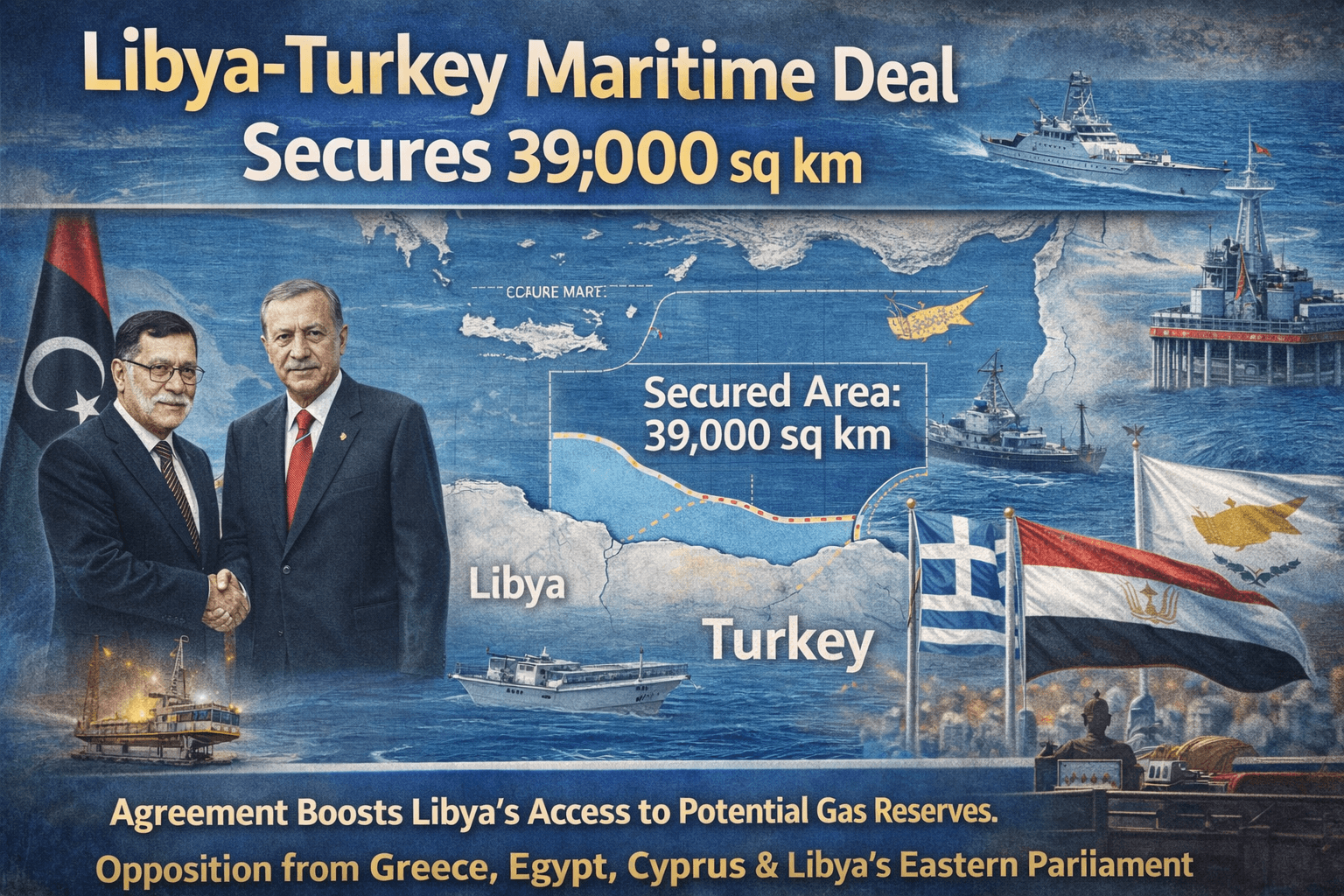
Tripoli, Libya — A long disputed maritime boundary agreement between Libya and Turkey has been highlighted for securing an area of about 39,000 square kilometers of maritime space for Libya, according to retired Turkish Admiral Cihat Yaycı, the architect of the pact. He said the deal clearly defines Libya’s maritime rights and prevents other states from claiming the area, which he asserts contains valuable natural gas reserves.
The 2019 Memorandum of Understanding (MoU) on maritime boundary delimitation was signed by the internationally recognised Government of National Accord (GNA) and Turkey, and later registered with the United Nations. It establishes zones in the Eastern Mediterranean that both countries say reflect their rights under international maritime law.
However, regional opposition has been vocal. Greece, Egypt, and Cyprus reject the claims that the memorandum is legally valid, arguing it violates the UN Convention on the Law of the Sea (UNCLOS) by ignoring the maritime rights of nearby islands such as Crete. They describe the deal as illegal and void, insisting it cannot override their own exclusive economic zones and continental shelf rights.
Internally in Libya, political divisions persist: the eastern based House of Representatives has declared the agreement “null and void” due to lack of parliamentary ratification, even as Turkish and Libyan officials continue diplomatic engagement on maritime cooperation.
The dispute underscores ongoing geopolitical tensions in the Eastern Mediterranean over offshore energy resources and competing maritime claims, with the Libya Turkey deal at the center of broader questions about sovereignty, resource rights, and international law.
Published by Banx Network. This article is part of the Banx decentralized media programme, powered by the BXE token on the XRP Ledger.