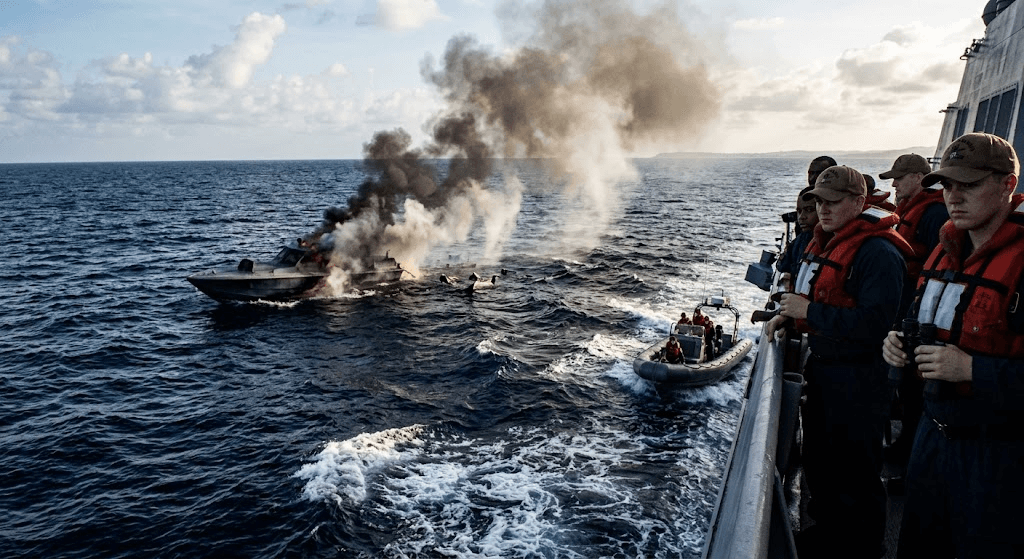
WASHINGTON — In a sharp escalation of maritime counter-narcotics operations, U.S. Southern Command (SOUTHCOM) confirmed that a lethal military strike destroyed a fast-moving vessel in international waters, leaving three individuals dead.
The engagement unfolded in the early hours along established maritime transit corridors frequently used by transnational organized crime syndicates. According to statement released by defense officials, Joint Task Force surveillance assets tracked the suspected "go-fast" boat after receiving actionable intelligence that the vessel was actively transporting large quantities of illicit narcotics bound for North America.
After the vessel repeatedly ignored warnings to halt in international territory, U.S. forces executed a kinetic strike to disable the craft. Visual surveillance confirmed the vessel was completely destroyed during the engagement, and subsequent search-and-recovery operations confirmed three fatalities aboard.
"Our assets maintain constant vigilance over critical maritime choke points," said a spokesperson for U.S. Southern Command. "This operation underscores our absolute commitment to disrupting cartels and neutralizing narco-terrorist networks before their dangerous payloads reach our shores."
The deadly interception marks one of the most direct military actions taken in the region in recent months as Washington doubles down on its aggressive posture against drug-trafficking networks.
While military officials hailed the strike as a crucial blow against transnational smuggling rings, international legal experts and regional diplomats are raising questions over the engagement rules applied during the operation. Human rights groups have expressed growing concern regarding the use of lethal kinetic force against civilian-style watercraft without prior law enforcement boarding attempts.
Authorities have not yet released the identities or nationalities of the three individuals killed. Federal agencies, alongside regional maritime coalition partners, remain on high alert as patrols intensify across primary Caribbean interdiction routes.
Congressional leaders are already calling for a classified briefing to review the chain of events and determine whether the strike complied with statutory authorities governing military interdiction. Meanwhile, Caribbean leaders have signaled plans to convene an emergency council to discuss maritime sovereignty and the implications of increased militarization along their trade corridors, setting the stage for high-stakes diplomatic friction in the weeks ahead.
Published by Banx Network. This article is part of the Banx decentralized media programme, powered by the BXE token on the XRP Ledger.