
Key Highlights
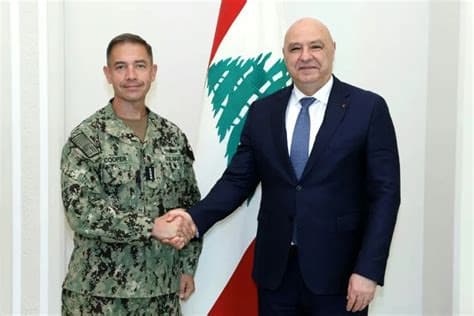
- Meeting:Lebanon's President Joseph Aoun met with US Central Command chief Admiral Brad Cooper.
- Sovereignty Assertion:Aoun emphasized plans to assert sovereignty over all Lebanese territory.
- Security Agreement:Discussions included a US-brokered agreement aimed at peace between Lebanon and Israel.
Lebanon’s President Joseph Aoun recently met with Admiral Brad Cooper, the chief of US Central Command (CENTCOM), to discuss Lebanon's plans to assert sovereignty over its entire territory. This includes deploying the Lebanese army up to the Israeli border, a significant move in the context of ongoing regional tensions. The meeting took place against the backdrop of a Washington-brokered agreement signed last week by Israel and Lebanon, which aims to lay the groundwork for a potential peace deal.
During the discussions, Aoun and Cooper focused on the implementation of the agreement, which includes provisions for security and cooperation between the two nations. Cooper also met with the Lebanese army chief, Rodolphe Haykal, to discuss the security aspects of the framework agreement and how to strengthen future cooperation between the US and Lebanese military forces.
A key component of the US-brokered framework is Lebanon's commitment to restoring sovereignty by managing the “verified disarmament” of non-state armed groups. This responsibility is expected to fall on the Lebanese army, which has been tasked with ensuring that all armed factions, including Hezbollah, comply with the disarmament process. Israeli leaders have indicated that their forces will remain stationed in southern Lebanon until this process is fully realized, raising concerns about the timeline and feasibility of such an undertaking.
Hezbollah, the powerful Shiite militant group in Lebanon, has voiced strong opposition to the agreement. Its leaders have warned that the imposition of such terms could lead to internal conflict within Lebanon. They have also asserted their right to self-defense in response to alleged Israeli attacks. Since the onset of the conflict in March, Lebanese authorities have reported that Israeli strikes have resulted in the deaths of over 4,200 people, further complicating the already tense situation.
As Lebanon navigates these complex dynamics, the international community will be watching closely to see how the situation unfolds. The assertion of sovereignty and the disarmament of non-state actors are critical steps for Lebanon's stability and its relations with neighboring Israel. The outcome of these discussions and the implementation of the agreement will have significant implications for the region's future.
Published by Banx Network. This article is part of the Banx decentralized media programme, powered by the BXE token on the XRP Ledger.



