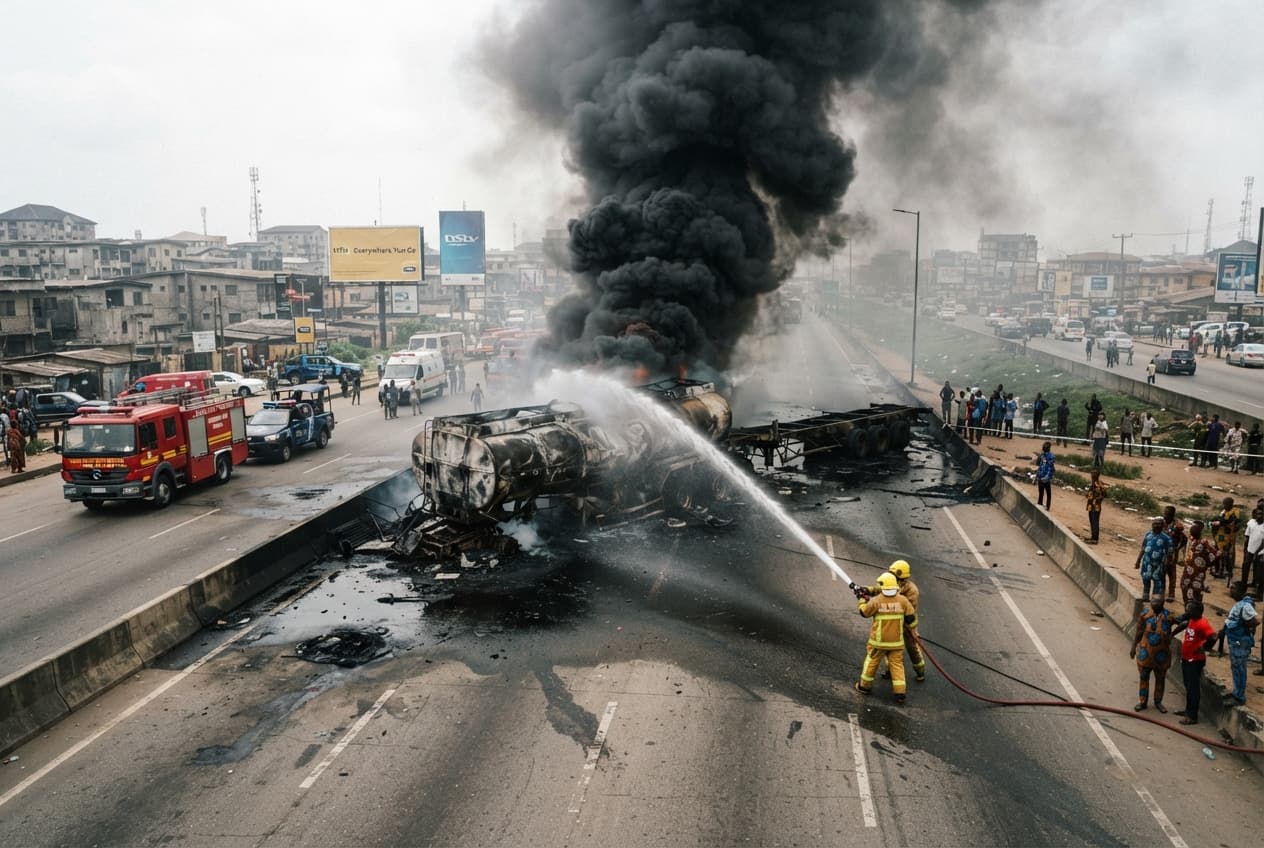
Lagos-Ibadan, Nigeria—Thick black smoke billowed for miles over the critical arterial corridor. A fuel tanker overturned and erupted into a massive fireball, trapping dozens of motorists in a searing inferno. Twelve bodies were recovered from scorched vehicle frames by midday.
The blast wave shattered windows of commercial buses caught in the gridlock behind the tanker. Panic erupted as passengers scrambled through windows to escape the advancing wall of flames. Federal road safety marshals arrived without adequate foam-suppression equipment. Local residents attempted to beat back the fire using buckets of sand and water.
"The heat was so intense we could not approach the vehicles within fifty meters," said commercial driver Sunday Adeleke.
Fire service units from neighboring districts arrived hours after the initial blast. Water tankers shuttled back and forth from nearby industrial depots to feed the pumper trucks. Traffic came to a complete standstill across both directions of the multi-lane expressway. Commuters abandoned their vehicles and fled on foot through roadside bush.
Emergency medical teams treated dozens of severe burn victims at makeshift roadside stations. Overburdened clinics in nearby towns lacked the specialized supplies required for critical trauma care. Relatives rushed to regional mortuaries to identify charred remains beyond immediate recognition. State authorities promised financial assistance for burial preparations.
Investigations point toward brake failure on a steep incline as the primary trigger. Commercial transport unions faced renewed scrutiny over poor vehicle maintenance standards. Past safety pledges by federal transit agencies yielded few visible changes on the ground. Drivers continue operating mechanically compromised heavy-duty trucks without regulatory pushback.
Bulldozers cleared the charred metal skeletons from the blocked lanes before nightfall. Structural engineers warned that the intense heat may have compromised nearby concrete bridge pylons. Traffic movement resumed at a crawl under heavy police supervision. Commuters navigated the blackened corridor in grim silence.
The scorched earth left a stark reminder of systemic infrastructural decay. Commuter associations called for immediate bans on daytime transit for volatile fuel haulers. Government ministries issued standard press statements expressing condolences without outlining enforcement changes. The highway remains a hazardous bottleneck for national commerce.
Published by Banx Network. This article is part of the Banx decentralized media programme, powered by the BXE token on the XRP Ledger.