
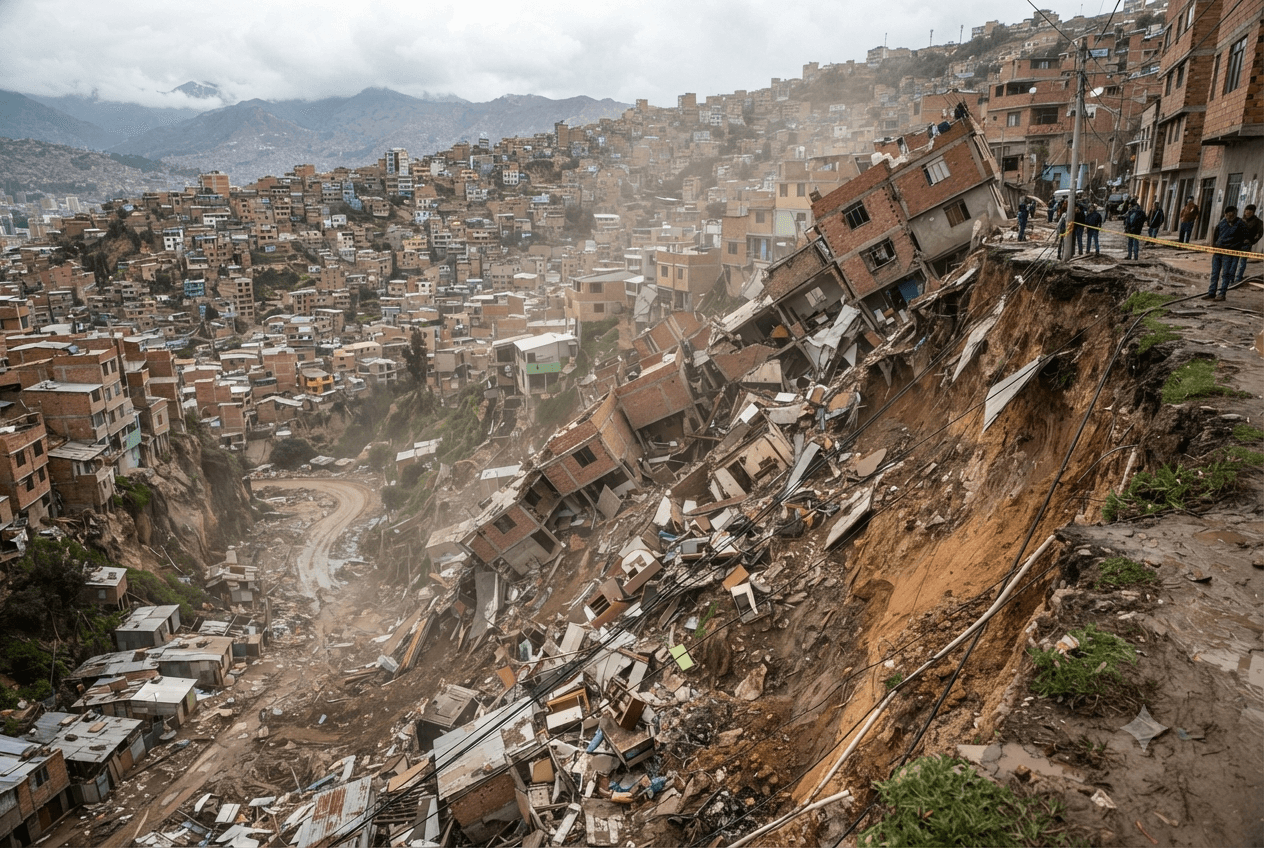
Key Highlights
- Fatalities:Three residents confirmed dead due to the landslide.
- Destruction:Multiple homes destroyed in a hillside neighborhood.
- Emergency Response:Authorities declared a red alert and initiated evacuations.
La Paz, Bolivia—A catastrophic ravine collapse tore through a hillside neighborhood in the national capital early Friday, destroying multiple residential structures. The Vice Ministry of Civil Defense confirmed three fatalities after tons of sliding earth and masonry buried sleeping families. Local residents described hearing a sound resembling rolling thunder moments before the ground completely gave way beneath the foundations. Emergency responders rushed to the scene with searchlights, facing treacherous footing along the unstable precipice.
Firefighters and specialized urban search and rescue units pulled three bodies from the rubble during frantic overnight extraction operations. Municipal engineers noted that persistent winter rains had severely eroded the structural integrity of the steep ravine walls. Makeshift homes constructed along the informal settlement boundary proved incapable of withstanding the massive earth movement. Heavy excavation equipment struggled to maneuver through narrow alleyways blocked by fallen concrete and twisted sheet metal.
Municipal authorities immediately declared a red alert across the affected district, ordering emergency evacuations for dozens of neighboring homes. Makeshift shelters were set up in a nearby municipal gymnasium to house families left completely destitute. Geological technicians utilized laser scanners to monitor ongoing ground shifting along the upper rim of the ravine. Government ministers arrived at the site to pledge immediate humanitarian aid and emergency housing subsidies for survivors.
Rescue dogs swept through the wreckage multiple times to ensure no additional victims remained trapped beneath the dense debris field. Neighbors gathered behind police tape, offering food and blankets to exhausted first responders battling freezing mountain temperatures. Public health officials distributed preventive vaccines and medical kits to families huddled inside the provisional community center. The precarious stabilization operation at the collapse site continues under heavy police guard.
As the community grapples with the aftermath of this disaster, the local government is under pressure to address the long-standing issues of informal housing in vulnerable areas. Experts warn that without significant investment in infrastructure and disaster preparedness, similar tragedies could occur in the future, threatening the lives of residents in La Paz and other cities prone to landslides.
The emotional toll on families affected by the landslide is profound, with many losing not only their homes but also their loved ones. Community leaders are calling for increased support and resources to help rebuild lives and ensure safety in the face of natural disasters.
Published by Banx Network. This article is part of the Banx decentralized media programme, powered by the BXE token on the XRP Ledger.



