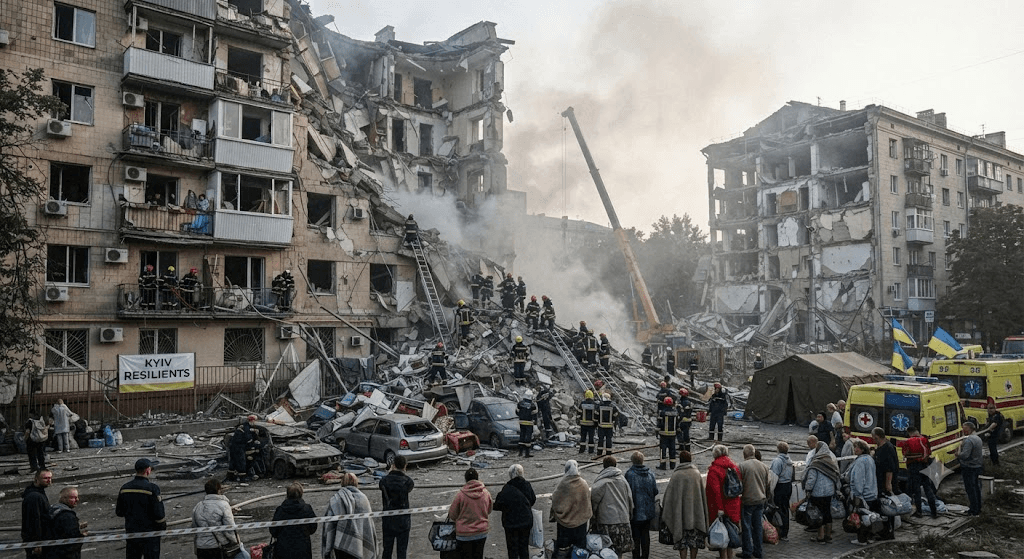
KYIV, Ukraine — A massive overnight aerial assault by Russian forces on July 2, 2026, has left at least 13 people dead and more than 90 injured in the Ukrainian capital, according to local authorities. The bombardment, which officials described as one of the most significant attacks on the city to date, involved a complex combination of ballistic missiles, cruise missiles, and hundreds of strike drones launched from multiple directions.
The attack began in the early hours of Thursday, following warnings from President Volodymyr Zelenskyy that intelligence reports indicated a large-scale strike was imminent. Residents across Kyiv were awakened by sustained air-defense fire and a series of powerful explosions that shook the city for several hours.
The strikes caused widespread destruction across 28 known locations in the capital, primarily targeting civilian infrastructure. The damage included at least 20 residential apartment buildings, some of which experienced partial or total collapses of several floors, as well as an ambulance substation and various commercial sites, such as a hotel on one of Kyiv’s central boulevards.
As of Thursday morning, rescue operations remained ongoing as emergency crews worked to pull survivors from under the rubble of collapsed buildings. Hospitals across the capital were mobilized to treat the more than 90 injured individuals, many of whom required urgent hospitalization. In response to the tragedy, the city has declared July 3 as an official day of mourning.
The Russian Ministry of Defense stated that the strikes were a retaliatory measure for recent Ukrainian attacks on Russian civil infrastructure, energy facilities, and military airfields. This latest escalation follows a period of intensified conflict, during which Ukraine has conducted a long-range drone campaign targeting Russian oil refineries and energy sites.
The scale of this attack—utilizing 74 missiles and 496 drones—marks a significant escalation in the ongoing war, which has seen repeated waves of aerial strikes on Kyiv over the past four years. Despite the intensity of the bombardment, thousands of residents sought safety in metro stations and underground shelters, continuing a pattern of resilience in the face of frequent aerial threats.
Published by Banx Network. This article is part of the Banx decentralized media programme, powered by the BXE token on the XRP Ledger.