

Key Highlights
- At least 11 people injured in a missile strike on Kyiv, including a child.
- The attack involved 10 missiles and 121 drones, marking a significant escalation.
- Ukrainian air defenses struggled to intercept the high-speed ballistic missiles.
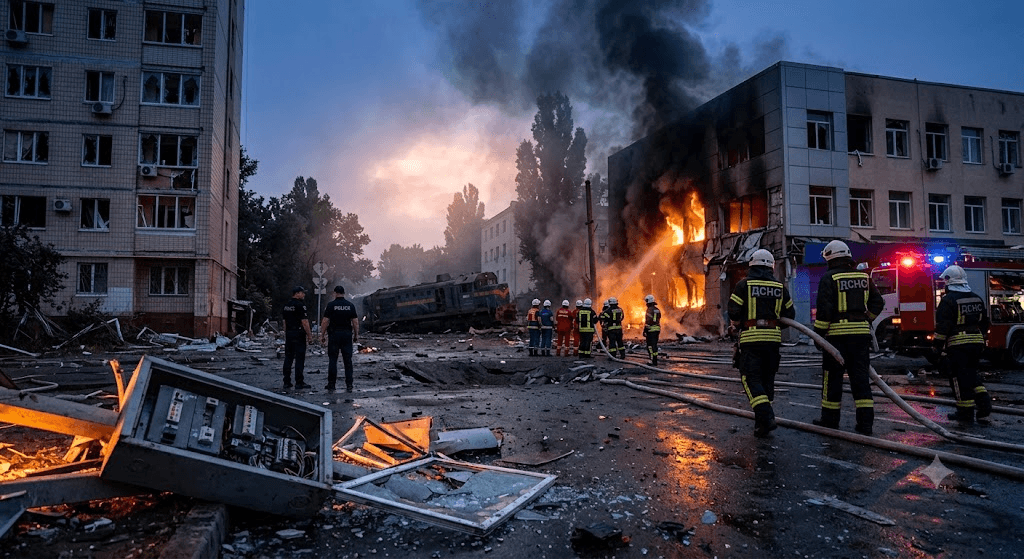
In the early hours of Saturday, July 11, 2026, Kyiv experienced a devastating missile strike that left at least 11 people injured, including an 11-year-old boy. The attack, which occurred around 3:38 a.m., involved a coordinated assault by Russia, deploying a mix of ballistic missiles, cruise missiles, and drones. This incident marks the third aerial bombardment of the Ukrainian capital within a week, indicating a troubling escalation in hostilities.
According to Ukraine's Air Force, the assault included 10 missiles of various types, with six being high-speed ballistic missiles. Despite the efforts of Ukrainian air defenses, which successfully intercepted 111 drones and two cruise missiles, the speed and trajectory of the ballistic missiles posed a significant challenge. The explosions were so powerful that they shook the ground, occurring just moments before air-raid sirens could alert residents.
Emergency responders quickly mobilized to address the aftermath of the strikes, battling fires and searching through debris across four districts in Kyiv. The Solomianskyi District was particularly hard-hit, where a three-story office and warehouse complex caught fire due to direct missile strikes. Other areas, including Darnytskyi and Sviatoshynskyi, also reported severe damage to infrastructure, with shattered windows and damaged buildings becoming a grim reminder of the attack's impact.
Kyiv Mayor Vitali Klitschko confirmed that a transformer substation was among the casualties of the assault, further complicating the city's recovery efforts. The Kyiv National Police reported that four of the injured were in critical condition, while others received treatment for shock and shrapnel wounds. The presence of an 11-year-old boy among the victims underscores the indiscriminate nature of the violence affecting civilians.
This missile strike highlights a critical vulnerability in Ukraine's air defense capabilities. Military officials have acknowledged a severe shortage of interceptors, particularly for advanced systems like the American-made Patriot. While Ukraine has been effective in countering slower-moving threats, the high-speed ballistic missiles require interception at much higher altitudes, a task that has become increasingly difficult without adequate resources.
In response to the attack, Russia's Ministry of Defense claimed that the strikes were aimed at destroying drone production facilities in Kyiv. However, the visible destruction and civilian injuries tell a different story, revealing the harsh realities faced by those living in the capital. As the conflict continues, the need for enhanced air defense systems becomes more pressing, as Kyiv remains exposed to further assaults.
The ongoing situation in Ukraine serves as a stark reminder of the challenges faced by the nation as it navigates through a complex and dangerous conflict. With each missile strike, the toll on civilians grows, raising urgent questions about the effectiveness of current defense strategies and the need for international support.
Published by Banx Network. This article is part of the Banx decentralized media programme, powered by the BXE token on the XRP Ledger.




