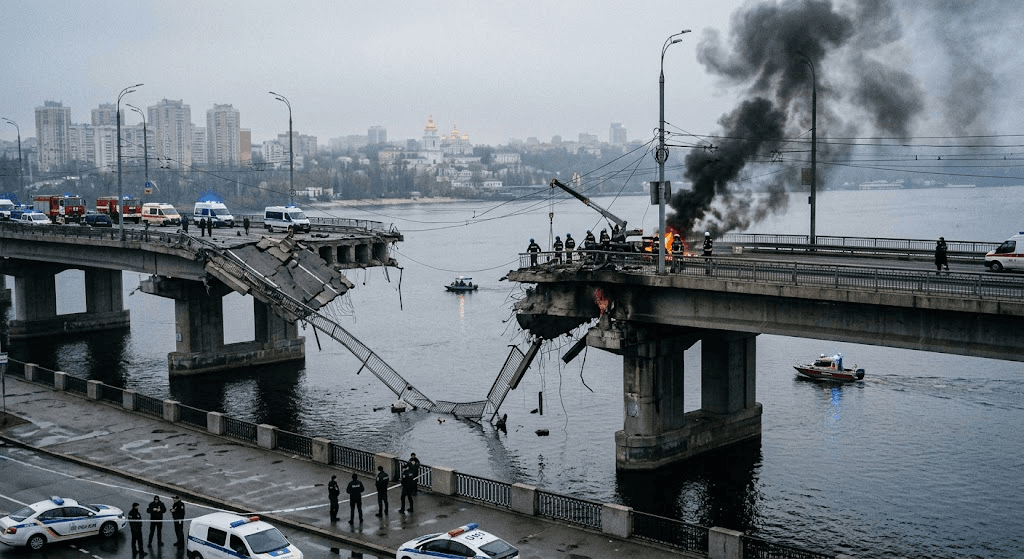
KYIV, Ukraine - A pair of Russian long-range attack drones struck a major river crossing in Kyiv early Thursday morning, October 1, 2026 causing significant structural damage to critical civilian infrastructure and throwing transit across the Ukrainian capital into chaos. Emergency services responded immediately to the scene as smoke billowed over the Dnipro River, marking one of the most direct strikes on the city's key transport arteries in recent months.
The dual strikes hit during the early hours, breaching city air defense networks before detonating on the bridge's main structural support span. The blasts tore through the roadway deck and ignited fires along nearby utility lines carried across the structure. Ukrainian municipal authorities confirmed that while initial casualties were minimized due to the timing of the attack, structural engineers have been forced to close the crossing indefinitely for safety assessments and emergency stabilization.
The targeted bridge serves as a vital economic and logistical transit route, connecting dense residential districts on the eastern bank with central administrative and commercial zones. The sudden closure created massive morning rush-hour gridlock as traffic was rerouted to adjacent crossings, which were quickly overwhelmed. Municipal transit authorities immediately dispatched emergency crews to secure the perimeter and repair damaged power lines, while tugboats and river patrols inspected the foundation for underwater structural failures.
Military officials stated that the attack was executed using Iranian-designed Shahed loitering munitions, launched in tandem to maximize impact on the primary support cables. Ukrainian defense spokespersons condemned the strike as another deliberate attempt to destabilize civilian life and disrupt key supply chains within the capital.
In the hours following the strike, regional military administrators ordered heightened air defense alerts across the Kyiv metropolitan region. Mobile air defense units and electronic warfare teams have been redeployed to bolster coverage over remaining river crossings and nearby power facilities, anticipating potential follow-up operations.
Local city leadership urged residents to restrict unnecessary movement across the river while emergency crews work to shore up the damaged spans. The strike underscores the persistent vulnerability of urban infrastructure as military forces continue to target energy and transport networks deep behind the front lines.
Published by Banx Network. This article is part of the Banx decentralized media programme, powered by the BXE token on the XRP Ledger.