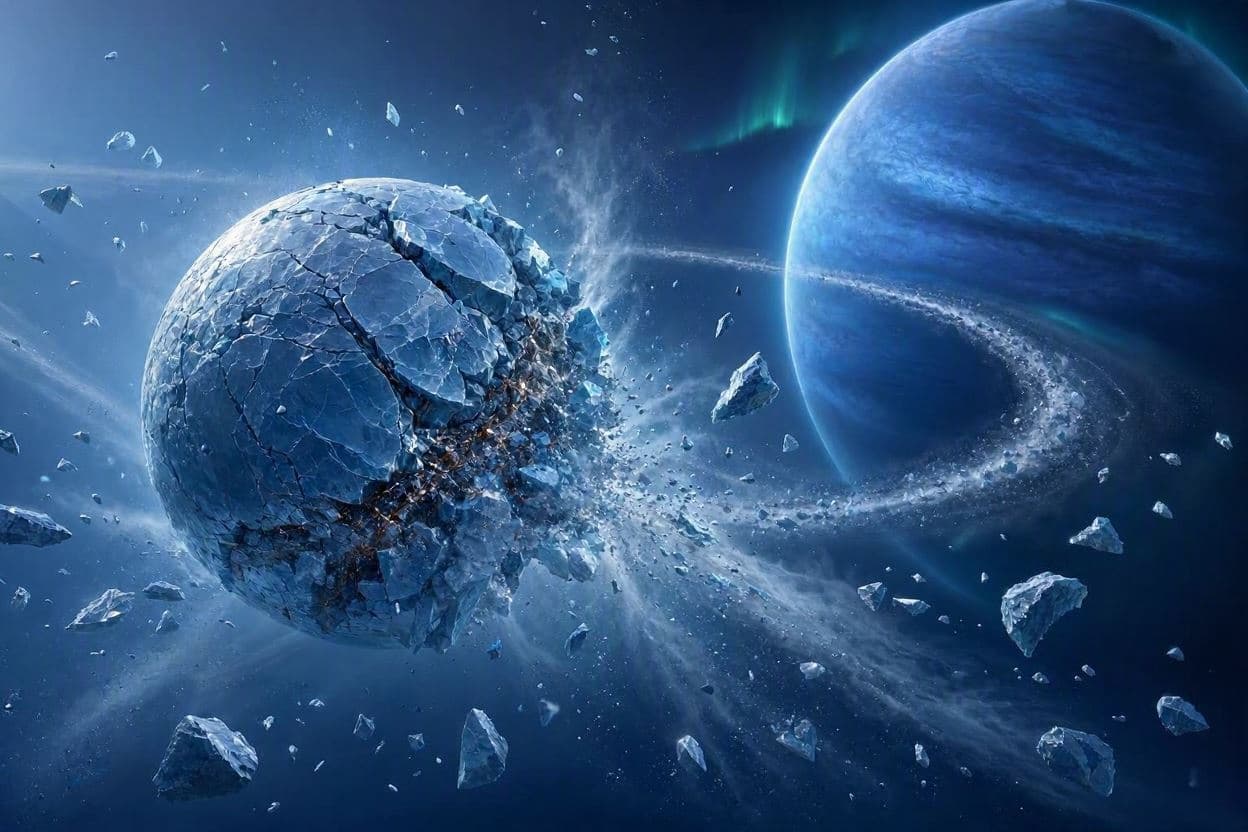
In the cold, distant reaches of our solar system, Neptune’s moons hold clues to a violent past. Recent data from the James Webb Space Telescope (JWST) has revealed water-altered clay minerals on two of Neptune’s tiny inner moons, Naiad and Thalassa, as well as in the planet’s faint rings. This discovery provides compelling evidence that these small bodies are not primordial remnants but rather the shattered debris of a much larger, ancient satellite system.
The presence of hydrated silicates, or clays, suggests that these materials once existed deep within larger icy worlds, where heat and pressure allowed water to interact with rock. When these progenitor moons were destroyed, their interiors were exposed, scattering mineral-rich fragments into orbit. Over time, gravity and collisions shaped this debris into the small moons and rings we see today. It is a cosmic archaeology project, uncovering history through spectral analysis.
The catalyst for this destruction was likely Triton, Neptune’s largest moon, which is believed to have been captured from the Kuiper Belt billions of years ago. As Triton settled into its current orbit, its gravitational influence would have destabilized the existing satellite system, causing catastrophic collisions. This event, known as the "Triton disruption," reshaped Neptune’s neighborhood, leaving behind a trail of rubble that JWST has now identified.
The findings challenge previous assumptions about the origin of Neptune’s inner moons. Rather than forming in place from the circumplanetary disk, they appear to be second-generation objects, born from the wreckage of their predecessors. This narrative aligns with computer simulations that predict a chaotic early history for the ice giant, marked by migration and capture events.
For planetary scientists, the detection of clays is significant because it indicates aqueous alteration, a process that requires liquid water. This suggests that the interior of the original moons was warm enough to sustain liquid water for a period, raising intriguing questions about the potential for habitability in similar environments elsewhere in the solar system. While these moons are now frozen and dead, their ancestors may have been more dynamic.
The rings of Neptune, often overlooked compared to Saturn’s majestic bands, play a crucial role in this story. They contain the same mineralogical signatures as the inner moons, confirming a common origin. This connection links the disparate components of Neptune’s system, showing that they are all part of the same historical narrative of destruction and reformation.
JWST’s ability to detect these subtle spectral features highlights the power of next-generation telescopes. By analyzing the light reflected from these distant, faint objects, scientists can determine their composition with unprecedented precision. This capability opens new avenues for exploring the outer solar system, where traditional methods often fall short.
As we continue to study Neptune’s system, the story becomes clearer. It is a tale of loss and renewal, where destruction paves the way for new structures. The tiny moons Naiad and Thalassa are not just rocks in space; they are memorials to a lost world, preserved in the icy silence of the outer solar system.
AI Image Disclaimer: Images accompanying this report are AI-generated artistic interpretations of Neptune’s moons and ring systems, intended to visualize the concept of ancient debris and mineral composition.
Sources: NASA, ESA, Nature Astronomy, Planetary Society
Published by Banx Network. This article is part of the Banx decentralized media programme, powered by the BXE token on the XRP Ledger.