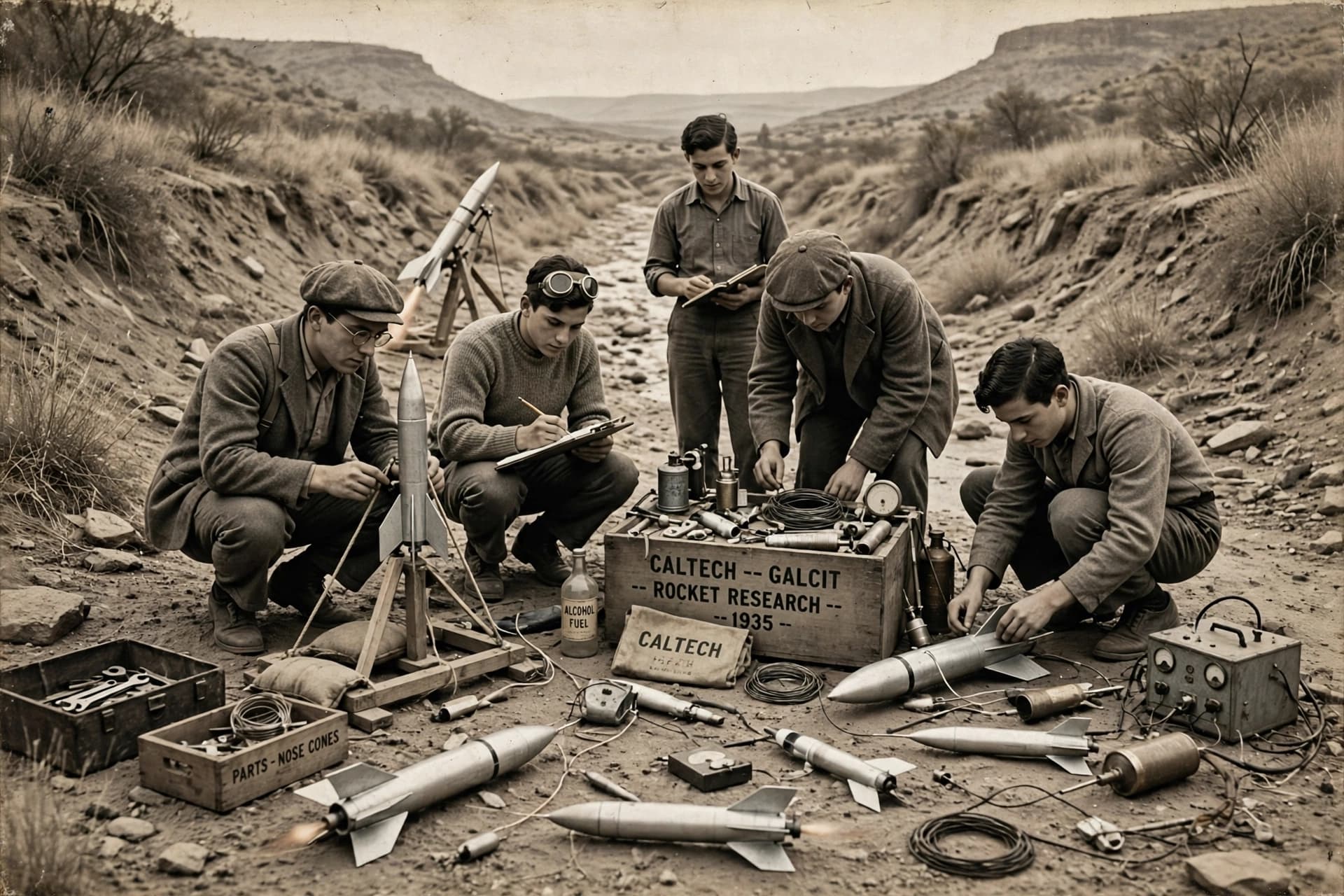
There is a particular poetry in an anniversary that arrives not as a commemoration but as a launchpad, a moment when an institution looks back at nearly a century of firsts and decides that the next chapter matters more than the last. On October 31, 1936, a group of Caltech graduate students and enthusiasts conducted rocket-propulsion tests in Pasadena's Arroyo Seco, an experiment that no one at the time could have known would become the Jet Propulsion Laboratory. Ninety years later, JPL is not resting on the ledger of what it has already done. It is building what comes next.
The list of firsts is long enough to fill a museum. Explorer 1, America's first satellite, launched in 1958 and carried a Geiger counter that discovered the radiation belts encircling Earth. Ranger 7 reached the Moon in 1964. The Lab went on to lead the first planetary flyby, the first probe to visit all four gas giants, the first rovers to roll on Mars, and the first rotorcraft to fly there . Dave Gallagher, JPL's director since 2025, described the foundation plainly: "Over the course of 90 years, JPL's first-of-a-kind missions have transformed our understanding of the universe and our place in it" .
What makes the anniversary more than a backward glance is the roster of missions now in development. SkyFall, aiming for a 2028 launch, will deploy three helicopters mid-descent over Mars to map hidden ice deposits and analyze weather patterns. MoonFall, also targeted for 2028, will land a group of large propulsive drones at the lunar South Pole in support of NASA's Moon Base ambitions. SunRISE, set for 2027, will fly six toaster-oven-sized satellites in formation to create a miles-wide radio antenna dish and study the Sun's activity . The asteroid-hunting NEO Surveyor will search for hazardous space rocks that other telescopes cannot find, and a suite of Earth missions will monitor water movement, tropical storms, and air pollution with instruments that add to a fleet JPL helps lead .
There is a quiet significance in the breadth of that portfolio. JPL is not a single-mission laboratory or a contractor for one program. It is an institution that has learned to operate across the full span of NASA's mandate, from the infinitesimal detectors in its Microdevices Laboratory—the same lab that invented the "camera on a chip" technology enabling cellphone photography—to the vast radio dishes of the Deep Space Network that still communicate with Voyager . The through-line is instrumentation, the capacity to build the tools that make the invisible measurable.
Caltech President Ray Jayawardhana, who has spoken of the "virtuous cycle" between the campus and the lab, described the present moment in astronomy as comparable to when Galileo turned his telescope at the heavens . That is not the language of institutional complacency. It is the language of an enterprise that believes the most important discoveries are still ahead, and that the tools to make them are being built now.
For the people who work at JPL, the anniversary is a marker in a longer journey. Gallagher, who led the team that built a camera for the Hubble Space Telescope in the early 1990s, said the lab stands on an extraordinary foundation and is ready to push boundaries so that future generations can go further . The sentiment is institutional, but it is also personal. The lab was founded by students who wanted to build rockets. Ninety years later, it is still building things that have never been built, for places no one has been.
AI Image Disclaimer: The visuals accompanying this article are generated by artificial intelligence and are intended for illustrative purposes only.
Sources: NASA Jet Propulsion Laboratory, Caltech Magazine
Published by Banx Network. This article is part of the Banx decentralized media programme, powered by the BXE token on the XRP Ledger.