
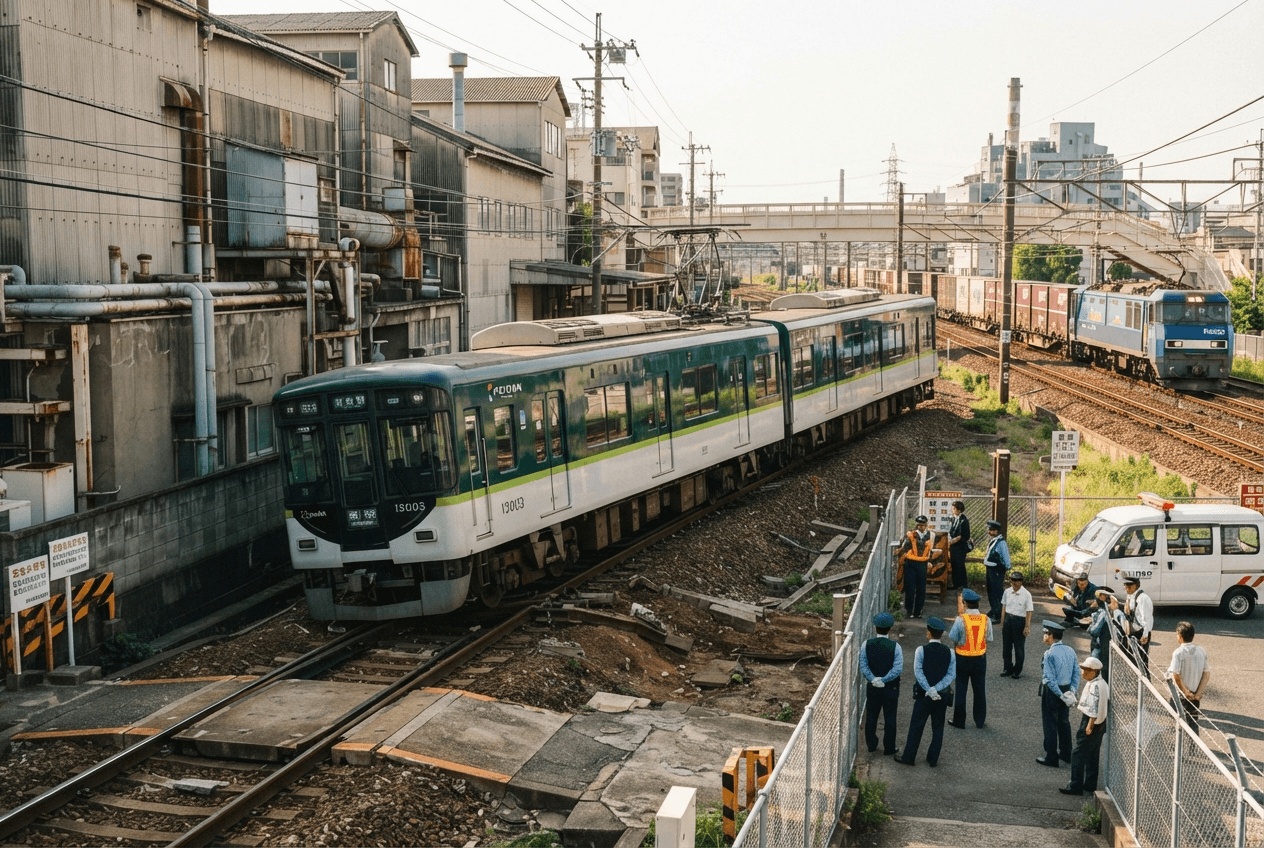
Key Highlights
- Incident:A train derailed in Osaka, Japan, due to track buckling caused by extreme heat.
- Injuries:Four passengers sustained injuries, including fractures and lacerations.
- Response:Emergency services quickly evacuated the train and treated the injured.
Osaka, Japan—A train derailed on the Fukuchiyama Line after the tracks buckled under extreme heat, resulting in injuries to four passengers. The incident occurred as the train was traveling at moderate speed, causing the front carriage to jump the tracks and crash into the ballast. Passengers were violently thrown from their seats, leading to injuries ranging from fractures to deep lacerations.
Emergency services responded promptly, arriving within minutes of the derailment. Paramedics set up a medical tent near the tracks to treat the injured, all of whom were subsequently transported to a local hospital. Fortunately, none of the injuries are reported to be life-threatening. The remaining passengers were escorted to the nearest station on foot, as railway operations on the line were suspended indefinitely.
Rail officials indicated that the extreme heat, which has persisted across the prefecture for three consecutive days, caused the metal rails to warp, a phenomenon they noted is rare but poses significant risks during thermal spikes. Maintenance crews are currently working to cool the steel tracks with water before commencing repairs. They are also inspecting nearby sections for similar signs of stress, as the heat continues to reach record levels throughout the afternoon.
In response to the incident, Japan's transport ministry has initiated an urgent review of the rail network’s heat resistance protocols. This review aims to address concerns regarding the frequency of inspections during heatwaves, especially given the aging infrastructure that may not withstand such extreme conditions. The derailment has triggered widespread delays across the region, causing significant gridlock on the road network as commuters seek alternative transportation.
This incident underscores the vulnerability of rail systems to climate change and extreme weather events. Technicians have acknowledged that the steel tracks are nearing their thermal limits, prompting the implementation of speed restrictions on multiple lines as a precautionary measure. Train operators are now on high alert for any track irregularities to prevent further accidents.
As police work to clear the wreckage from the main line, the site remains a restricted area for safety reasons. Repairs are expected to take the entire night, with railway officials committed to restoring safe operations as quickly as possible. The incident serves as a stark reminder of the challenges faced by transportation infrastructure in adapting to increasingly severe weather patterns.
Published by Banx Network. This article is part of the Banx decentralized media programme, powered by the BXE token on the XRP Ledger.



