There are discoveries that fit neatly into the categories we have built, and there are discoveries that force us to build new ones. In the twilight depths off the coast of Costa Rica, where the ocean holds its secrets close, scientists have found a creature so strange, so unlike anything known, that it required an entirely new branch on the tree of life—a family created for a single, golden species.
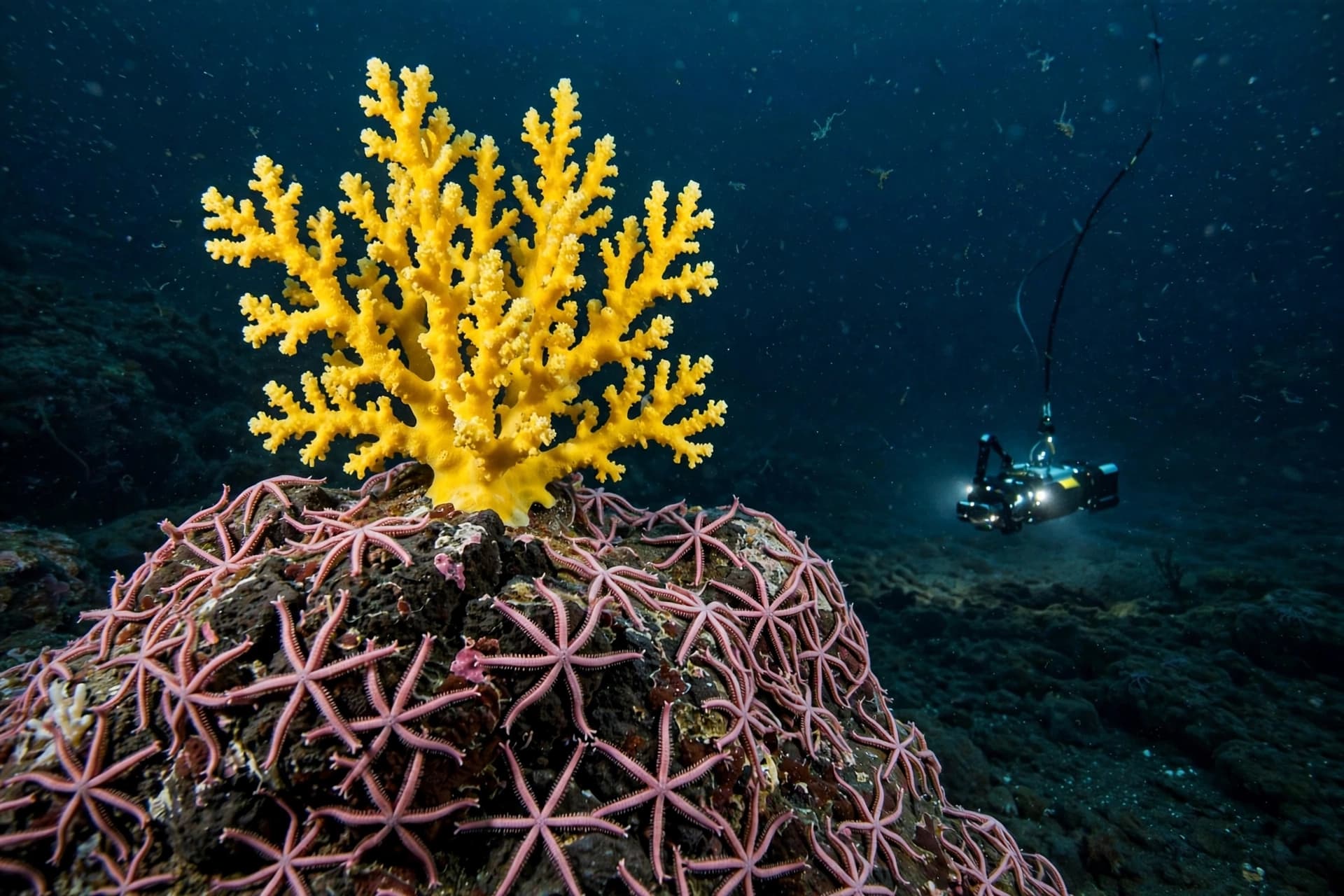
It looks like a tree, but it is not a tree. It glows with a vivid yellow that seems almost impossible in the darkness, rising from rocky outcrops that are themselves carpeted with a shimmering field of brittle stars. The coral, named Laurinque elenya, was discovered during expeditions in 2019 and 2023 using the remotely operated vehicle SuBastian, at depths between 360 and 529 meters . Its colonies can grow more than a meter tall, with densely branching structures covered in unusually elongated polyps that can partially retract into the branches .
The name tells its own story. Laurinque comes from "Laurinquë," meaning "golden tree" in Quenya, the Elvish language created by J.R.R. Tolkien. Elenya means "stellar" or "of the stars," a nod to the fields of brittle stars among which the coral was found .
But the beauty of the discovery was matched by the difficulty of classifying it. When researchers led by Dr. Odalisca Breedy of the University of Costa Rica analyzed three genetic markers commonly used to classify corals, each one pointed to a different, unrelated family. One mitochondrial gene placed it strongly in Incrustatidae. Another was equally strong for Eunicellidae. A third marker was inconclusive . It was, as Breedy later described, "something very different that I could not match with the known taxa" .
The breakthrough came through phylogenomics—analyzing hundreds of genetic regions at once. This revealed that Laurinque elenya does not belong to any known family at all. It represents a unique evolutionary lineage most closely related to Eunicellidae, but distinct enough in both genetics and anatomy to warrant a new family, Laurinqueidae, and a new genus, Laurinque, built specifically to house it .
The coral thrives in waters with extremely low oxygen levels and temperatures between 8 and 11 degrees Celsius—conditions that might seem inhospitable but that support extensive coral gardens . These gardens are considered vulnerable marine ecosystems, providing structurally complex habitat for other deep-sea life . The discovery adds to a growing list of undocumented species revealed on Costa Rica's seamounts, a reminder of how much of the deep ocean, which covers roughly two-thirds of the planet's surface, remains unexplored.
AI Image Disclaimer: The accompanying visual is AI-generated and does not depict the actual coral species or its deep-sea habitat.
Sources: ScienceAlert, EurekAlert!, ZooKeys, Ocean News & Technology, Pensoft blog
Published by Banx Network. This article is part of the Banx decentralized media programme, powered by the BXE token on the XRP Ledger.