
Key Highlights
- XRP is not just a marketing tool; it has real utility in finance.
- RippleNet offers a modern payment network for institutions.
- On-Demand Liquidity (ODL) uses XRP to lower operational costs.
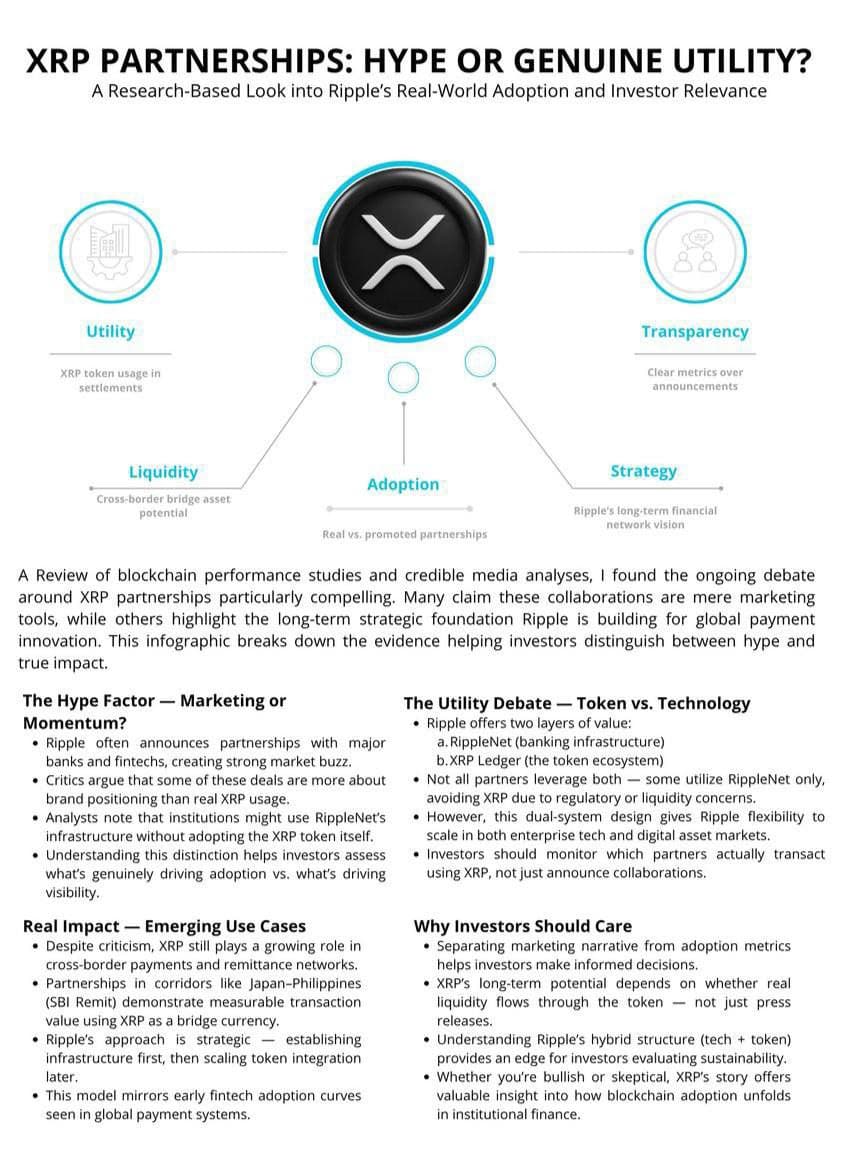
The cryptocurrency XRP has often been criticized as a mere marketing triumph, overshadowing its substantial role in modern finance. Detractors frequently focus on the corporate entity Ripple and its adept public relations strategies, dismissing XRP's potential as a transformative financial tool. However, this perspective overlooks the dual-system utility that XRP offers, which is quietly reshaping the landscape of global finance.
[The Dual System: Tech and Token]
XRP operates on two distinct paths for adoption: the Technology Path and the Token Path. The Technology Path, represented by RippleNet, is a proprietary global payment network that many financial institutions and payment providers initially adopt. RippleNet provides a modern, efficient messaging system that allows for real-time tracking and certainty of settlement. In this model, partners utilize the technology for faster and more transparent communication between banks, often without engaging the underlying token. This initial step allows major players to test the waters of Ripple's offerings.
Conversely, the Token Path is where XRP truly differentiates itself and disrupts traditional financial systems. The most significant application of XRP is through On-Demand Liquidity (ODL). This innovative solution allows financial institutions to bypass the need for pre-funded accounts in destination currencies, known as nostro and vostro accounts. Instead, they can use XRP as a bridge asset, converting their domestic currency into XRP, sending it across borders almost instantaneously, and then converting it back into the destination fiat currency. This process dramatically reduces operational costs, liberates billions in trapped capital, and enables service to previously unprofitable corridors.
Crucially, some partners leverage both RippleNet technology and the XRP token to create a comprehensive, end-to-end payment solution. This dual approach highlights the versatility and effectiveness of XRP in modern financial transactions.
[Following the Liquidity]
The true measure of any financial technology lies in its ability to facilitate real monetary transactions across international borders. When a currency is actively involved in tangible transactions rather than merely speculative trading, the narrative shifts from marketing hype to genuine infrastructure. The argument that XRP is merely a marketing tool often stems from a focus on price fluctuations or social media discussions. In reality, the most impactful adoption of XRP is occurring quietly within the backend systems of financial institutions, where it optimizes payment flows, enhances speed, and, most importantly, follows the liquidity.
To grasp the true impact of XRP, it is essential to look beyond the noise generated by critics. Instead, one should focus on the data: the increasing number of payment corridors being established, the rising volume of ODL transactions, and the capital being freed up by institutions that no longer need to maintain pre-funded accounts globally. This shift signifies a transformation in how digital assets are perceived and utilized.
As XRP transitions from being viewed as a speculative asset to an essential component of global financial infrastructure, its role in the financial ecosystem becomes increasingly significant. This transition is not just a possibility; it is already underway, marking a pivotal moment in the evolution of cryptocurrency and its applications in real-world finance.
Published by Banx Network. This article is part of the Banx decentralized media programme, powered by the BXE token on the XRP Ledger.



