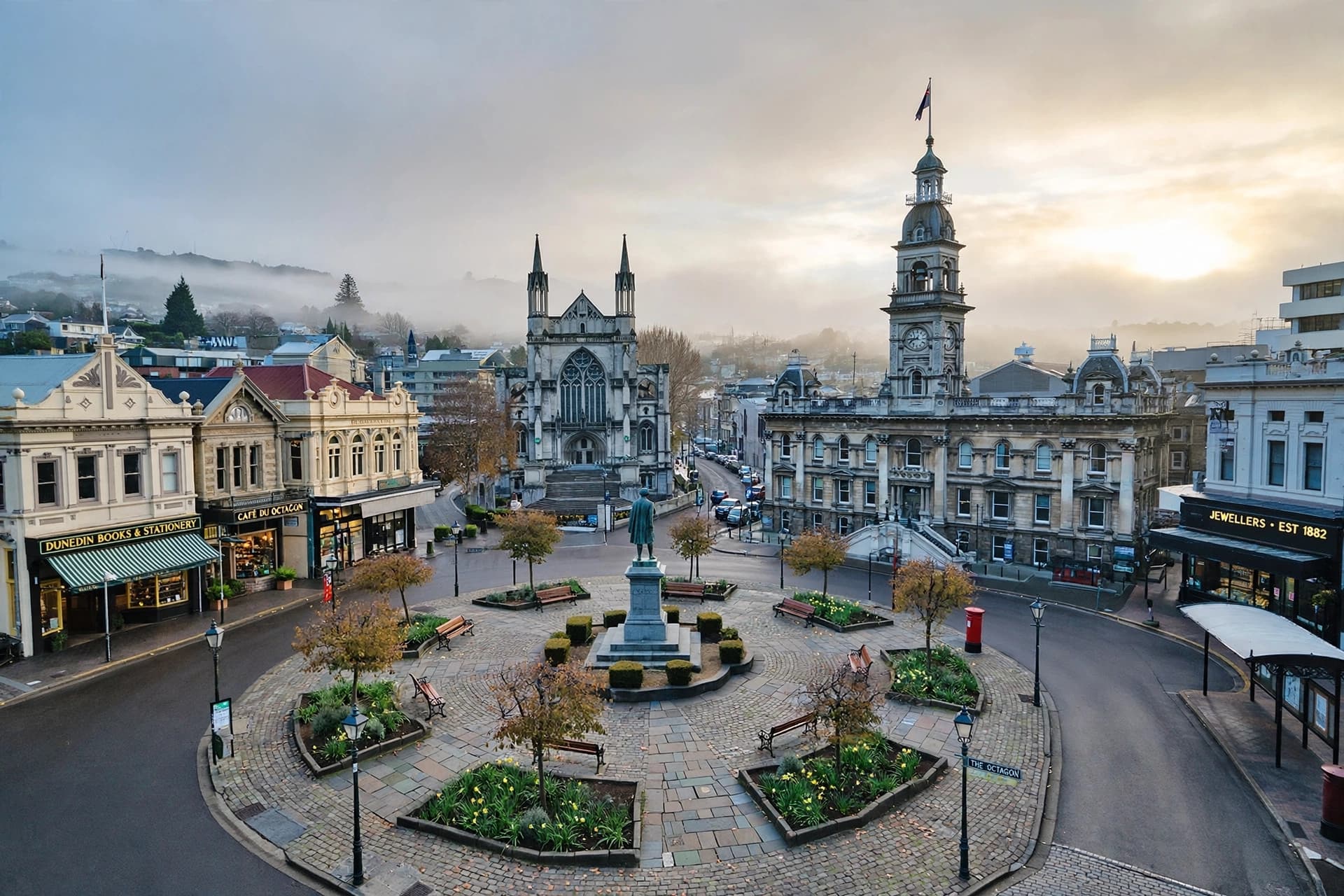
There is a particular kind of city that does not announce itself, that does not demand attention or vie for the traveler's gaze. It waits, quietly, for those who are willing to look beyond the obvious. Dunedin, on the South Island of New Zealand, is such a city—a place of Victorian architecture and Scottish heritage, of albatross colonies and bone-carved art, of a university that lends it youth and an edge that keeps it interesting. To pass through Dunedin on the way to Queenstown, as many do, is to miss a place that rewards those who linger.
The city sits at the head of Otago Harbour, its streets climbing the hills that surround the water. The architecture speaks of the 1860s gold rush, when Dunedin was New Zealand's wealthiest city, its Victorian and Edwardian buildings a testament to the prosperity that flowed through its banks and warehouses . But the city is not a museum piece. The post-earthquake rebuild of Christchurch, further north, produced a city of innovative contemporary architecture, but Dunedin has a different kind of story—one of preservation and adaptation, of Gothic revival buildings repurposed and street art appearing on walls that once held nothing but advertisements .
What sets Dunedin apart, perhaps, is its quirkiness. The Museum of Natural Mystery, occupying the front rooms of artist Bruce Mahalski's home, is a case in point—a collection of carved figures, bird and bat skeletons, Papua New Guinean masks, and more than two hundred animal skulls, alongside Mahalski's own sculptures constructed entirely from bone . It is the kind of place that could only exist in a city confident enough to embrace its eccentricities, where the line between home and museum is deliberately blurred.
But Dunedin's appeal extends beyond its urban curiosities. The Otago Peninsula, a short drive from the city center, is home to the world's only mainland breeding colony of the Northern Royal albatross . On a wildlife cruise with Monarch Wildlife Cruises, visitors can watch Buller's and Salvin's albatrosses glide on the updraughts, see fur seals sprawled across wave-battered rocks, and spot little blue penguins torpedoing through the water . The peninsula sits where nutrient-rich currents collide, creating one of New Zealand's richest marine ecosystems, a place where the last time one might see such a concentration of species is in Antarctica itself .
The region is also rich with Maori history. Karitane Maori Tours offers walks across Huriawa Pa, a fortified settlement on a narrow headland between the Waikouaiti River and the Pacific Ocean . Guides Irie and Tau Pomare share stories of long sieges, giant ancestors, greenstone traders, and tohunga—experts in spiritual knowledge believed to move between the physical and spiritual worlds . At its height around three hundred years ago, Huriawa was home to several thousand people; today, only traces remain, but the stories keep the place alive .
Dunedin's calendar, too, offers moments of cultural significance. Matariki, the Maori New Year, is marked by the rising of its namesake star cluster and has been a national public holiday since 2022 . In the depths of winter, hundreds gather outside the Otago Museum before dawn, wrapped against the cold, to remember those who have died and to look with hope toward the year ahead . It is a time of beginning again, of acknowledging the past while facing forward—a ritual that feels especially potent in a city that has known both prosperity and hardship.
For those willing to look beyond the well-trodden tourist paths, Dunedin offers something increasingly rare: a city that feels lived-in rather than performed. It is clever without being pretentious, cool without trying too hard, quirky in ways that feel organic rather than curated. The question, then, is not whether Dunedin is New Zealand's most underrated city, but why so many travelers still pass it by.
AI Image Disclaimer: The imagery in this article is AI-generated and provided for illustrative purposes only.
Sources:
· WAtoday · ANZCRO
Published by Banx Network. This article is part of the Banx decentralized media programme, powered by the BXE token on the XRP Ledger.