
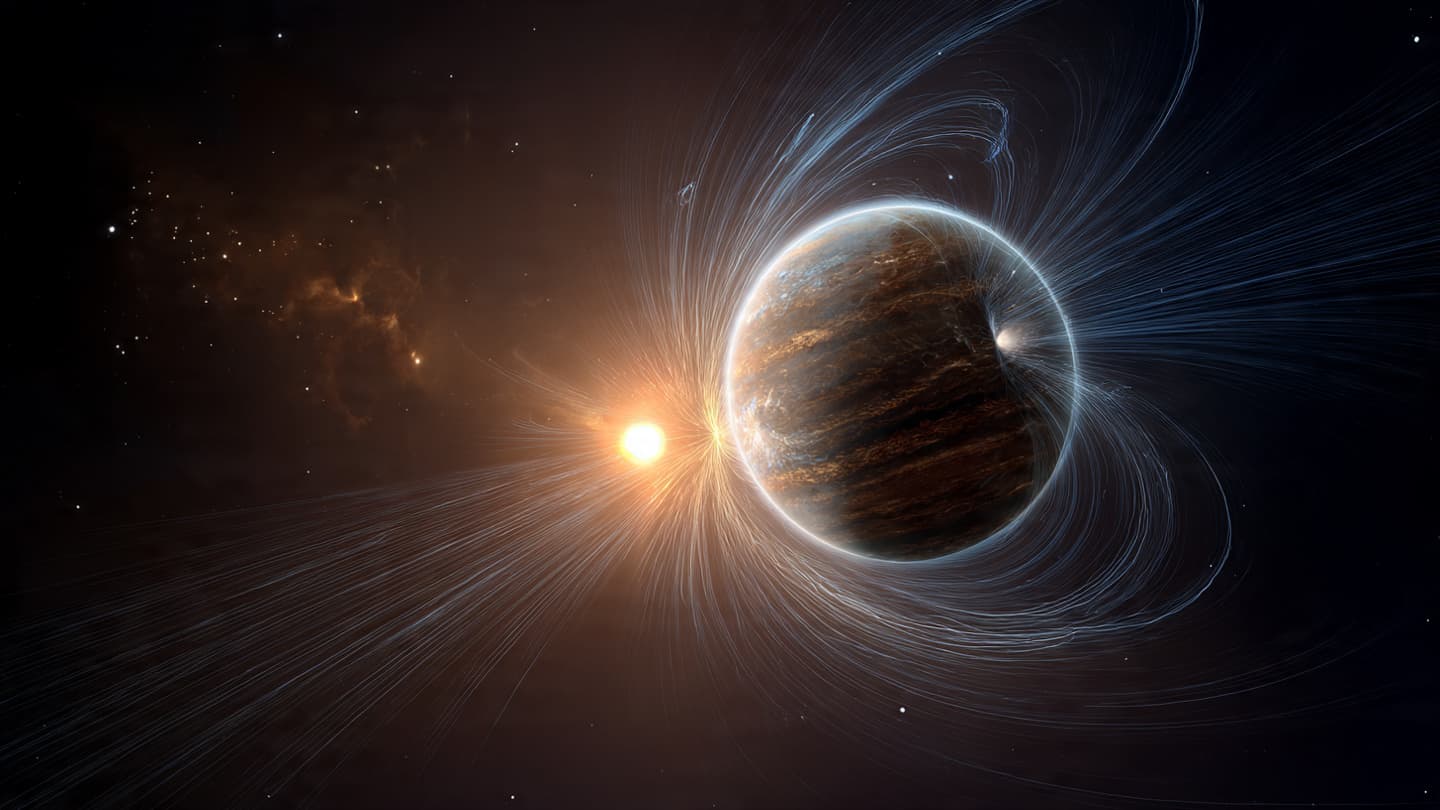
The night sky has long inspired curiosity, inviting humanity to imagine worlds beyond the reach of ordinary experience. Each new astronomical discovery expands that horizon a little further. Now, researchers have reported evidence that some distant exoplanets possess magnetic fields, a finding that could deepen scientific understanding of planetary evolution and habitability.
Body:
The discovery emerged from observations conducted using advanced astronomical instruments capable of detecting subtle signals from planets orbiting distant stars. Scientists identified indicators suggesting the presence of magnetic fields surrounding several exoplanets.
Magnetic fields play an important role in shaping planetary environments. On Earth, the magnetic field helps shield the planet from harmful solar radiation and contributes to the preservation of the atmosphere.
For astronomers studying distant worlds, the presence of a magnetic field can provide valuable clues about a planet's internal structure and geological history. It may also influence assessments of whether certain conditions could support life.
Detecting such fields beyond our solar system is a significant scientific challenge. Exoplanets are often located many light-years away, making direct observation difficult and requiring sophisticated analytical techniques.
Researchers explained that magnetic signatures can sometimes be inferred through interactions between planets and their host stars. These interactions may generate observable effects that reveal otherwise hidden planetary characteristics.
The findings contribute to a rapidly growing field of exoplanet research. Since the first confirmed exoplanet discoveries in the 1990s, scientists have identified thousands of worlds with a remarkable range of sizes, compositions, and orbital patterns.
Future observatories and space missions are expected to provide even more detailed information about these distant systems. As technology advances, astronomers hope to gain a clearer understanding of which planetary environments may resemble conditions found on Earth.
Closing:
The discovery of magnetic fields on distant exoplanets adds another piece to the puzzle of planetary science. While many questions remain, the findings offer researchers a valuable new perspective on the diversity and complexity of worlds beyond our solar system.
AI Image Disclaimer: The accompanying image is AI-generated and intended solely to visualize concepts discussed in this scientific report.
Sources Verified: Reuters, NASA, European Space Agency, Nature Astronomy, Scientific American
Published by Banx Network. This article is part of the Banx decentralized media programme, powered by the BXE token on the XRP Ledger.



