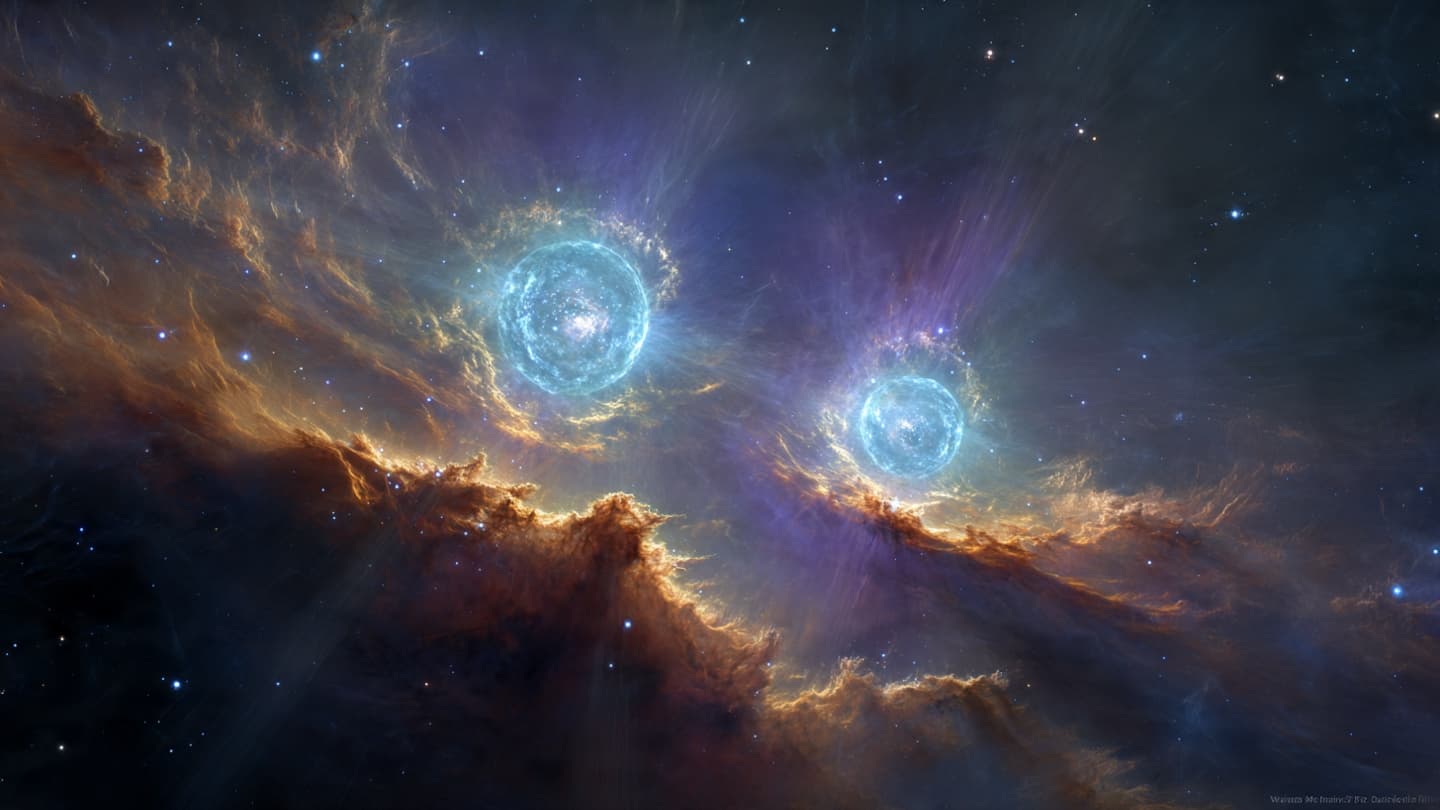
The night sky presents stars as isolated points of light, yet many of them are not alone. Across the universe, pairs of stars orbit one another in intricate gravitational dances that can last billions of years. Understanding how these binary systems form has long been a central question in astronomy, and new research suggests magnetic fields may play a larger role than previously believed.
Scientists have used advanced computer simulations to investigate the earliest stages of star formation. Their findings indicate that magnetic forces within giant clouds of gas and dust may significantly influence whether a developing stellar system produces one star or two.
Stars originate within vast molecular clouds scattered throughout galaxies. Under the influence of gravity, dense regions within these clouds begin collapsing, eventually forming new stars. The details of this process, however, remain complex and not fully understood.
Previous theories often emphasized gravity, turbulence, and angular momentum as primary factors in determining stellar outcomes. The new simulations suggest magnetic fields may interact with these forces in ways that strongly affect the structure of emerging systems.
Magnetic fields are invisible but widespread throughout the universe. They influence the behavior of charged particles, guide flows of matter, and contribute to processes occurring on scales ranging from planets to entire galaxies.
Binary star systems are of particular interest because they are remarkably common. Many stars observed by astronomers belong to pairs or larger multiple-star arrangements. Understanding their origins therefore contributes to a broader understanding of galactic evolution.
Researchers note that advances in computational power have made increasingly sophisticated simulations possible. Modern models can incorporate physical processes that were previously too complex to analyze in detail.
The findings may also help explain differences observed among stellar systems throughout the Milky Way and beyond. Improved models allow scientists to compare theoretical predictions with real astronomical observations.
As additional studies continue, astronomers hope to refine their understanding of how stars are born and evolve. The research highlights the possibility that unseen magnetic forces may be among the most influential architects of the cosmos.
AI Image Disclaimer This article features an AI-generated illustration created to visualize stellar formation processes and astronomical research.
Sources ScienceDaily, Nature Astronomy, Astronomy Magazine, Physics World
Published by Banx Network. This article is part of the Banx decentralized media programme, powered by the BXE token on the XRP Ledger.