
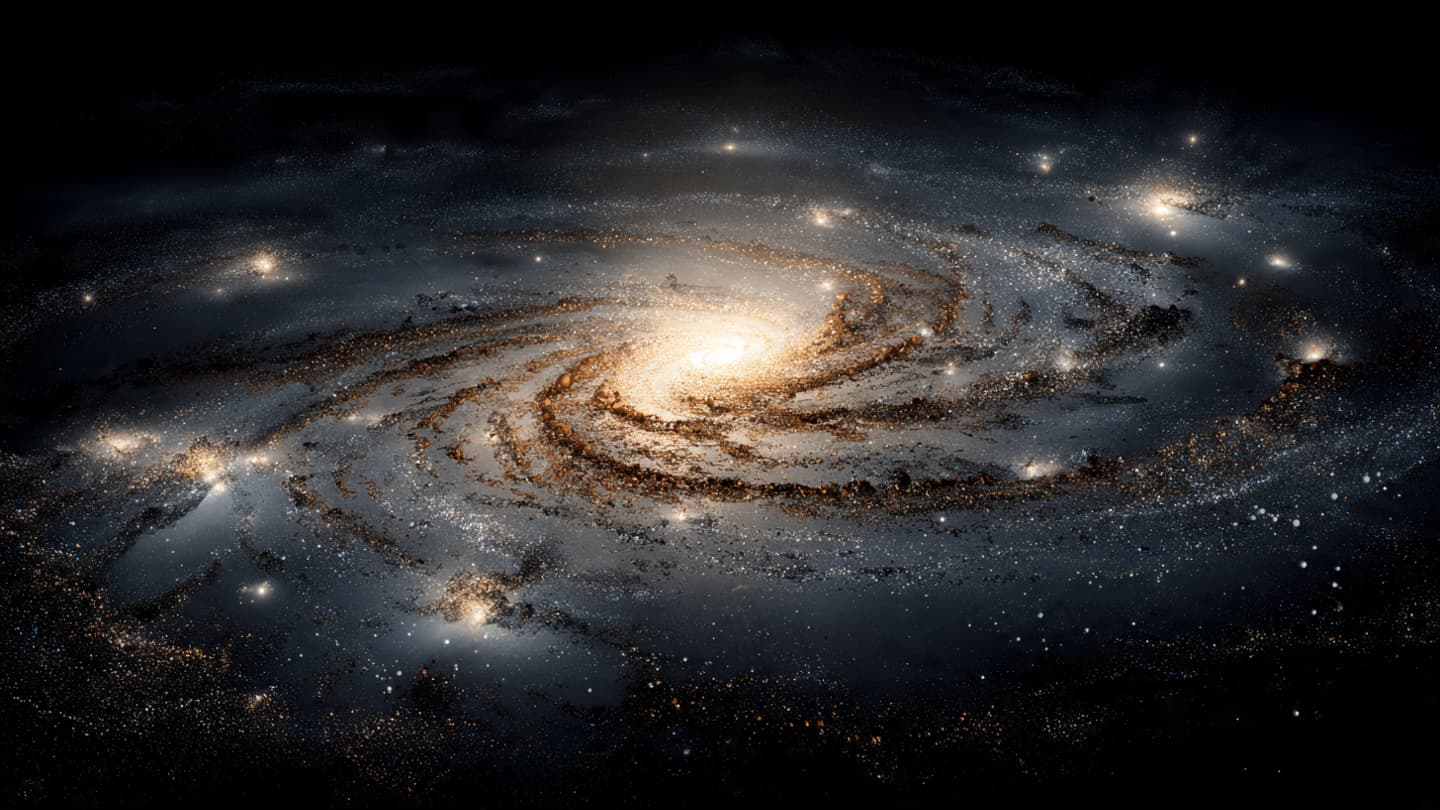
Galaxies rarely stand still. Like ships navigating invisible currents, they move through a universe shaped by gravity's persistent influence. Near the Milky Way, astronomers have observed what has been described as a gravitational battle, a dynamic interaction that offers new insight into how cosmic structures evolve over time.
Body:
The phenomenon involves gravitational forces acting between massive astronomical objects located within the broader neighborhood of our galaxy. These interactions can influence the motion, shape, and future development of galaxies and smaller stellar systems.
Gravity is the fundamental force that governs large-scale cosmic architecture. It binds stars into galaxies, planets into solar systems, and galaxy groups into larger structures. When massive objects approach one another, their mutual attraction can create complex and sometimes dramatic effects.
Researchers studying the region have identified evidence suggesting that competing gravitational influences are affecting the movement of nearby structures. Such observations provide valuable clues about the distribution of matter, including matter that cannot be directly observed.
Astronomers frequently rely on motion as a tool for discovery. By measuring how stars and galaxies travel through space, scientists can infer the presence of unseen mass and better understand the forces shaping cosmic evolution.
The findings contribute to ongoing efforts to map the local universe surrounding the Milky Way. This cosmic neighborhood contains numerous dwarf galaxies, star clusters, and other structures whose histories are closely connected through gravity.
Scientists emphasize that these gravitational interactions occur across vast distances and timescales. Processes that appear dramatic in scientific models may unfold over millions or even billions of years, reflecting the immense scale of the universe.
Continued observations using advanced telescopes and computational simulations are expected to refine understanding of the region. Each new measurement helps researchers reconstruct the complex relationships between neighboring cosmic systems.
Closing:
The newly observed gravitational dynamics near the Milky Way provide another reminder that the universe remains active and interconnected. As astronomers continue tracing these invisible forces, they reveal a richer picture of the cosmic environment that surrounds our galaxy.
AI Image Disclaimer: Visual elements accompanying this report were generated using AI to illustrate the scientific concepts discussed.
Source Verification Check: NASA European Space Agency (ESA) Space.com Nature Astronomy The Astrophysical Journal
Published by Banx Network. This article is part of the Banx decentralized media programme, powered by the BXE token on the XRP Ledger.



